Be a better photographer: 5 reasons to share your knowledge

We live in a culture of sharing.

Between Facebook, Instagram, YouTube, blogs, and forums like Clickin Moms, people are everywhere, sharing just about everything.

If you are reading this blog, you are part of a sharing community and more than likely have benefited from another’s willingness to share their knowledge with you. You are probably sharing a bit, too. Like most photographers, you are posting your favorite images to social media and blogging your recent sessions.

But have you taken the leap to sharing what really matters to you – your knowledge, your passion, and your skill – with the world?

Have you gone beyond posting beautiful images and kind comments to others and started sharing what makes you and your work special?

If you haven’t shared more of yourself, I invite you to consider why. Perhaps you feel you don’t know enough or that everything you know is already out there, shared by someone else. Or maybe you fear embarrassment, that no one will care or, even worse, you will look silly or just plain wrong. You might even want to share, but think you don’t have the time, or lack any idea of what you should share. You may even feel possessive of your hard earned skills and be reluctant to share for fear someone else will use your knowledge to surpass your success. Perhaps you just don’t think it’s important.

I invite you to consider that you, along with everyone else, most certainly have something to contribute, regardless of your skill level, interests, or where you are in your creative journey.

Your unique background, education, perspective, skill, and talent, make you qualified to have a voice in the creative community. In fact, the more voices we bring to the conversation, the more we all benefit.

If you are still feeling reluctant to jump in, let’s consider what you stand to gain by sharing:

1. When you teach, you learn.

The mere act of explaining your thoughts to another helps you to slow down, organize information in your mind, and evaluate your own process. As a result, you better understand what you know or how you do something. You may recognize gaps in your knowledge or alternative methods or ideas, or new ideas may be sparked. So even if you think no one cares about your idea, technique, or opinion, or you think everyone already knows what you have to teach, go ahead and teach it anyway. You will reap the benefits regardless of how many people are watching.

2. Sharing allows you to create relationships and enter into a community.

Sharing is the foundation of human connection. When we share what is important to us, whether it is our work, our knowledge, our ideas, or our opinions, we invite friends with similar interests to find us and be a part of our conversation. Our offering creates trust and a connection to us and our work. In photography, where our work is often personal, both to us and our clients, sharing more about our process allows people to get to know us better. The more personal our relationship, the more interested, or even invested, others are in our success, and the more likely they are to want to work with us or contribute to our success in some way. By starting a conversation, or jumping into an existing one, and giving freely of what we have to offer, we create opportunities to learn from others and to receive valuable feedback. No matter where you are on your journey, you have something to offer and even more to gain.

Click Away photography conference in Seattle 2016

3. Sharing is a less obvious, but very effective form of self-promotion.

When you share knowledge, you increase your visibility to potential clients and become recognized as an authority on the topic. What you share helps define your brand and sell your work. You are engaging in content marketing, defined by the Content Marketing Institute as “a strategic marketing approach focused on creating and distributing valuable, relevant, and consistent content to attract and retain a clearly defined audience – and ultimately, to drive profitable customer action.” This is one of the key strategies used for business development and sales today.

4. Sharing is fun and it feels good.

When we share about our passions, it feels good. We are spending time with the thoughts and ideas that stir us. Plus, we are engaged in the act of giving, which by its nature, feels good. As Ben Carson once said,

Happiness doesn’t result from what we get, but from what we give.

And, when you are happy, you apt to be much more successful at everything you do.

5. Personal growth.

All of these benefits combined lead to both personal and professional growth. Learning, growing, making connections, and giving back are the keys to success in any area of your life, and all involve sharing yourself with others.

On an intuitive level, we all know that sharing is a good thing. And research backs this up with study after study showing that when you share, you start a cycle that returns greater benefits back to you. Essentially, “the more you give, the more you get.”

So now ask yourself, “what can I share of myself today,” and go share it! Want to share here on the CM Blog? Submit a proposal here.

The post Be a better photographer: 5 reasons to share your knowledge appeared first on Clickin Moms.


Clickin Moms

Posted in Photograpy How To | Tagged , , , , | Leave a comment

Do you need a jumpstart or a recharge?

Picture

© mariusz szczygieł

​The greatest way to recharge your battery as an artist is to attend a conference like ShutterFest or the upcoming Project Lunacy.  The interaction with great instructors and your peers is invaluable.
 
However, too many of you do nothing in between conferences. Just like watering and feeding a plant, as hokey as it sounds, you need to feed your soul every day.  You need something to help you remember why you’re working so hard. Often it’s as simple as just reading a great quote.
 
I thought it would be fun to share a few of the ideas that have helped me maintain focus on everything outside my business as well as the daily challenges.

  • I love reading quotes, especially if they hit home. Also, some of my most favorite quotes have been inspirational in creating new content for my blog. Just wander into Google and type in “Quotes about ________.” Pick anything you want. In seconds you’ll be at the gateway to hundreds of relevant quotes.  Here are few of my recent favorites:
“Don’t tell people your dreams, show them!”
Anon
“Breathe. It’s just a bad day, not a bad life.”
Anon
“Unless you try to do something beyond what you already mastered,
you will never grow.”

Ralph Waldo Emerson
“You will never reach your destination if you stop and throw stones
at every dog that barks.”

Winston Churchill

  • Take a scroll through YouTube.com. YouTube is loaded with great videos, but you have to make the effort to find them. Search by photographers you admire. Search by words like “motivational”, even typing in “funny” might get you the chuckle you need for a quick jumpstart.  One of my favorite channels is TED Talks – it’s loaded with some of the most powerful presentations in the world.
  • Looking for business inspiration in short hits – check YouTube search for Sal Cincotta’s “Outside the Softbox”.  These are older videos. There are 16 in the series, but the information Sal shares is invaluable and still totally relevant.
  • Check out the blogs of artists you admire. Also, don’t forget the manufacturers of the products you use. They all have blogs and share regular content, often loaded with inspiration.

 
There are obviously days when you need more than just something to read, watch or listen to. Make it a point to keep in touch with that inner you. So often you might be approaching burnout and just refuse to see the signs.
 
The ideal time to give yourself a day off or just a few hours away from the business needs to happen before you crash and burn. Learning to spot the signs of your own burnout is as important a skill set as understanding exposure, lighting, composition, etc.  

You’re working hard to build a brand and a business – take whatever time you need, whenever you need it and learn to step away for recess! If you think about it, it wouldn’t be a bad idea to go right back to the schedule we had in kindergarten – right down to the little nap on the floor and a chocolate milk in the afternoon! LOL 

SkipCohenUniversity – SCU Blog

Posted in Photograpy How To | Tagged , , | Leave a comment

Exclusive PL FastRawViewer Discount – 25% Off!

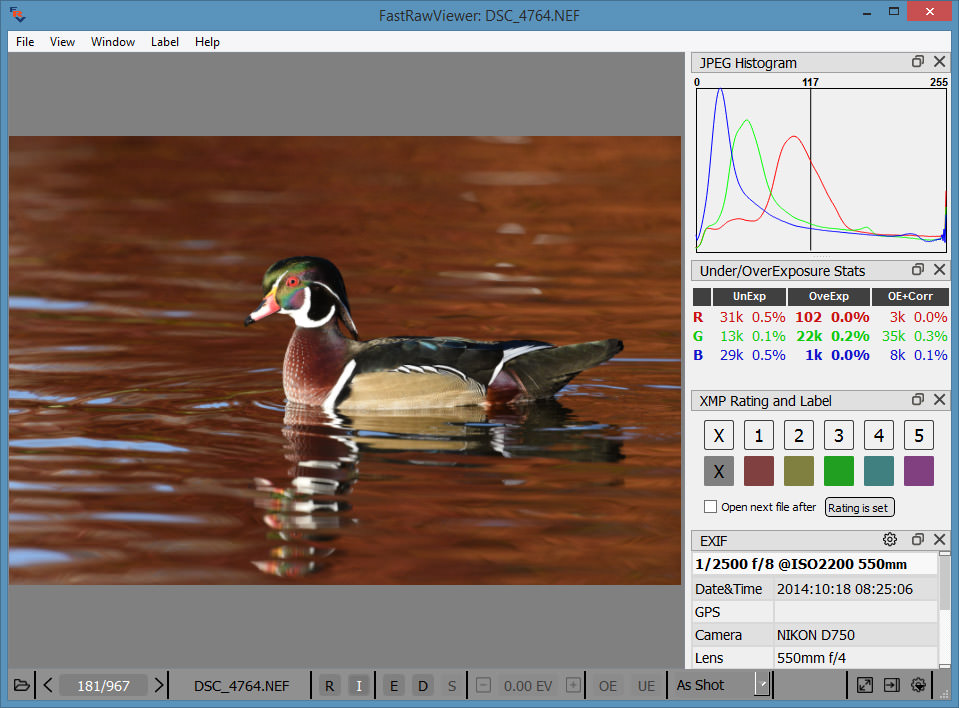
Our friends at LibRaw are joining our video course promotion by offering an exclusive discount for PL readers – 25% off the software! This is a time-limited offer to give you access to the fastest and best (in our opinion) RAW viewing and culling software on the market – the deal is only good until August 15, 2016, so act quick to get this amazing tool. In addition, everyone who has purchased our video courses will be receiving a permanent 30% discount, which is awesome! If you have bought the course, you were probably amazed by how quick one can go through hundreds of RAW images using FastRawViewer directly from the memory card and leave only the images intended to be imported into post-processing software like Lightroom. It is a huge time saver for me personally, which is why I have been advocating the use of the software to our readers.

FastRawViewer

To take advantage of this offer, please go to FastRawViewer.com and put the code “PGLF-4GL4-DCCK” on the cart page (click the “Have a coupon or promotional code? Enter code here” link to reveal the coupon input area). Once you do that, the system will automatically decrease the price of the selected software by 25%. With this offer, you can get FastRawViewer only for $ 14.99! And trust me, it is worth every penny – other readers who actively use FRV will attest to that.

If you have previously bought our video courses, as pointed out above, you will be receiving a 30% discount code to purchase LibRaw software! An exclusive discount code will be available in a separate text file later tonight, so you can download it from the Downloads area of the site (you must first login, then navigate to Shop->My Account->Downloads).

Big thanks to Iliah Borg and his team for giving us this great opportunity! We love supporting their work, because they are a very talented team of programmers who truly listen to customer feedback. As I have previously pointed out, I really hope that FastRawViewer will evolve into a much more capable tool in the future – perhaps we could see a solid Lightroom replacement one day 🙂

The post Exclusive PL FastRawViewer Discount – 25% Off! appeared first on Photography Life.

Photography Life

Posted in Photograpy How To | Tagged , , | Leave a comment

Basic Flash Photography With a Digital Camera

In this article we look at one of the most useful feature you have on your camera, the flash. Surprisingly we almost always take this feature for granted, thinking that all there is to it is to switch it on and off whenever we need it or don’t. Well, this time, I’ll share some tips with you on how you can effectively use your flash.

Most of us would have the standard flash unit built-in on our (digital) camera. Of course if you have moved on to a prosumer (digital) SLR camera, then you may already know about the different ways of using an external flash. This set-up gives you the versatility of using bounce flash and a more powerful flash output. But this month we’ll focus on the compact digicam.

Understanding Your Camera’s Built-in Flash

We are most familiar with the usage of flash at times when there is not enough light to take a good picture. Set on Auto, your camera would compensate by adjusting shutter speed and aperture to light up and give you the best exposure for your subject. It is also the most portable lighting equipment that you will ever have.

On a standard camera, your flash unit has 4 settings, namely “On”, “Off”, “Auto” and “No Red-Eye”. “On” and “Off” is quite obvious, allowing you manual control in switching the flash on and off. “Auto” setting lets your camera choose to activate the flash depending on lighting conditions. The “No Red-Eye” setting prevents red-eye effect on your subject caused by the flash illuminating the blood vessels at the back of the eye and bouncing it back to the lens. Almost all cameras do this by activating an initial flash which shrinks your subject’s pupils before taking the actual shot.

Let There Be Light

Okay, on with the tips. Here are a list of things you would use your flash for apart from just illuminating the scene.

1) Light up shadows : One of the most useful times to use flash is when natural light is at its brightest. This is when harsh shadows are created on your subject. Because of the amount of light, your camera would not automatically switch on your flash; therefore you would have to do it manually. The resulting flash will light up the shadow areas on your subject giving you a more balanced shot.

2) Put a sparkle in her eyes : Sometimes even when natural light is enough, consider using the flash to give a sparkle in your subject’s eyes. This also lights up your subject’s face resulting in a livelier look.

3) Flash in a night scene : When you are taking a picture of your subject against a night scene with the normal flash setting, you would probably end up with your subject brightly exposed by your flash and little else of the background. Most new digicam have “Night-Scene/Mode” setting on them. This means the camera uses flash along with a slow shutter speed. Use this to illuminate your subject and at the same time enough lighting from the scene will be captured by your camera.

4) Freeze the moment : Using your flash is also a great way to freeze motion. What happens when you are faced with low lighting condition and you have a moving object to capture? Use your flash for a burst of light to freeze your subject. Your shot is then less likely to result in blurring. You could even try using “Night-Scene/Mode” and panning (using your camera’s viewfinder to track your subject) to create nice effect. This allows you to capture your subject sharp against a motion-blurred background.

5) Improve contrast and saturating colors : Low ambient lighting results in poorly lit low contrast images. Use your flash to improve the contrast level of the object you are shooting. This also brightens and increases the color saturation of your picture. You will have to trigger your flash manually to do this.

When Not to Use Your Flash

Okay, in getting to know when to use your flash, you should also know when not to use it.

1) When your subject is out of range : Most built-in flash have an effective range of approximately up to 10ft or 3m. If your subject is standing beyond this range, either move closer to your subject or switch off your flash and use a slower shutter speed setting. On your digicam you can also use a higher ISO setting to capture your subject at a higher shutter speed.

2) When you are taking a pleasant and usually warm ambiance : If you want to effectively take the pleasant nature of a scene that is lit by warm lighting such as candle light, don’t use flash if it is possible. However, make sure you have enough ambient lighting to prevent underexposure or blurring due to movements. A tripod is best used here.

3) When you are shooting a reflective surface : Shooting with the flash on and directly in front of a reflective object is a sure way of ruining your picture. This includes shooting through a window or between metal bars or fencing. The reflection from your flash will bounce off the shiny surface and right back to the lens resulting in a blurred highlight. If you have no other choice, try shooting from an angle to avoid reflections.

4) No flash photography allowed : Some places like museums, art gallery, or specialty zoos do not allow flash photography. Here using a slower shutter speed coupled with a tripod or simply switch your camera to a higher ISO setting.

Personally, I almost always keep my flash on. The added highlight created by the flash on my subject is a good ingredient in creating a brighter and livelier shot. Practice on having a good eye on observing lighting conditions around you. Eventually you will be able to predict how your flash will work in different conditions without having to do a double-take.

So, go ahead, flash it!

Hi! My name is Kenny Goh. I have been passionate about photography for the past 11 years. I love the emotions that come with photography… the passion, the excitement, the excitement, the calmness, the pleasures, the expressions. It’s all there for interpretations. Capturing time at its most vulnerable moment and then looking at it over and over again trying to emulate the same feelings… but, then it’s never the same. Currently, my full-time career as a Senior Creative Director for an advertising company has allowed me to create, conceptualize and also view photography works of others. From this, I find myself having to critique about my own work as much as I do of works by others. Moving on from taking photographs I have also since ventured into the field of Digital Imaging. This is an inevitable move to the next level of digital photography and imaging. I have been writing articles and conducting workshops on photo-editing and always on the search for even more creative executions. I have been a writer and a contributor for magazines and book publications such as Sound & Pictures, Chip Photo Video, Click! Magazine and Digital Photography and Camera as well as frequent photography contributor to foreign book publishers. I hope you find what I have here, enjoyable and worth reading as much as I loved writing and shooting too.

Posted in Camera Photography | Tagged , , , , | Leave a comment

A Rainbow and a Waterfall at Sunrise: The Making of a Photograph

After a week in Ireland, I have seen some incredible sights. This is a beautiful country, and the people are incredibly warm and welcoming. Although most days here have been rainy, I’ve tried to make the most of foggy landscapes and simply enjoy my time in such a unique place. However, the weather has made it difficult to take colorful sunrise and sunset photos, which is a bit unfortunate — it is no secret that golden hour is a wonderful time to take pictures. Still, there has been one incredible morning for photography so far. In just a few minutes, the sky turned from a dull sheet of gray into a magnificent show of color, and a rainbow appeared during the best light. In this article, I’ll cover the entire story and thought process behind my favorite photo from this beautiful sunrise.

To start, everything begins with scouting. I had been in this area, the town of Doolin, Ireland, for a few days, and I had seen a few good landscapes already. Two were particularly interesting: a rocky beach and a distant waterfall that fell directly into the ocean. The waterfall was visible from only a couple vantage points, and I hadn’t found a foreground that was very interesting. Still, I scouted a possible photograph one night, which helped cement the location in my mind:

Ireland-Waterfall-Ocean

This scouting photograph was taken after sunset on a cloudy day.
NIKON D800E + 70-200mm f/4 @ 200mm, ISO 100, 30/1, f/6.3

I had taken some pictures of the beach, too, but I still hoped to get a better shot; that’s why I set my alarm for sunrise in the first place. Because of the time of year, as well as Ireland’s northern latitude, I had to get out of bed around 4:45 in the morning to reach the location in time. The weather was dreary when I got out of bed — a light rain and a boring sky. Still, I was awake already, and the clouds were starting to thin along the horizon. I decided that it was worth going outside.

The seashore, though, was about a thirty minute walk away, and I was running a bit late — mornings are tough. I wasn’t going to make it to the beach, so I decided to take some landscape photos at a nearby farm instead. At this point, it had stopped raining, and the sky had begun to clear. The conditions were changing rapidly for the better:

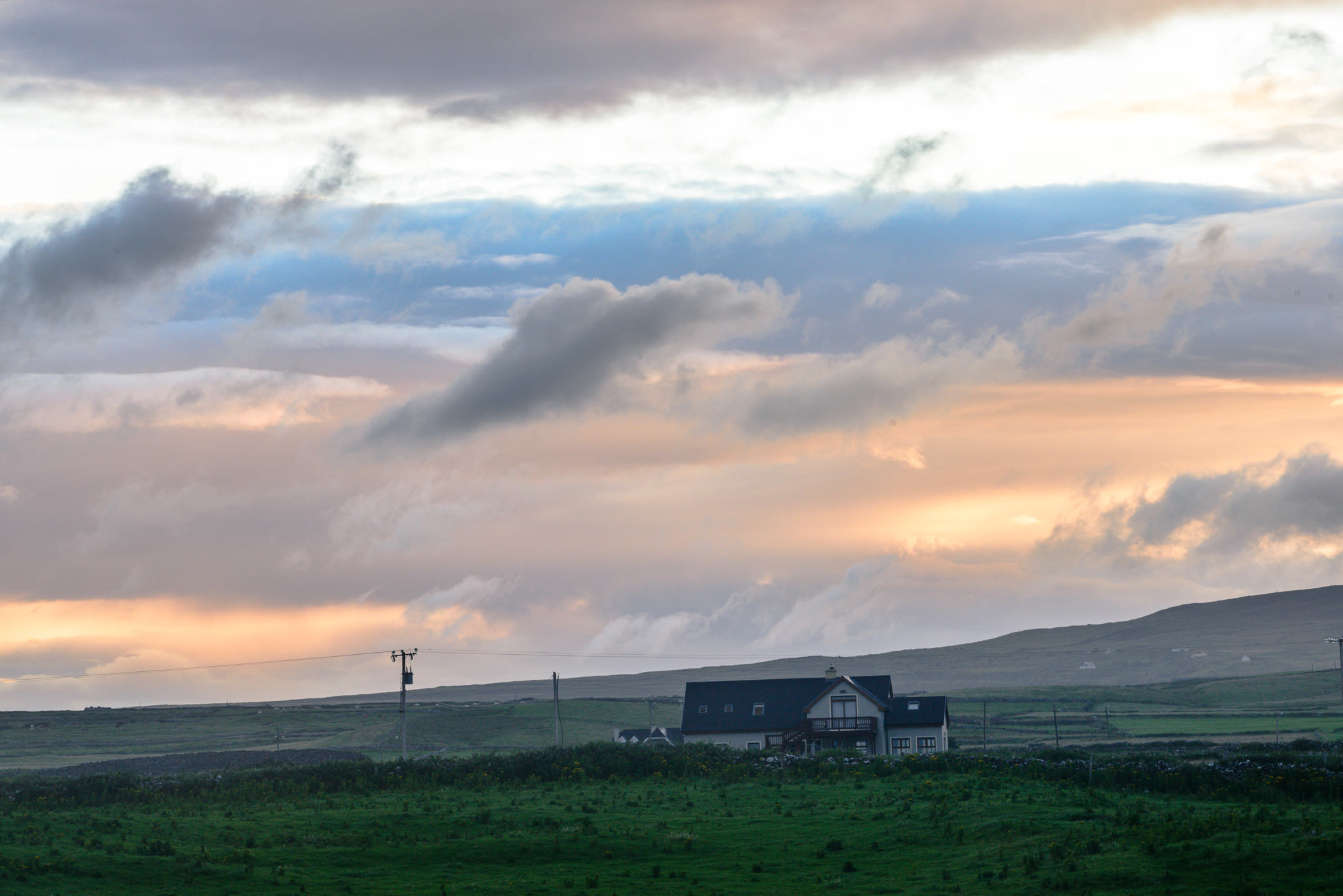
Ireland-Farm

NIKON D800E + 70-200mm f/4 @ 170mm, ISO 100, 1/8, f/16.0

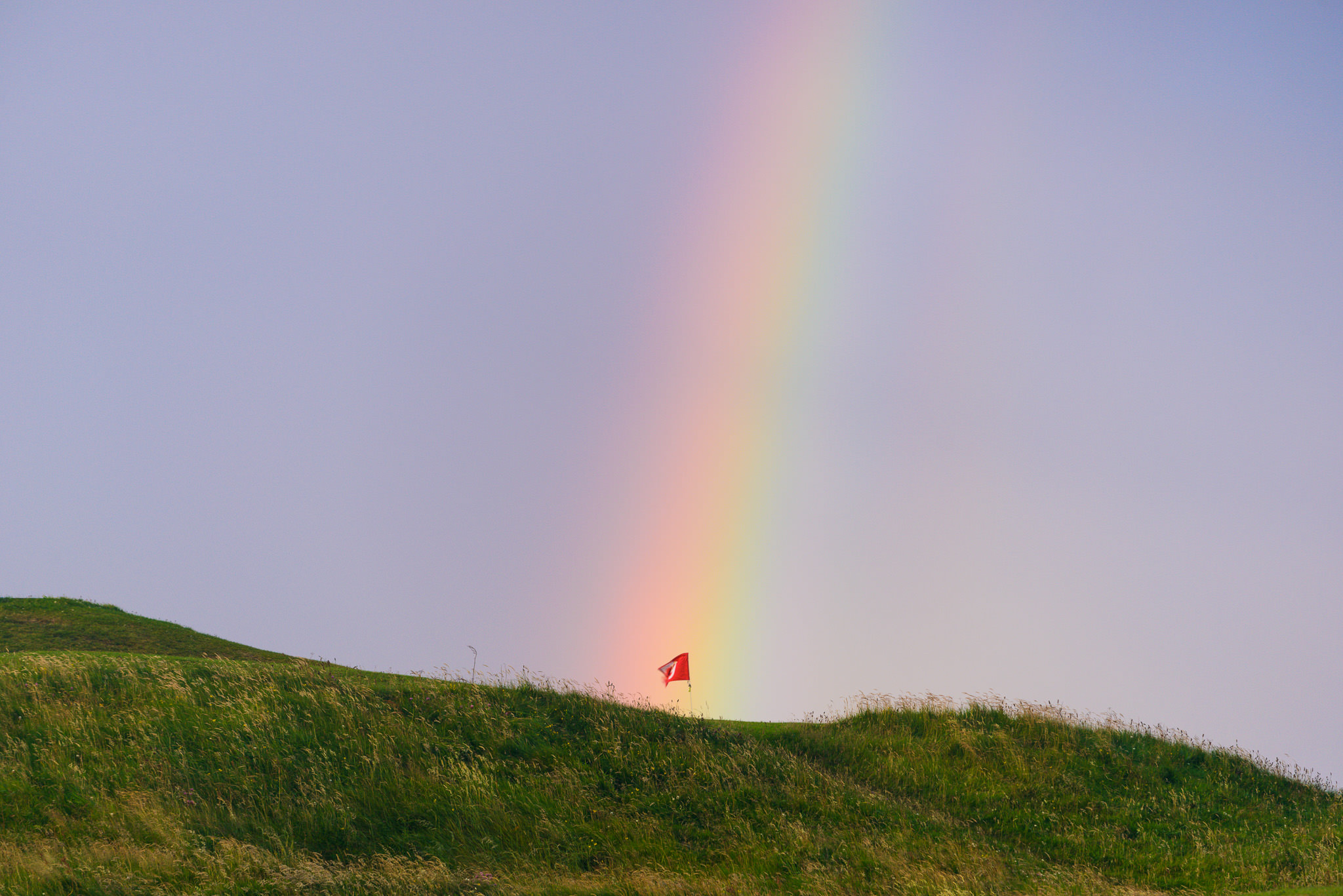
The sun peeked over the horizon, and the landscape begin lighting up in a soft, gold-yellow color. I was facing the sun, which meant that the scene’s dynamic range had grown too large to photograph without blending exposures. I looked around for other landscapes to shoot, and I saw a rainbow forming in the opposite direction. The foreground, though, was not particularly good — a golf course without any interesting features. I took one photo of this golf course, but it didn’t turn out very well:

Golf-Course-Rainbow

A good rainbow, but a boring landscape.
NIKON D800E + 70-200mm f/4 @ 200mm, ISO 100, 1/30, f/5.0

At this point, I was still at least fifteen minutes from the beach, so there was no hope of getting such a photo with the rainbow. The waterfall I scouted earlier, though, was only a couple minutes down the road. Leaving my backpack on the ground, I ran towards the location with my tripod and camera. In the sky, the rainbow grew brighter, and then it began to dim.

Once I saw the waterfall in the distance, I set up my tripod and framed a quick composition. The foreground was much better than what I had found a couple days prior, with an interesting fence stretching across the bottom of the frame. Even better, the rainbow was still visible in the sky, although it wasn’t quite as strong as before. I managed to take three photographs before it faded completely. The first image — with the brightest rainbow — ultimately worked out the best:

Ireland-Waterfall-Rainbow-Sunrise

This is the final photograph, the first of three images I took before the rainbow faded.
NIKON D800E + 70-200mm f/4 @ 130mm, ISO 100, 1/2, f/16.0

Why did I choose this composition? Since the rainbow faded so quickly, this was the first arrangement that came to mind. I cropped to a 4×3 aspect ratio, since the most important parts of the photo — the waterfall and the rainbow — are near the center. The edges were just distractions, and they added very little to the final photo. For every photo, I also think about the overall balance of the scene. In this particular image, of a peaceful landscape, I wanted the left and right sides of the composition to be of equal interest. The balance is not perfect, but any differences are slight enough that they don’t bother me.

My equipment was nothing particularly unusual. I used my 70-200mm telephoto, since the waterfall would have been invisible with a wide-angle lens. I also used a polarizing filter, which darkened the water and — far more importantly — saturated the colors of the rainbow. I shot at f/16 for depth of field, since the foreground was significantly closer than the waterfall. At a wider aperture, the background would have been a bit blurry. (In fact, even as it is, the background is a slight bit less sharp than the foreground. I would have stacked focus or used hyperfocal distance, ideally, but I didn’t have enough time for any more shots before the rainbow faded.)

Finally, in terms of post-production, I did not make any particularly drastic changes. Mostly, I added global contrast and brightness. The colors are almost entirely unchanged from the original RAW file, since any edits caused the rainbow to look blotchy and discontinuous. I did a bit of local brightness adjustments to the waterfall itself, and I darkened some of the houses on the hill. Aside from the crop and a bit of sharpening, those are the only noticeable edits that I made — it was a relatively simple photo to process.

If nothing else, my main takeaway was simple: every morning can result in beautiful photos, even if the sky looks dull and dreary. It certainly helped to have a good location in mind, but the most important part of this photo is that I was outside in the first place. The more that you look for photographic opportunities, the more that you will see unexpected, incredible sights.

The post A Rainbow and a Waterfall at Sunrise: The Making of a Photograph appeared first on Photography Life.

Photography Life

Posted in Photograpy How To | Tagged , , , , | Leave a comment