Is it Time to Give Windows Another Chance?

For thousands of photographers, this week marks a special time of the year, when Apple announces their new products for the creatives, with iMacs, MacBook Pros, and Mac Pros that will be used to create art for years to come. However, yesterday’s announcement of the new MacBook Pros was met with some lackluster feelings and disappointment, a feeling not unfamiliar to Apple users in recent years. So one must ask, is it time to give Windows another chance?

To the surprise of many, Apple hasn’t made the most exciting product this year, on all platforms of their technology. The iPhone 7, well, it was okay. Many users were furious with the headphone jack removed, and many questioned the reliability of the ‘portrait mode,’ which they mocked years prior on the HTC One. And moments after the announcement of the new phone, came the better, more exciting announcement from Google with the Google Pixel.

pixel-google

And the same can apply to the MacBook Pro announcements and the new Windows system, the Surface Studio. But while one was able to wow and excite us, the other asked us where the ESC key was going.

The PC versus Apple debate has always been filled with preconceived notions. PC users will complain about how Apple computers are underpowered, overpriced, and buying more into an ideology than a sustainable product. Many Apple users will say Windows sucks, rant about blue screens of death, driver issues, and other relics from Windows’ earlier era. But Windows has changed a lot in the last 10, no, five, years. Let’s take a closer look.

The Blue Screen of Death is All But Gone

Perhaps the biggest smudge mark on Windows’ reputation came with its Blue Screen of Death. During a driver failure, heat issue, or another other critical problem, your screen would go blue, and give you an error in some techy language that felt more like Chinese than English, just before it would slowly process itself to rebooting. However, in recent years, the Blue Screen of Death has virtually disappeared from Windows 7 and beyond. Now, software is given the rights to update itself behind the scenes, allowing for fewer driver issues or catastrophic failures.

Windows 10 Has Opted for a More Visual Experience

Apple has always succeeded in giving the visually minded people a visual representation of how an Operating System should perform. Where Windows has always been known for it’s code-based background, Apple has done a much better job of hiding that. Windows 10 has done an exceptional job of pushing itself into the visual world, allowing for you to talk to your computer to open apps, and tucking away a list of apps commonly found in Windows iconic Start Menu.

Now, Windows 10 looks more like an Apple OS than what many have come to expect from their earlier renditions. While it has its own way of doing things, the transition from one system to the other isn’t as much of a learning curve than one would expect.

They’re Different Systems with the Same DNA

In 2005, Apple quietly admitted defeat in the hardware aspects, transitioning from their IBM microchips into the more powerful and robust Intel-based chips systems. In non-nerd talk, Apple decided to make PCs with their operating system laid overtop of them. That’s right, the hardware found in an Apple Computer is no different than that found in a Windows based system, meaning you can install OS X on a PC, making a computer commonly called a ‘Hackintosh.’ The difference between a PC and an Apple computer comes with the ability to upgrade (and of course, the OS). Apple will often solder RAM and other components into the motherboard, making it so you cannot upgrade the components without Apple’s Customer Care fee. PCs, on the other hand, are entirely swappable with their components.

The Practical Reason for an Apple Computer Has Died

The benefits of using an Apple computer to do graphic design, photography or video editing used to be obvious. With exclusive and beloved software developed by Apple, like Final Cut Pro, Aperture, and Garage Band, it was easy to justify Apple systems for the creative workforce. However, in recent years, Apple has chosen to end development on these pieces of software, handing the throne to Adobe with Premiere Pro and Lightroom. Additionally, the popular software you use, from developers like Google (with Google Chrome) and Adobe (with Lightroom, Premiere Pro, Photoshop, Illustrator etc etc), seem to prefer the PC platform, offering more advancements and faster than for the OSX users (case and point, Adobe’s love affair with the Microsoft Surface Pro).

The Cost and Complications are Gone

Apple doesn’t segment their market. They release one new phone each year, and a couple of computer systems with limited options. Those who want simplicity can rely on Apple for that, while PC purchasing have always been a complicated process. With a million different manufacturers, all promising they’re the best, the entire process of shopping for a computer can be a headache. But the rewards are indeed paying off. For the cost of the new MacBook Pro, you can get a Windows based laptop with the Razer Blade Pro – a system with three times as much GPU, 4K matte color-calibrated screen, and a faster processor, for the same cost, and still retaining a lot of sexiness in design.

razer-blade-pro

Safety is No Longer a Concern

The biggest push away from Windows in the early 2000s came with the rise of spyware and malware, traditionally found on PCs. It took only one misguided download, and your Windows based machine would be limping to do anything. However, virus and malware developers tend to side with the masses, and in recent years, PC malware has dropped considerably, whereas malware on Apple machines is at an all time high.

It’s Time to Reward Risks

Let’s consider the concept of risk. Apple’s greatest innovations have always come from how they’ve been able to look at new ways to do things creatively. Apple revolutionized the smartphone market with the original iPhone. The Macbook Air blew us away with how portable and thin it was. Apple has developed into the massive company they are today based purely on how they were able to innovate the tech world into something that was previously impossible. But one must ask, does Apple still hold true to that innovative drive? When was the last time they truly excited us? When was the last time you raced to buy the new product, for a reason other than crowd mentality?

Microsoft, on the other hand, has found a new way to excite us. The Microsoft Surface Studio is the definition of innovation – showing us a new and exciting way to do the things we’ve been doing for years. The promo video had us wanting more, and every early look at the system has focused entirely on how amazing and immersive it is.

And if you think Apple is still innovating, please explain to me why we need to buy a dongle to plug our three week old iPhones into our brand new MacBook Pro?

Resource Magazine

Posted in Photograpy How To | Tagged , , , , | Leave a comment

Replacing GAS with SAS

Three anniversaries of ‘firsts’ have been in a state of convergence for me this fall. Number one is my daughter’s first wedding anniversary. The next is the fourth anniversary of my first visit to Utah. And, the last one is the third anniversary of my first article being published here at Photography Life. Each of them in their own way has caused me to think about why many of us replace our camera gear on a frequent basis…and quite likely do so needlessly.

SAS 1

NIKON 1 J5 + 10-100mm f/4-5.6 @ 40.6mm, ISO 160, 1/80, f/8.0

My daughter hired a professional wedding photographer for her special day and it was a very wise decision. The images captured were simply wonderful and they will serve as cherished memories for decades to come. There were two things that stood out for me when watching this professional photographer do her magic. The first was her precision, and the second was the gear she was using. Like most wedding photographers she used multiple camera bodies, each fitted with a different lens to enable fast response. I took notice of the three camera bodies she was using (I recently double checked this with the EXIF data on the images she created) – a Canon 5D Mark III, an older 5D, and a Nikon D300S. Regardless of the camera body used her work was stellar.

SAS 2

NIKON 1 J5 + 30-110mm f/3.8-5.6 @ 49.3mm, ISO 1600, 1/400, f/5.6, Deluxe Vello Extension Tubes

It was certainly an interesting experience for me to revisit a location like Utah that I had photographed four years ago. Back in 2012 I was shooting with what most people would consider much ‘better’ gear than I used in 2016. Back then I had a Nikon D600 along with a D7000 and a reasonable selection of Nikkor glass. After returning from our recent photography tour I had the opportunity to not only go through my most recent photographs, but also compare them to the images I created back in 2012.

What hit me like a ton of bricks was how poor my 2012 images were. Assessing photographs in large amount is a subjective exercise of course, but nonetheless it was blatantly obvious to me that having ‘better’ camera gear back then certainly didn’t help me create ‘better’ images than I did on this most recent trip. In some cases as I perused my older images the question that most often popped into my mind was, “What the heck was I thinking?” Better sensors do not overcome bad composition or a poorly executed image concept.

SAS 3

NIKON 1 J5 + 10-100mm f/4-5.6 @ 100mm, ISO 160, 1/640, f/5.6

Three years ago next month my first ever article appeared here on Photography Life – a hands-on review of the Nikon 1 V2 that Nasim had asked me to write. Back then I owned a single Nikon 1 V2 with a few 1 Nikon lenses. I was using it on occasion for specific captures with my client video work, and as an inexpensive tele-converter of sorts with an FT-1 adapter, mainly with my Nikkor 70-200mm f/4G VR zoom. At that time I was in my infancy stage in terms of exploring the V2 and all of its capabilities. Since the time of that first V2 article I made more investments in full frame gear, eventually ending up with a Nikon D800 and eight full frame lenses – all Nikkor other than the Tamron 150-600mm.

Well, all of that full frame gear is long gone having been sold in July 2015 after my youngest son’s wedding. I now shoot with Nikon 1 gear exclusively. Three V2s, two J5s and a J4 thrown in for occasional underwater fun with a WP-N3 housing. I have a pretty full compliment of 1 Nikon lenses that serve my needs well and I have absolutely no interest in looking at any other camera format or system. Over the past 18 months or so I haven’t read even one camera body or lens review, nor do I have any plans to do so. Quite frankly I don’t need any temptation to rekindle my now very dormant GAS (gear acquisition syndrome).

SAS 4

NIKON 1 J5 + 10-100mm f/4-5.6 @ 100mm, ISO 160, 1/100, f/8.0

I’ve been thinking about why many of us replace our camera gear so frequently. Heaven knows I’ve wasted a lot of money doing that over the years. Most of the time it really isn’t because our old gear is no longer capable or serviceable. My daughter’s professional wedding photographer proved that in spades with the outstanding work she produced using some older bodies. My V2s are still going strong and doing a great job helping to keep my video clients satisfied.

It isn’t because most of us need new equipment with much better technical specifications and performance. My own feeble attempts to capture the spectacular scenery in Utah back in 2012 are proof of that fact.

sas 5

NIKON 1 J5 + 6.7-13mm f/3.5-5.6 @ 8.1mm, ISO 160, 1/160, f/8.0

Nope. A lot of it is emotion and ego. We get caught up in the thrill of reading about new gear and the latest whiz-bang technical advancements. And, we find that it is actually really easy to rationalize the purchase of new camera gear. After all who wouldn’t want these ‘to die for’ upgrades? The truth of the matter is that whenever we make decisions in a highly charged emotional state (either negative or positive emotions by-the-way) logic goes out the window.

I suppose it’s lucky that most professional photographers apply some business acumen to their purchase decisions including cash flow projections and return-on-investment calculations. Doing that can help keep the GAS monster in check…at least a little bit. Regular consumers likely fall prey to their emotions on a more frequent basis when it comes to their GAS urges than do the pros…but perhaps not by as much as we may think.

SAS 6

NIKON 1 J5 + 10-100mm f/4-5.6 @ 100mm, ISO 800, 1/1250, f/8.0

Ego does raise its ugly head more often than any of us would like to admit when it comes to buying camera gear. And, its pretty easy to spot. Just go to an airshow or to a popular birding site and watch some owners of ‘big gun’ gear strut their stuff. Some individuals seem to spend more time watching whos watching them and looking at their ‘impressive’ gear, than actually using it.

SAS 7

NIKON 1 V2 + 1 Nikon CX 70-300mm f/4.5-5.6 @ 300mm, ISO 5600, 1/80, f/5.6

I think the other reason that many of us replace our camera gear so often is that it’s an easy cop-out and a way to gloss over our skill sets. For many of us it’s so much easier to replace camera gear and spend our time learning how to operate all of the new fangled features, menus etc. than it is to actually work on improving our photographic skill set. I know I did that unconsciously with my forays into full frame camera ownership…so its likely that at least some of you have done that as well.

SAS 8

NIKON 1 J5 + 30-110mm f/3.8-5.6 @ 41.2mm, ISO 3200, 1/20, f/5.0, 16mm Deluxe Vello Extension Tube

For the past eighteen months or so I’ve been trying hard…usually with some success…to replace all of my GAS (gear acquisition syndrome) urges with dedicated SAS (skill acquisition syndrome) efforts. Everyone’s photographic interests may be different of course…and those interests directly impact required skill sets. For me, it has meant learning to effectively use a camera without an EVF. Practicing to shoot at increasingly slower shutter speeds with my Nikon 1 J5s. Experimenting and trying weird stuff with my existing gear like stacking 5 extension tubes together then trying to photograph butterflies hand-held. And, getting out of my comfort zone and trying to photograph different types of subjects. Who knows…maybe all of this SAS focus will actually lead me into photographing people some day…hmmm….I hope I live that long.

Article and all images Copyright 2015 and 2016 Thomas Stirr. All rights reserved. No use, adaptation or reproduction of any kind is allowed without written consent. Photography Life is the only approved user of this article. If you see this article or any images contained in it reproduced anywhere else it is an unauthorized and illegal use.


The post Replacing GAS with SAS appeared first on Photography Life.

Photography Life

Posted in Photograpy How To | Tagged | Leave a comment

Mary Lou Williams Canvas Traditional 1 5/8″ Natural Espresso Wood Grain 24×29 Photo On Canvas

Mary Lou Williams Canvas Traditional 1 5/8″ Natural Espresso Wood Grain 24×29 Photo On Canvas


Mary Lou Williams” is an art print by Gjon Mili from The Life Picture Collection. Get photo prints of “Mary Lou Williams” in a variety of frames, styles, and materials. Photographer Bio Emigrating to the United States from Albania in 1923, Gjon Mili is regarded as the first photographer to use electronic flash and stroboscopic light to create photographs outside of a scientific context. A true pioneer of the artform, Mili’s photographs of dancers, athletes, and pictures or performances have shaped our understanding of how movement too rapid or too complex for the eye to discern is captured in the still image. Mili’s career as a photographer for Life Magazine spanned four decades and saw the publication of thousands of his photographs, taking him around the world; from collaborations with Pablo Picasso, to the incarceration of Adolph Eichmann, to original photos from Broadway plays. The Life Picture Collection From one of the most iconic magazines ever to hit the shelves comes The Life Collection – an archive of some of the most recognizable imagery of the 20th Century. Documenting events in politics, culture, celebrity, the arts and the American experience, these compelling and provocative photographs include the works of some of the greatest photographers capturing some of the greatest moments in history.

Price: $
Sold by Photos.com by Getty Images

Posted in How To Photograph | Tagged , , , , , , , , , | Leave a comment

Throwback Thursday – Photography, Winter, Yellowstone 1995?

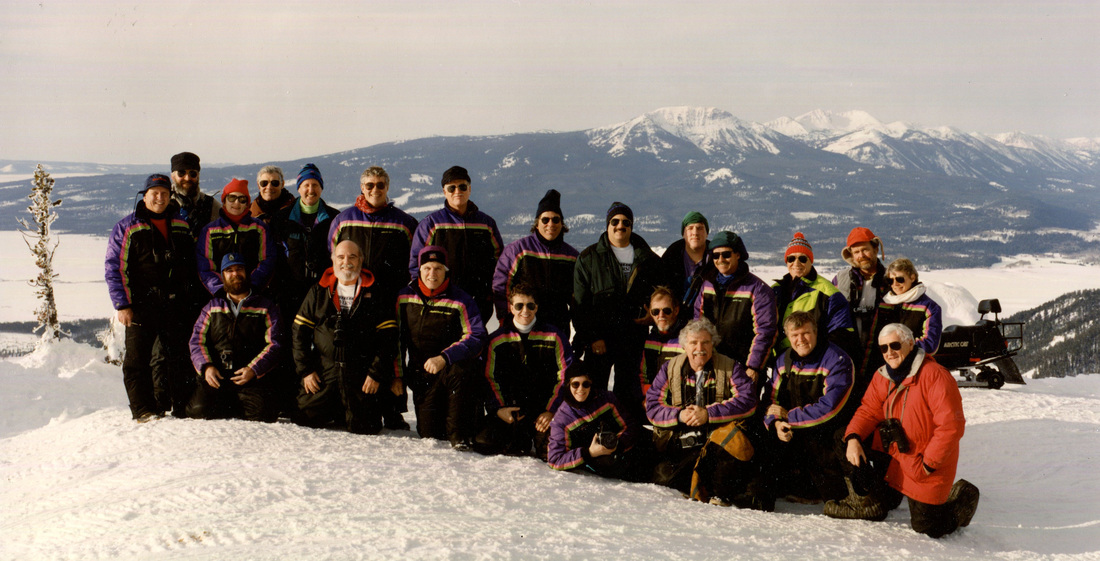
I’ve shared a lot of throwback images from the infamous snowmobile trips to Yellowstone over the years. What started with just four of us, Duncan MacNab, Chris Kent, Bob Thompson and me, became a decade of annual trips each winter with a good number of leaders from the photographic industry.

There’s that old line about “he who dies with the most toys wins!” Well, years ago we decided Duncan didn’t need to die to win – he already owned the title. Here’s a perfect example. In addition to all his other toys, he had a gas grill on runners that he towed behind his sled. On one trip, I think the one above; he towed the grill to Two Top. The Two Top Loop is one of the most famous snowmobile trails in America. It’s 28 miles long with a spectacular view from the top. Plus, the snow blows across the trees forming snow/ice sculptures that look like something out of Hollywood.

But, just the view for our group wasn’t enough. At the top, around 8,000-foot elevation, Duncan would fire up the grill for cheeseburgers. Even topped with a grilled onion if you wanted. Imagine being at the top of a snow covered mountain buried in the silence of winter and smelling burgers coming off the grill. Now and then another group would come snowmobiling by and do a double-take at twenty+ people at a barbecue!

One year it was so cold the Pepsi I was drinking turned to slush within minutes. The temperature was below ten degrees. You had to drink very carefully to avoid a repeat performance of the kid in Christmas Story with his tongue stuck to the flagpole.

Take some time looking at who’s in this throwback image. You should find a whole bunch of familiar characters from the industry.

While the fun of Throwback Thursday is in the images we find, it’s a great marketing tool. Use throwback images to remind your blog readers of the importance of photography and capturing those special memories. Plus, this is the perfect time of year to highlight holiday time and the opportunity to update the family portrait!

SkipCohenUniversity – SCU Blog

Posted in Photograpy How To | Tagged , , , , , | Leave a comment

Sammy Davis Jr. In ‘porgy & Bess’ Canvas Gallery Wrap 18×27 Photo On Canvas

Sammy Davis Jr. In ‘porgy & Bess’ Canvas Gallery Wrap 18×27 Photo On Canvas


Sammy Davis Jr. In ‘Porgy & Bess'” is an art print by Gjon Mili from The Life Picture Collection. Get photo prints of “Sammy Davis Jr. In ‘Porgy & Bess'” in a variety of frames, styles, and materials. Photographer Bio Emigrating to the United States from Albania in 1923, Gjon Mili is regarded as the first photographer to use electronic flash and stroboscopic light to create photographs outside of a scientific context. A true pioneer of the artform, Mili’s photographs of dancers, athletes, and pictures or performances have shaped our understanding of how movement too rapid or too complex for the eye to discern is captured in the still image. Mili’s career as a photographer for Life Magazine spanned four decades and saw the publication of thousands of his photographs, taking him around the world; from collaborations with Pablo Picasso, to the incarceration of Adolph Eichmann, to original photos from Broadway plays. The Life Picture Collection From one of the most iconic magazines ever to hit the shelves comes The Life Collection – an archive of some of the most recognizable imagery of the 20th Century. Documenting events in politics, culture, celebrity, the arts and the American experience, these compelling and provocative photographs include the works of some of the greatest photographers capturing some of the greatest moments in history.

Price: $
Sold by Photos.com by Getty Images

Posted in How To Photograph | Tagged , , , , , , , , | Leave a comment