JPEGmini 60% Off Today and Tomorrow Only

As many of our readers know, there are only a few software packages out there that we always recommend at PL to our readers. One of such software packages is JPEGmini, which in my opinion, is worth every penny, even when paying for it in full. Well, today and tomorrow only, our friends at B&H Photo Video decided to host a really nice special for our readers, by bringing the price of the JPEGmini Pro photo optimization software down to $ 59.95, which is basically 60% off its original sticker price of $ 149.95. Considering how much you can do with JPEGmini, that’s one heck of a deal for it! If you do not know about JPEGmini, I would highly recommend to give my JPEGmini Pro review a read, as it details all the feature of the software and explains exactly what it does. In short, JPEGmini is capable of reducing the file size of your JPEG images by up to 80%, while keeping the quality indistinguishable for the viewer.

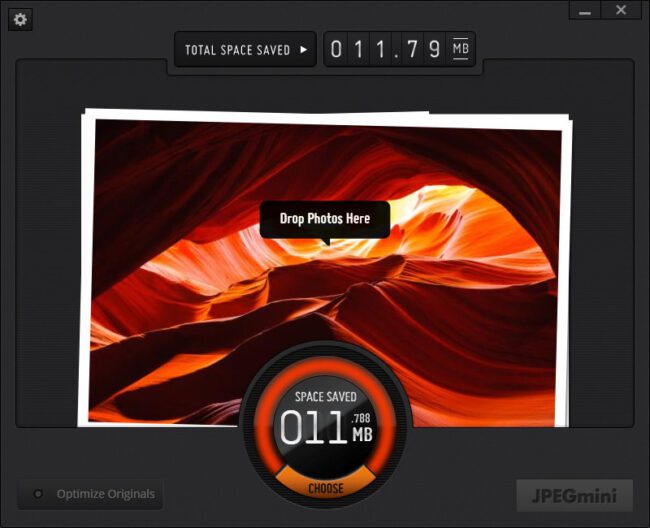
JPEGmini Pro Total Space Saved

The great thing about JPEGmini Pro, is that it comes with a plugin for Lightroom, which allows you to run the software during the export process, integrating right into your photography workflow without any disruptions. So you can export your images always at the highest quality, without worrying about JPEG compression and artifact issues, delivering the best quality to your clients – all without compromising on space. In addition to the plugin, the main software package (as pictured above) is capable of running through your entire image library, finding JPEG images and batch-compressing them. I have done this a number of times on my entire photo library and I have spaced a few terabytes of space just like that.

Please note that Photography Life has no affiliation whatsoever with JPEGmini. We only promote this software to our readers, because we love it and use it on a daily basis. We have never been paid to promote any product and we will never accept any payments for promoting products and services at Photography Life. Along with FastRawViewer (also on sale until January 1st), JPEGmini is the software I personally use on a day-to-day basis and highly recommend.

You can already purchase your copy of JPEGmini through B&H Photo Video for $ 59.95. The sale has already started and will last until December 28, 2016 11:59 PM.

The post JPEGmini 60% Off Today and Tomorrow Only appeared first on Photography Life.

Photography Life

Posted in Photograpy How To | Tagged , , , | Leave a comment

Pelican Cases Are Up to 63% Off Today Only

Pelicans are not only a great way to transport your gear when you travel, they are my favorite way to store equipment long-term without worrying about dust, moisture and bugs. Right now, several Pelican cases of various sizes are on sale for up to 63% off, which is a great deal if you are swimming in gear with no place to store it. You can select either padded foam or velcro dividers, whatever your might need.

[Via Amazon]

Resource Magazine

Posted in Photograpy How To | Tagged , , , | Leave a comment

George Chakiris Paper Framed Print 1 5/8″ Matte Black 28×22 Photo On Paper

George Chakiris Paper Framed Print 1 5/8″ Matte Black 28×22 Photo On Paper


George Chakiris” is an art print by Gjon Mili from The Life Picture Collection. Get photo prints of “George Chakiris” in a variety of frames, styles, and materials. Photographer Bio Emigrating to the United States from Albania in 1923, Gjon Mili is regarded as the first photographer to use electronic flash and stroboscopic light to create photographs outside of a scientific context. A true pioneer of the artform, Mili’s photographs of dancers, athletes, and pictures or performances have shaped our understanding of how movement too rapid or too complex for the eye to discern is captured in the still image. Mili’s career as a photographer for Life Magazine spanned four decades and saw the publication of thousands of his photographs, taking him around the world; from collaborations with Pablo Picasso, to the incarceration of Adolph Eichmann, to original photos from Broadway plays. The Life Picture Collection From one of the most iconic magazines ever to hit the shelves comes The Life Collection – an archive of some of the most recognizable imagery of the 20th Century. Documenting events in politics, culture, celebrity, the arts and the American experience, these compelling and provocative photographs include the works of some of the greatest photographers capturing some of the greatest moments in history.

Price: $
Sold by Photos.com by Getty Images

Posted in How To Photograph | Tagged , , , , , , , , | Leave a comment

How to Make Sharp Watermarks in Lightroom

One of the biggest frustrations with Lightroom’s built-in watermarking tool, is the fact that it often ends up making watermarks appear too soft / blurry, especially when extracting smaller JPEG images. This happens due to Lightroom’s rather poor implementation of watermarking on images. Not only does Lightroom seem to apply sharpening to images before adding a watermark, but also, the resizing algorithm used by the software appears to be pretty bad. No matter what image dimensions one chooses, Adobe has not provided a way to turn off scaling in Watermark Editor, even if one provides transparent PNG / GIF images with the correct dimensions. For this reason, many photographers end up using Photoshop for adding watermarks to images, which certainly does take more time and effort, but certainly delivers much sharper results in comparison. After seeing poor watermarking results, I decided to look into alternative methods to see if there is a way to make watermarks sharper using the same tools. After some experimentation, I came up with two methods that ended up working well and that’s what I am going to share with our readers in this article.

Take a look at the two images below – the “Before” image shows how poorly the watermark is added by Lightroom, whereas the “After” image shows how it can look if it is done right:

Please note that the methods discussed below are somewhat advanced and require specific software such as Adobe Photoshop (for the first method) and Illustrator (for the second method). For the second method, you will also need to download an open-source font generation software called FontForge.

Method #1 – Resizing Watermarks to Exact Dimensions

This method is probably the easiest one to implement, since you only need to use Photoshop to adjust your watermark. Basically, the idea is to adjust your transparent PNG or GIF image, so that it has exactly the same image dimensions as the output image. For example, if you have an export preset that exports images at 960 pixels wide, you will need to adjust your PNG / GIF image so that the image width is exactly 960 pixels. This way, Lightroom can be forced not to scale your watermark and it will appear as sharp as you make it from Photoshop.

Unfortunately, this method has a few serious drawbacks. First of all, you will need to create two sets of watermarks for each side of image if you want to be able to place watermarks in all four corners. Second, you will need to create watermarks for both horizontal and vertical images separately, or Lightroom will again revert back to scaling. And if you output in multiple resolutions, you will need to repeat the same process for the rest of them, which can quickly increase the number of watermark presets you have on your computer. The result is definitely worth the effort still in my opinion though, as your watermarks will look drastically better in terms of sharpness and quality compared to the poorly resized versions that Lightroom spits out by default.

Here is the full list of steps you need to run:

  1. Determine the desired image dimensions for both horizontal and vertical images. In this particular example, I will only run through horizontal images that I want to output at 960 pixel wide resolution.
  2. Open up your transparent logo in Adobe Photoshop. Make sure that the logo has a transparent background, as seen below:

    PL Transparent Logo White
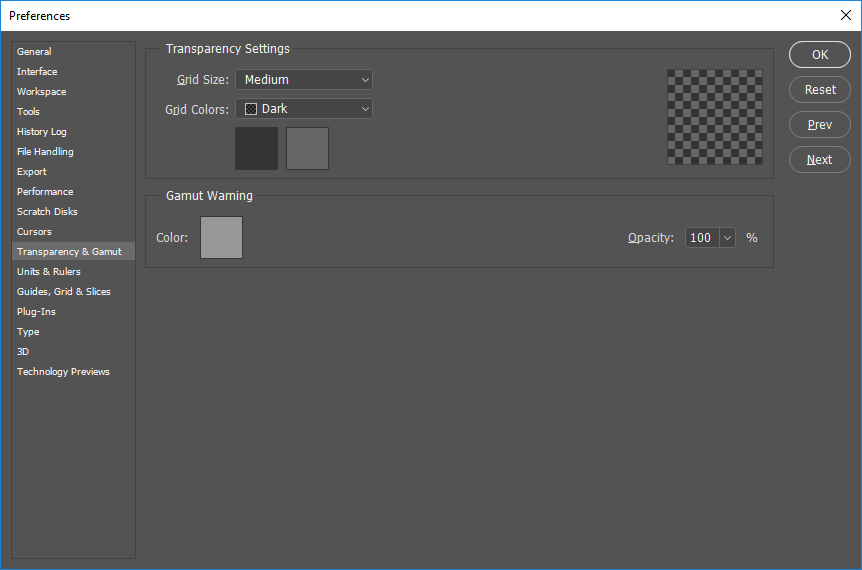
    If your logo is white, it might be hard to see it due to the bright checkerboard pattern of the background. If that’s the case, you can easily change it by visiting “Edit->Preferences->Transparency & Gamut” and setting “Grid Colors” to “Dark”:

    Photoshop Transparency and Gamut
    Now it should be much easier to see the logo:

    PL Transparent Logo White Dark Background
    Note that we have not changed anything on the image itself – we simply made the transparent background appear darker. If your logo is dark, you can choose the lighter transparent background / checkerboard.

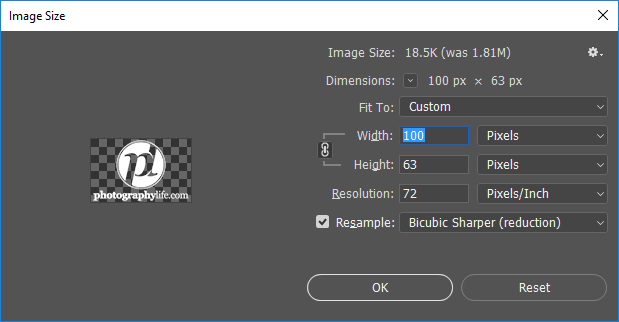
  3. Now determine how big the logo should be when exported at your desired image dimensions – that’s what we need to resize the logo to. For the image size example of 960 pixels wide that I am using, I will be resizing the logo to 100 pixels wide, basically around 10% of the total width of the image. Go ahead and press CTRL+ALT+I (CMD+ALT+I on Mac) on the keyboard and type the target size:

    Photoshop Image Size
    For the “Resample” algorithm, choose Bicubic Sharper, since we are reducing the image dimensions and want to keep it sharp while resizing.

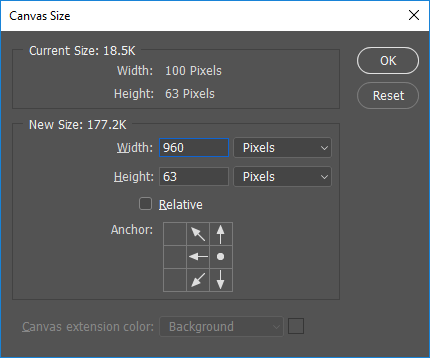
  4. The next step is to fill up the resized logo with extra space to cover the lost dimensions. Press CTRL+ALT+C (CMD+ALT+C on Mac) to bring up the Canvas Size tool:

    Photoshop Canvas Size

    Put the desired image dimension under width (in this case it is 960 for me) and leave the height value the same – that one does not matter. Make sure to move the Anchor to the right, so that the watermark is moved to the right side of the canvas. Once you click OK, you should see something like this:

    Logo in Canvas

  5. The watermark image is ready, but there is one small step I recommend you take. If there is not enough space to the right side of the image, it is best that you leave a little bit there to avoid using the horizontal inset in Lightroom. Unfortunately, Lightroom will again down-size your logo if you use the Horizontal inset, so it is best to leave a little bit of empty space to the right of your logo. You can simply drag the logo to the left a little, or for consistency, I always prefer using the keyboard left button instead. Make sure to press the “V” key to switch to move tool, then after selecting the corresponding layer that hosts the watermark, simply press the left arrow on your keyboard to start moving the logo away from the right edge of the frame. I moved mine about 10 times, which is 10 pixels from the edge of the frame.
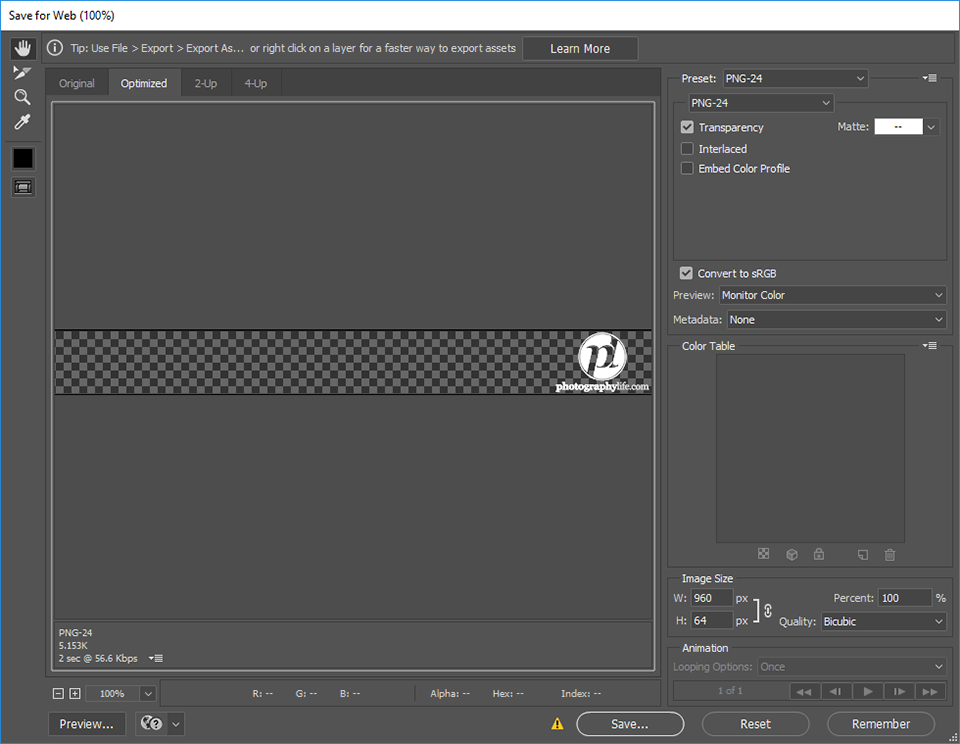
  6. Save it as a PNG file again by pressing CTRL+SHIFT+ALT+S / CMD+SHIFT+ALT+S (Save for Web) and choosing PNG-24 as file format. Make sure “Transparency” is checked:

    Photoshop Save for Web

    Give it a meaningful name like “960px Horizontal-Right.PNG”

  7. Repeat the above step, but this time put the Anchor to the left side when resizing the canvas. This one will be used for the left side, so save it just like above with a name like “960px Horzontal-Left.PNG”
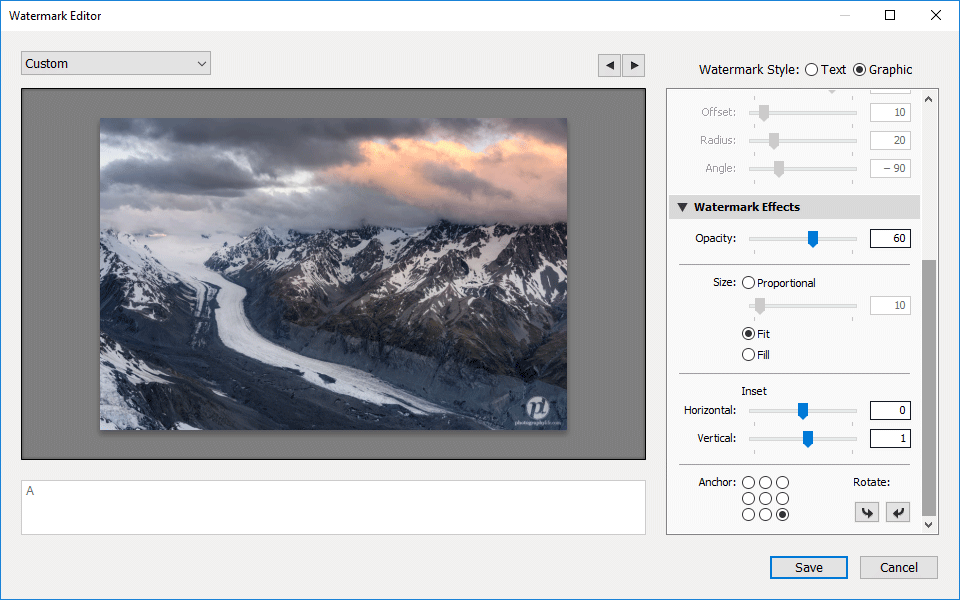
  8. Now that you have both files for the horizontal images, let’s go ahead and create the necessary templates in Lightroom. Fire up the Watermark Editor by going to “Edit->Edit Watermarks…”:

    Lightroom Watermark Editor Graphic

    Choose “Graphic” and pick the first file that we have just created. In my case, I used the “960px Horizontal-Right.PNG” image. Scroll down to “Watermark Effects” and make sure to select “Fit”. This way, nothing will get up-sized or down-sized, since the horizontal dimensions of the watermark match the dimensions of the image. Under “Inset”, do not touch the Horizontal value, but feel free to change the Vertical value, since you probably want to move it up or down a little depending on where on the right side you are placing the watermark.

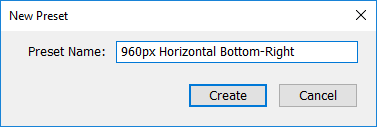
  9. Save the Template with a meaningful name such as “960px Horizontal Bottom-Right”:

    960px Horizontal Bottom-Right

  10. Repeat the last twp steps above for the top of the image, then repeat it for the two left sides and give all three appropriate template names.
  11. You are all set! From here, all you have to do is export horizontal images and pick the right template to specify exactly where your logo is going to be.
  12. If you are planning to extract vertical images, repeat all of the steps above for the vertical images as well and name templates like “960px Vertical Bottom-Right”.

Here is the final result, with a crisp watermark applied to the exported image:

Watermark looks sharp after using one of the methods

Without a doubt, the above process is much more complicated than it should be. Adobe’s software design team should really get a slap on their hands for not making it possible to choose a watermark with exact dimensions and not scaling it in any way. There should be a way to add a simple option called “No Scale” under “Watermark Effects”, which allows the end user to choose a watermark and apply it to any side of the image, making “Inset” work by simply shifting the watermark by pixels either horizontally or vertically. It would save so many steps for sure!

Method #2 – Creating a Logo Font

The second method, which is a bit more complicated as it involves the process of creating a font and then installing it into your computer, is a much better approach compared to the first one, because you do not have to deal with different image sizes and dimensions – you could literally just have 4 templates in your Lightroom to make watermarks, irrespective of the image dimensions. The initial process is somewhat painful, but if you are ready to commit some time, you will be very happy with the results.

The only issue with this method, is that you cannot have different colors in your watermarks, since fonts can only be of one particular color! In my case, it is not an issue, but if you have different colors and tones that you want to preserve, your only bet is to use the first method.

Basically, the idea is to create a true-type font with your logo placed in one of the characters (like “A”, for example). Once the font is created and installed on your computer, you no longer have to use a Graphic watermark style. You can use “Text” and simply type the character that holds your watermark. Since fonts are vector-based, increasing or decreasing font size will not result in up-sizing or down-sizing of images, preserving sharpness in watermarks every time you use them.

Let’s get started:

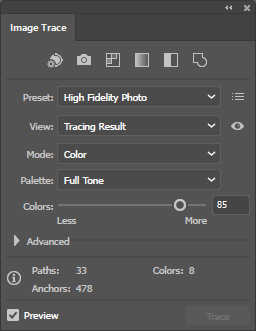
  1. First, if you do not already have an SVG-formatted file containing your logo, make sure to convert it from your .AI or .PNG format logo file using Adobe Illustrator. Fire up Illustrator, then open up your logo. If you already have your logo in Illustrator vector file (.ai extension), all you need to do is save your file in SVG format. If you only have a transparent .PNG file, you will need to open it first, then run Image Trace in order to convert the logo to vectors that you can later export. Go to “Window->Image Trace” to bring up the Image Trace panel:

    Illustrator Image Trace
    Select “High Fidelity Photo” for the best quality vector conversion, then uncheck “Preview” and click “Trace” to start the process.

  2. After tracing is done, you will be able to view the tracing results from the top drop-down panel. Take a look at “Outlines” and make sure that your logo edges look good. If you are happy with the result, click the “Expand” button to convert the tracing object into paths.
  3. Now your logo is converted to vector paths! If you select the Direct Selection Tool (A), you will be able to select the different vector paths, as shown below:

    Illustrator Converted Vectors
    As you can see, I was able to select the “.com” part of the logo – those blue dots indicate different vector paths.

  4. The last step in Illustrator is to get rid of the potential borders of the image that got added as a result of the image trace. Simply click on the blue edges as shown below, then press the “Delete” key to get rid of them:

    Illustrator Delete Outer Borders
    Also, go through any of the areas that need to be removed for transparency – if you have letters such as “o”, you will need to clean those middle areas up, so that the vector paths only cover the actual edges of the letters and not their insides.

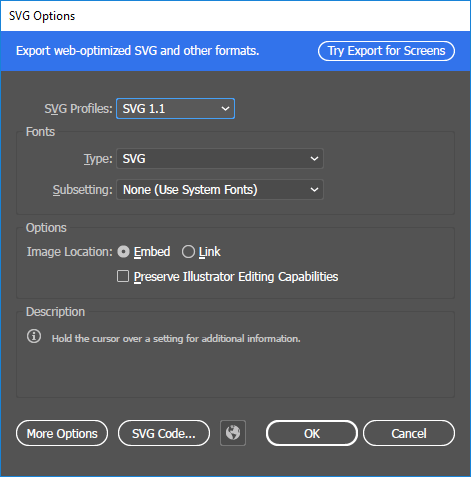
  5. From here, all we need to do is save the image to SVG format. Go to “File->Save As”, then click the drop-down menu where it says “Save as type” and pick SVG (*.SVG). Give your file a name like “Logo.SVG” and click “Save”. A window will pop-up that looks like this:

    SVG Save Options
    Just choose the defaults and click OK. The vector file is ready to be imported into a font creation tool. You can now close out of Adobe Illustrator.

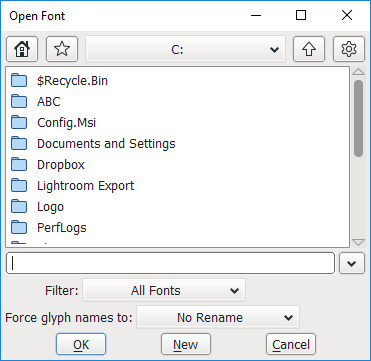
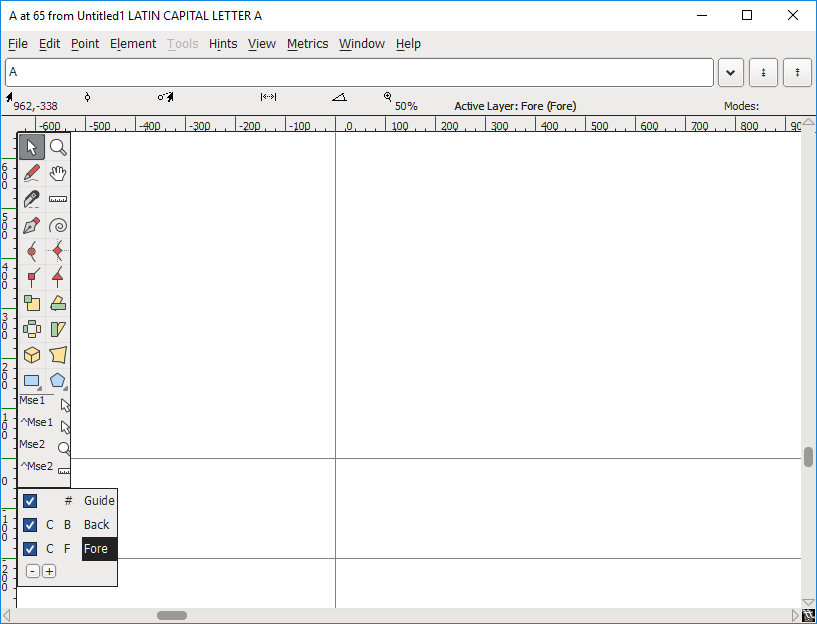
  6. Download and install the open source font creation tool called FontForge from here. Fire up the software, then when the first window comes up, click the “New” button on the bottom to create a new font:

    FontForge New
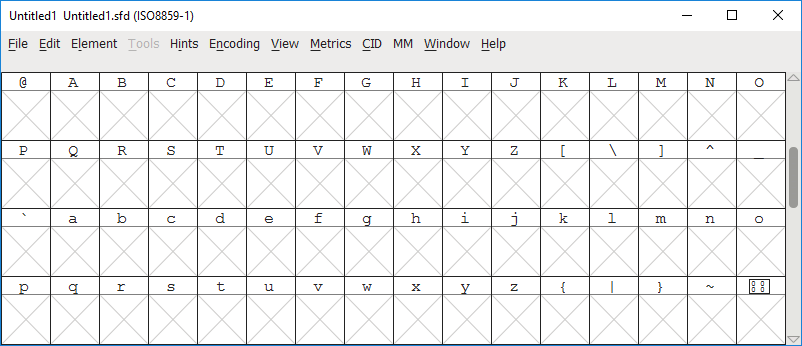
    You will see a new window that looks like this:

    FontForge Main Screen

    If you have never used FontForge before, the software can look a bit complex to use. However, we only need to perform a couple of tasks here – mainly import the SVG file into one of the characters, then generate a TTF file.

  7. Put the logo into one of the characters – simply double click any of them. I went ahead and picked capital letter “A”. You will see another window pop-up that looks like this:

    FontForge Character Screen

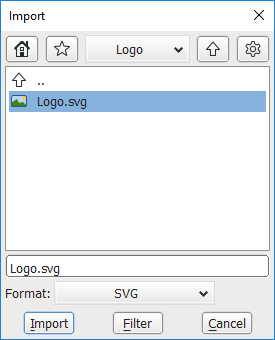
    Go to “File->Import”, then click on the “Format” drop-down and choose “SVG”. Double-click on the “Logo.SVG” file you previously created from Illustrator:

    FontForge Import SVG
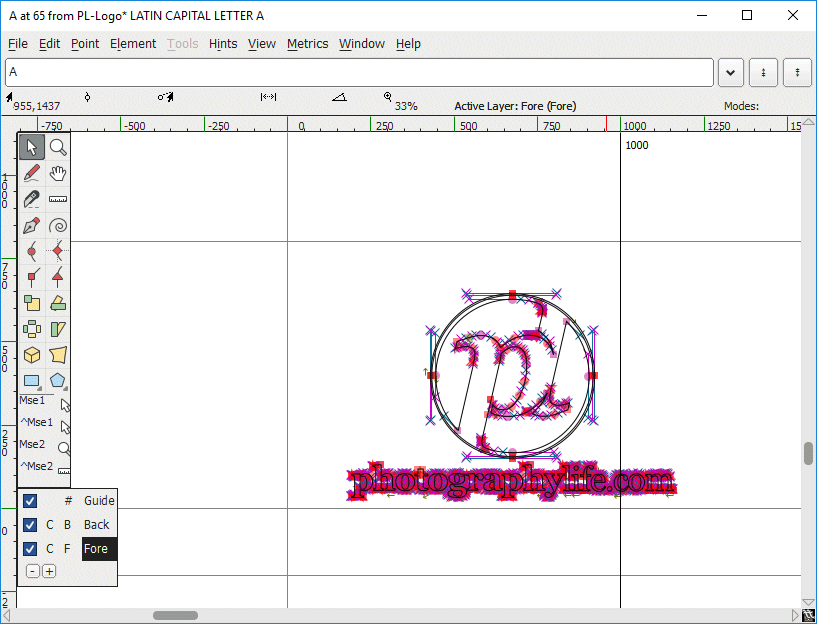
    You will now see the vector paths appear in the main window, as shown below:

    FontForge SVG Imported

    Everything looks good, so you can go ahead and close out of this window to return to the main window.

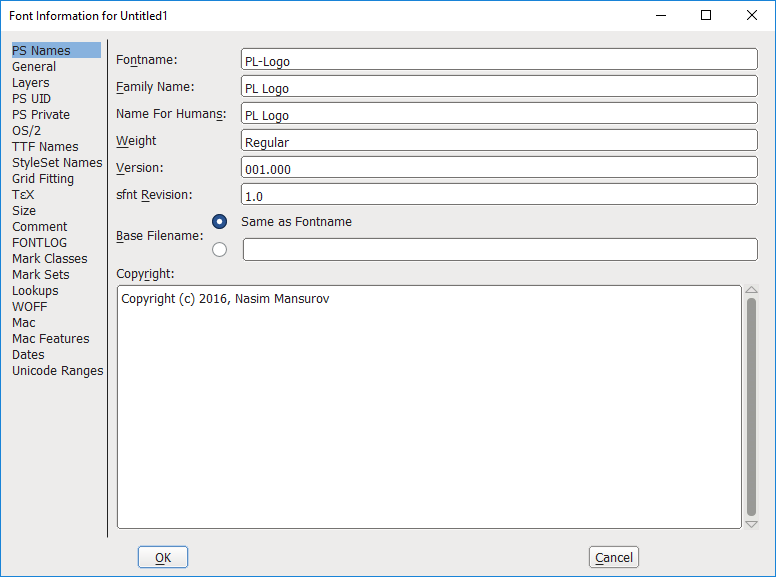
  8. If you click on any other cell, you should now see that the character you previously chose now contains your logo, which is exactly what we want! From here, we now need to give the font description and name and save it. Go to “Element->Font Info” (CTRL+SHIFT+F) and type the necessary information such as Fontname, Family Name, etc:

    FontForge Font Information

    I chose “PL-Logo” for the “Fontname” field and “PL Logo” for “Family Name” and “Name for Humans” fields. You can name your font anything you want – just don’t use any special characters or a space in the “Fontname” field. Once done, click the “OK” button on the bottom of the window.

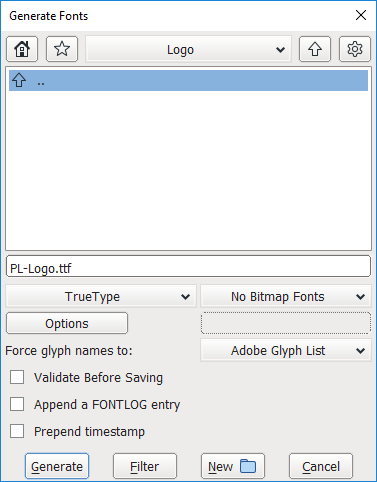
  9. We are done with font logo creation! Now let’s go ahead and save this font in TTF format. Go to “File->Generate Fonts” (CTRL+SHIFT+G), type the name of the font file name, then pick “TrueType” from the drop-down menu:

    FontForge Generate Font
    Go ahead and click “Generate” to generate the TTF file.

  10. The font file is now created, so let’s go ahead and get it installed in the operating system. In Windows, all you have to do is right-click the TTF file and click “Install” to get the font installed. If you are a Mac user, you can double click the font file to open up fontbook. From there, just click on “install font” on the bottom of the preview to get the font installed.
  11. The font is now installed in your operating system, but Lightroom does not know about it. Make sure to close out of Lightroom and reopen it.
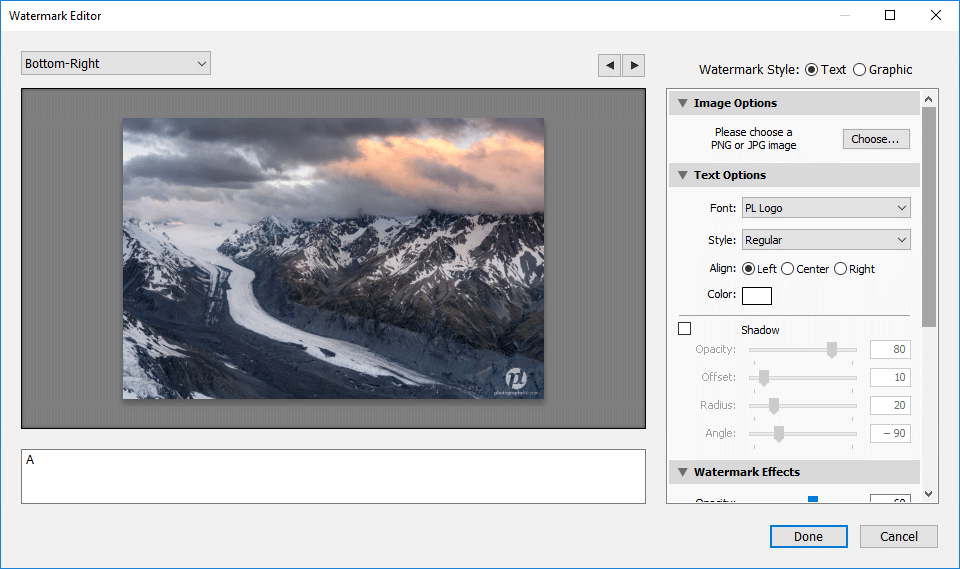
  12. After Lightroom relaunches, go to “Edit->Edit Watermarks”. Choose “Text” as the Watermark Style, then click on the “Font” drop-down area and find the font that you have previously installed. For me, it was “PL Logo”. After you pick the phone, type the character in the bottom-left field that stores your logo. In my case, I saved the logo under capital “A”, which is exactly what I typed:

    Watermark Editor Logo Font
    Make sure you de-select “Shadow”, so that shadows are not added to your logo. The cool thing is, now if you wanted to, you could make your logo in any color, including black and white – just select the appropriate color and you will be good to go. Since it is a font, it will always work with any color 🙂

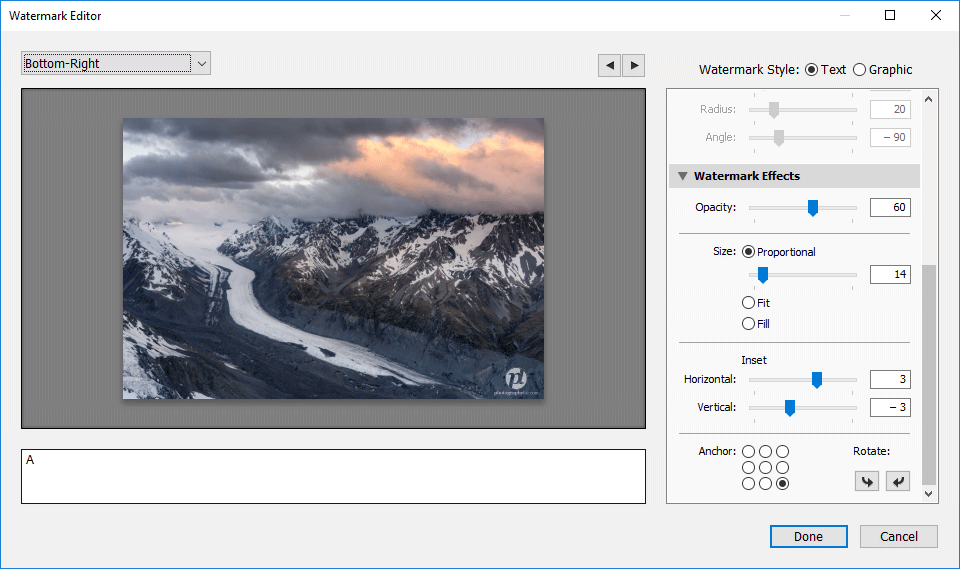
  13. Just like with any other font, you will be able to indicate Opacity, Inset and Anchor locations. Don’t forget that the font size is set through the “Proportional” Size. In my case, I had to set it to 14 to make it about the same size as with a PNG file:

    Watermark Editor Watermark Effects

    Just like it is explained in my How to Watermark Photos in Lightroom article, go ahead and create templates for each corner of the frame.

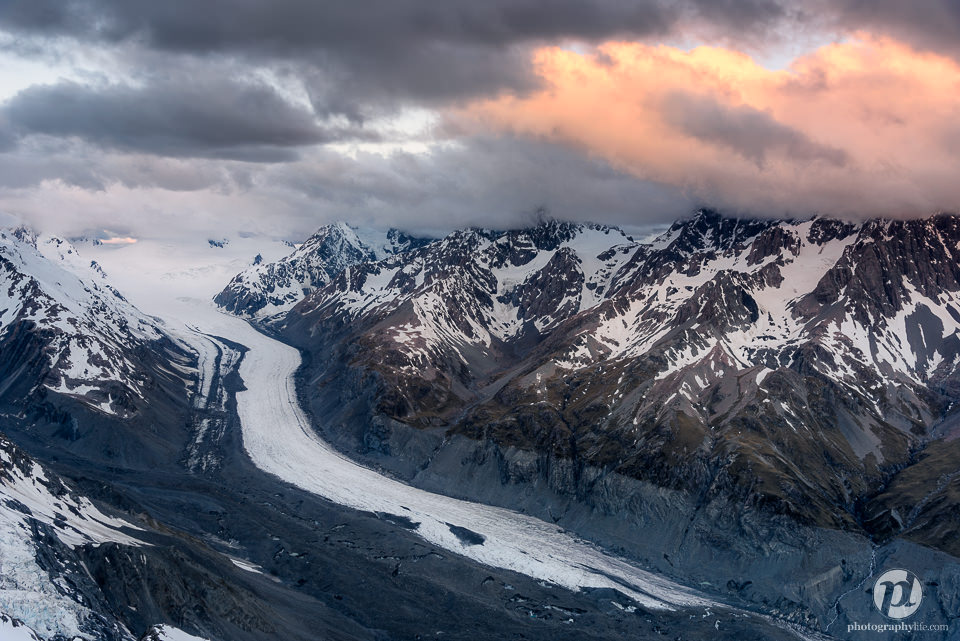
Here is how the watermark looks when using the above settings:

Watermarked Image with Font Logo

Watermark added using logo embedded into a TrueType font.

Not bad – much better than what Lightroom did to the watermark when it down-sized it via a PNG file!

From now on, you will be able to create watermarks of any size on any part of the image, whether it is a horizontal or a vertical image, which is really neat! Now that you have the font with your logo on it, you can also use it in Photoshop or any other application – it will always be available for your use, even in documents. Just keep in mind that other people won’t be able to view your documents with your logo, unless they get the TTF file from you and get it installed on their computer.

Hope this article was useful – let me know if you have any questions or feedback in the comments section below!

The post How to Make Sharp Watermarks in Lightroom appeared first on Photography Life.

Photography Life

Posted in Photograpy How To | Tagged , , | Leave a comment

The Best Lighting Modifier That No One Knows About

It’s not very often anymore, where I look at a photo and think “How did they do that?”. That’s not a comment to boast or bolster, cause more often than not, I miss that feeling of wonderment – I’ve just been doing photography for a long time, and have figured a lot of the tips and tricks over the years. However, a year or so ago, I saw the work of photographers like Dan Winters and Nadav Kander and had that remarkable sense of curiosity with their work. Lighting wise, it’s among the most intricate I’ve seen in a long time, so I excitingly began taking it apart, and figuring out how they made their light so controlled and tight.

Profoto Spot Small Example

Photo by Zach Sutton. Retouching by Jennifer Mcintyre

And their work is just two examples of this. For the last 12 months, the photography has been faced with a style change (and thank the heavens). No longer are people interested in the big parabolics shining graceful, even light on a 20 ft scene, lighting everything with a straightforward and elegant cloud of soft light. Instead, precision is finally making its comeback. People are more intrigued with how to shape light, and slowly, the focus has shifted to shadows instead of highlights.

Studying this work, I’ve come to some brash conclusions of flags, snoots and grids being the answer to the how – and have had some pretty good results using the techniques. But there is another way – The Profoto Spot Small.

What is the Profoto Spot Small?

If you’ve followed me on social media over the last two months, you’ll know my obsession with this newly discovered tool. The Profoto Spot Small is a …well… a complicated piece of gear – far more complex than it may seem on paper. From my understanding, it’s a piece of frosted glass, followed by a gobo system, followed by a convex projector lens on a slide – allowing for zooming and focusing. But what it does, is allows you to hyper-control your lighting through the use of gobos. Allowing you to cut light like a samurai, and shape it like an expert in ceramics.

If you’ve ever tried to strictly shape light, you may have noticed how difficult it can be to do with precision. All traditional lighting modifiers have a little feathering to the light, making it difficult to do refined shaping, and even systems like grids and snoots and make the light too big to control. The Profoto Spot Small makes the task easy, allowing you to use a modeling light, and adjust the light as needed.

Profoto Spot Small Los Angeles Photography

Photo by Zach Sutton. Using the Profoto Spot small

And the build quality is incredible. Made of metal, the Profoto Spot Small can handle both Pro Packs, and the OCF series of tools made by Profoto – meaning that any Profoto light will attach to it and work without any problems. However, keep in mind, that non-LED modeling lights will heat the unit up, and leave you with a nice Profoto brand if you’re not careful.

Additionally, LED video lights from brands such as Fiilex also connect to the Profoto Spot Small, giving you incredible light control for both video and photography.

Potential is Limitless

Perhaps the biggest aspect of the Spot Small is that it’s not the one trick pony you might think of it as. Gobos come in thousands of shapes and sizes and are incredibly affordable (as lighting modifiers go). Additionally, I’ve also taken some black posterboard of my own and made my simple gobos as needed – though I’d only recommend this if you’re using LED based modeling lamps. Through the seemingly infinite scrolling of the Roscoe catalog, millions of pieces of inspiration can be found – all of which can work with the Profoto Spot Small.

Photo by Zach Sutton. Using the Profoto Spot Small

Furthermore, the system itself is small, meaning you’re able to add gels to the mix with ease (again, only really recommend this with LED based lights (Profoto B1 & Profoto B2)). Using gel systems along with the Profoto Spot Small, you’re able to hyper-control not only where your light falls, but the colors as well.

The push-pull focus mechanism on the front allows you to decide if and how much of the Gobo design you want in focus. Allowing you to actually feather hard lights and sharp lines, the design gives you a wealth of additional uses by simply focusing in and out on your subject until you achieve the light you’d like.

Promotional Image from Amazon’s The Man In The High Castle. © Amazon

Don’t have a Profoto light? That’s not a problem. The system itself has a detachable speedring, allowing you to set it up on any mounting system you’d like. To prove this, I took a friend’s Alien Bee, and within a few minutes, and a small wrench, I had the system up and running.

Gobos

I did also want to touch base on gobos, specifically for the Profoto Spot Small. For $ 300 extra dollars, you can order the Profoto Gobo set. It includes 12 different Gobos to use for the Profoto Spot Small. And while the window shaped gobos are nice, I generally can’t recommend these for purchase. Roscoe has gobos available on their website for about $ 15 a piece and will let you choose from thousands of different designs to hand select your kit. Additionally, if you are using an LED-based lighting system like the Profoto B1 or Profoto B2, you can also just make simple gobo sets using an Exacto knife, and a little patience. In fact, my handmade gobos are what I use 95% of the time, and prefer sharp lines and cuts over star and heart shapes which are what you’d find in the Gobo kit.

The Downside

If you’ve made it this far in my love letter to the Profoto Spot Small, you’ve likely thought “There has to be a villain in this fairy tale”; and there is. The Profoto Spot Small isn’t cheap. At $ 1,000, the Profoto Spot Small is a pretty hefty price for a light modifier. Though with the price comes a one of a kind tool that allows you to shape and control your light with pinpoint precision easily. And the reality is it’s actually a two of a kind tool – with it’s bigger brother – the Profoto ZoomSpot – priced at ten times the cost of the Spot Small.

Conclusion

In the two months that I’ve owned the Profoto Spot Small, it has become my favorite tool for shaping light. I find myself looking for excuses to try it on my subjects – even if it’s a shoot where that lighting style isn’t required. I also find myself experimenting, and excited about lighting again – a feeling I haven’t had in a good while now. The Profoto Spot Small might not be for everyone – even the pricing puts it out of the range for many photographers. But if you’re also excited about this trend of tight lighting, and want to find a tool that changes the way you light, look no further than the Profoto Spot Small.

Profoto Spot Small
Incredible Precision in a Unique Lighting ToolMetal Construction – Built Like a TankEndless Possibilities with Gobos
Premium Price TagProfoto Gobo Kit is Overpriced
9.3Excellent
Build Quality10
Ease of Use9.8
Performance of Core Features9.5
Price Point7.5
Overall Appeal9.7
Reader Rating 0 Votes

0.0

Resource Magazine
Posted in Photograpy How To | Tagged , , , , | Leave a comment