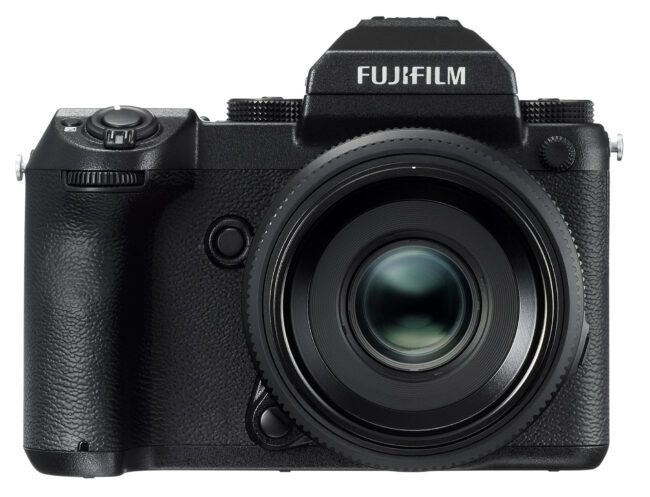
Without a doubt, the announcement of the medium format Fujifilm GFX 50S and its revealed price of $ 6,500 has sent a shockwave across many different photography communities across the world, sparking many discussions and debates about the future of the camera industry. We now have a medium format mirrorless camera that is lighter and more compact than a typical full-frame DSLR, with a price point of a top-of-the-line DSLR like the Nikon D5. Significantly cheaper than any other digital medium format camera on the market today and less expensive than the recently-announced Hasselblad X1D-50c, or even the discounted Pentax 645Z. This is a groundbreaking and brave move on behalf of Fuji, which jumped directly to medium format from its current APS-C X-series cameras, completely skipping over full-frame. In this article, I would like to go over some information on why it may or may not make sense to invest in the Fuji GFX 50S for photographers who have been shooting with Fuji X-series or other full-frame cameras.
1) Sensor Size
When it comes to camera sensors, we have come to expect to see one typical size when defining a full-frame sensor. For example, we know that every full-frame camera on the market has a sensor size of approximately 36 x 24mm and an aspect ratio of 3:2. However, when dealing with smaller APS-C sensors, we know that they can vary in sizes, with crop factor ranging from 1.52x to 1.7x and sensor sizes stretching from 20.7 x 13.8mm all the way to 24 x 16mm, depending on manufacturer or even a particular camera model. Well, the same thing applies to medium format. Basically, anything larger than a full-frame / 35mm sensor and smaller than large format (4 x 5 inches, or 102 x 127mm) is considered to be medium format.
In the case of the Fujifilm GFX 50S and other medium format cameras with a similar sensor size, such as the Hasselblad X1D-50c and the Pentax 645Z, the sensor area measures approximately 43.8 x 32.9mm, as shown in the below illustration comparing different sensor sizes:
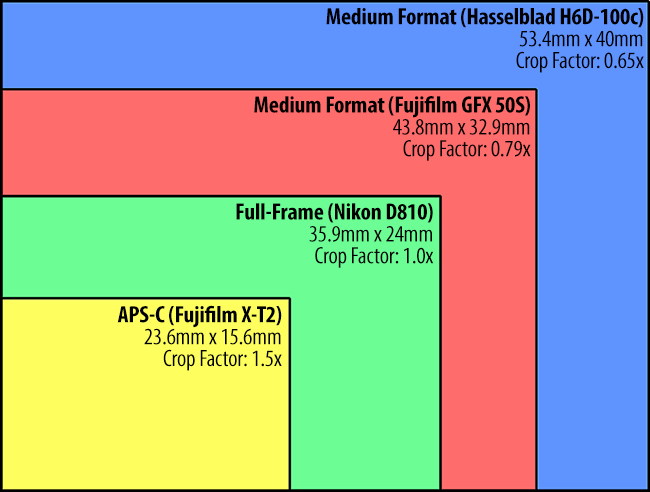
As you can see, we have two different kinds of medium format sensors available today. One that is used on high-end and expensive medium format cameras like the Hasselblad H6D-100c (with a hefty price tag of $ 33K), and one that is used on cameras like the GFX 50S. And the size differences between these sensors is pretty drastic, especially once we start comparing them to full-frame. So, in a way, these are “mini” versions of medium format sensors, or as one of our readers described it, it is a “macro four thirds” sensor (makes sense, since the aspect ratio is also 4:3). Now if we put things in perspective, the gain from an APS-C size sensor to a full-frame sensor is pretty drastic – we are talking about a 2.34x increase in sensor area. This obviously does translate to visibly higher overall image quality when comparing APS-C and full-frame sensors. And if we look at the difference between an APS-C sensor and the GFX 50S, the gains are huge – almost a 4x difference in sensor area. Hence, for a current Fuji X-series shooter, moving up to medium format would provide a massive difference in image quality and resolution.
However, if we take a closer look at size differences between full-frame and the medium format sensor on the Fuji GFX 50S, we only see a gain of 1.67x in total sensor area. At the same time, if we were to look at the medium format sensor from the Hasselblad H6D-100c, that gain would be much larger in comparison at 2.47x – similar to a jump from APS-C to full-frame. One could certainly argue that the jump from a full-frame camera to the Fuji GFX 50S would not be worth it, as the 1.67x gain in sensor size seems inadequate compared to a much larger 2x+ hike in price when comparing something like the Nikon D810 to the GFX 50S. It seems like the next step up from full-frame should be the full size digital medium format sensor. But at $ 33K and higher prices for a 53.4 x 40mm medium format camera, we would be looking at a 12x+ increase in cost! Why is that? Well, that’s because making those full size medium format sensors is expensive. Such large sensors are considered to be niche products and hence, the cost of manufacturing, marketing and selling is very high when compared to mass-market products. Thanks to Pentax, which was the first to take medium format below the $ 10K price range for a larger market appeal, we now have options…
2) Weight + Size Advantages and Newer Technologies
So why would anyone invest in a smaller medium format sensor that will only have a 1.67x advantage in sensor size, which theoretically won’t even result in one full stop advantage? For most photographers, such a jump would not make much sense. Still, for those of us who want to move beyond full-frame in terms of image quality and take our work to the next level, that 2x increase in price vs a 1.67x larger sensor size is worth it. Add the benefits of the newer mirrorless technology in the form of an electronic viewfinder (EVF), ability to review and zoom into images through the EVF in bright daylight conditions, on-sensor focusing that eliminates the need to AF micro-adjust lenses, ability to adapt older medium format lenses, etc – i.e. things we cannot normally achieve on our DSLR cameras, one would realize that the benefits of moving up to medium format mirrorless would extend far beyond the growth in sensor size. And once you factor in the size and the weight advantages of the Fuji GFX 50S over a pro-level full-frame DSLR, it starts to make even more sense. I loved the images I was able to get out of the Pentax 645Z (see my detailed Pentax 645Z review), but the weight and the bulk of the camera were a huge penalty I was not willing to take, especially when traveling. With the GFX 50S, I would not have those concerns.
3) Lens Selection, Quality, Size and Weight Considerations
As of today, Fuji has announced a total of 3 lenses: GF 32-64mm f/4 R LM WR, GF 63mm f/2.8 R WR and GF 120mm f/4 Macro R LM OIS WR and three more prime lenses in the shape of 23mm f/4, 45mm f/2.8 and 110mm f/2 are supposed to be announced later this year. That’s a nice line-up of 18mm, 35mm, 50mm, 25-51mm, 87mm and 95mm full-frame equivalent lenses. That’s a pretty big commitment on behalf of Fuji on a new mount and it shows that the company has been planning for the GFX 50S for a while now. With these lenses, the GFX 50S will appeal to many different types of photographers and I am sure Fuji will consider releasing ultra-fast lenses for specific needs such as portrait photography in the future. Given the history of the X mount, I have no doubt that the G mount lenses will not disappoint. In fact, if one looks at the current APS-C mirrorless cameras on the market, Fuji is definitely on the top when it comes to quality of lenses and I am sure the top management of the company wants to keep it that way for both mounts.
Thanks to the short flange distance of the G mount, it will be possible to adapt pretty much any medium or large format lens in the future. Starting from the launch, Fuji will already be providing an H mount adapter in order to be able to use any Hasselblad HC / Fujinon H lenses on the GFX 50S. While the lenses will not be able to autofocus, that should not be a problem, as one will be able to use the viewfinder in order to be able to zoom in on the subject and perfectly nail the focus. This is a pretty big advantage to anyone who currently owns Hasselblad lenses, as they will be able to instantly use these lenses with the adapter. And with time, I am sure we will see adapters for all kinds of medium and large format mounts.
For macro, product and landscape photography needs, Fuji will also be selling a view camera adapter, which will make it possible to mount the camera on bellows. While it might sound like overkill for some, having access to a bellow setup at launch is a huge advantage, as one does not have to stop down significantly in order to get the whole scene or subject in focus.
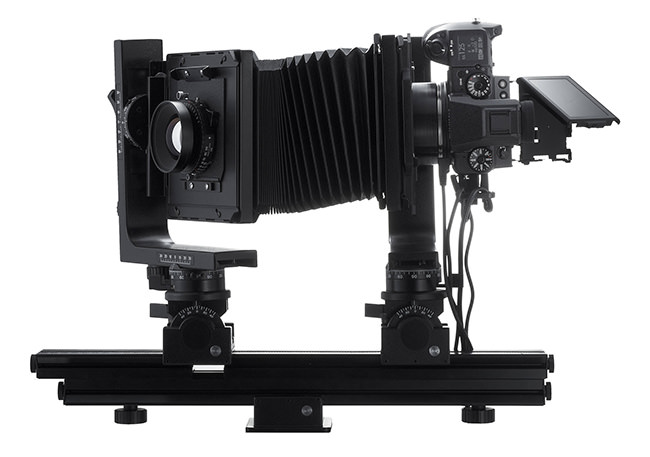
I am not sure if Fuji is planning to release any tilt-shift lenses for the G mount in the future, but I would personally welcome tilt-shift lenses for my landscape photography needs, as they are much easier and quicker to use compared to a full bellow setup.
It is true that the G mount lenses have to be designed bigger than their full-frame counterparts in order to accommodate a larger image circle of the medium format sensor. However, considering that Fuji is now making lenses specifically for this sensor size and not anything bigger, I do not foresee heavy, enormous lenses in the future. For example, Fuji’s new GF 32-64mm f/4 WR lens (25-51mm full-frame equivalent) is not a heavy monster when compared to full-frame lenses. At 875 grams, it is lighter than the Nikon 24-70mm f/2.8G and it has a shorter barrel, although it obviously does not cover the same focal length range. I am sure Fuji will keep weight and size considerations in mind when designing future lenses for the GFX 50S.
4) Resolution Potential
Now in terms of resolution potential of the Fuji GFX 50S, let’s take a quick look at something important – pixel size. With a resolution of 8256 x 6192 and sensor width of 43.8mm, we can easily calculate the pixel size of the sensor (see my article on Camera Resolution for details): 43.8mm / 8256 = 5.3µm. Interestingly, the Nikon D810 with a 36.3 MP sensor has a pixel size of 4.87µm, whereas the Nikon D750 with a 24.3 MP sensor has a pixel size of 5.96µm. Purely based on the performance of these cameras and without factoring in other criteria such as sensor age, differences in processing, etc., we can estimate that the GFX 50S will perform a bit better than the D810 at pixel level, whereas being potentially inferior to the D750. We can also estimate the future potential of the GFX cameras if we look at some higher resolution full-frame cameras of today. For example, if Fuji releases the next-generation GFX camera with the same 4.14µm pixel size as the Canon 5DS R, we would end up with an 83.8 MP camera – a pretty noticeable jump from 51.4 MP.
5) Firmware Updates
Fuji has an excellent track record when it comes to firmware updates. In fact, the company believes in providing value to its customers, even after their products are refreshed with the newer models. I do not know of any other camera company that provides such commitment and exceptional service on a continuous basis. That’s how we were able to get all the amazing firmware updates to older cameras like the Fuji X-Pro1, X100, X-T1 and many others – Fuji engineers continuously provided updates to the latest and greatest, constantly tweaking and updating their cameras to provide the best overall performance. Because of this, I am convinced that the Fuji GFX 50S will be a success. So far, the initial feedback from those who had a chance to test out the pre-production models of the cameras is very positive and even though we will most likely find initial bugs and issues at launch, I know that Fuji won’t leave its customers behind and work on addressing those issues as soon as possible. Fuji has demonstrated their commitment in the past and I know that we can trust the company to do the same going forward. I do not anticipate Fuji to address a serious flaw of a camera by ignoring a problem completely or releasing another model, like Nikon, Canon and others have done in the past…
Overall, I personally see a lot of potential in the GFX 50S and what is to come in the next few years from Fuji for the G mount. I have already placed a pre-order for the Fuji GFX 50S, the GF 32-65m f/4 WR lens and an additional NP-T125 battery and I am planning to use the GFX 50S as my main camera. If it proves to be more versatile than my Nikon D810 in the long run, I will be fully transitioning to the GFX 50S for my landscape photography needs. For everything else, I will keep on shooting with my Nikon gear, as it is a complete system and it will take years for Fuji to catch up in terms of lens and accessory selection. I hope that both Canon and Nikon wake up from their deep sleep and give us more exciting products later this year. With the 100th year anniversary coming up later this year, the hopes are high!
The post Fujifilm GFX 50S Considerations appeared first on Photography Life.
Photography Life