Nikon 105mm f/1.4E Review

Ever since it was introduced back in 1993, the DC Nikkor 105mm f/2 DC has been a classic – it was one of the most favored lenses for film portrait photographers and when digital came about, many photographers continued using the stellar lens to create stunning portraits. It took Nikon 23 years to bring out an update in the form of the Nikon AF-S NIKKOR 105mm f/1.4E ED – a drastically different lens in every way. Although Nikon decided to eliminate the de-focus control feature on the new 105mm, the biggest change is in fact the maximum aperture: at f/1.4, it is a much brighter lens compared to its predecessor. A full stop brighter, which is a huge difference for a portrait lens of this class. With this update, Nikon claimed another “world’s first” title, since no other manufacturer has ever been able to make a 105mm telephoto lens with such a wide aperture. In this review, I will detail my personal experience with the new Nikon 105mm f/1.4E lens and compare it to its predecessor, the 105mm f/2 DC.
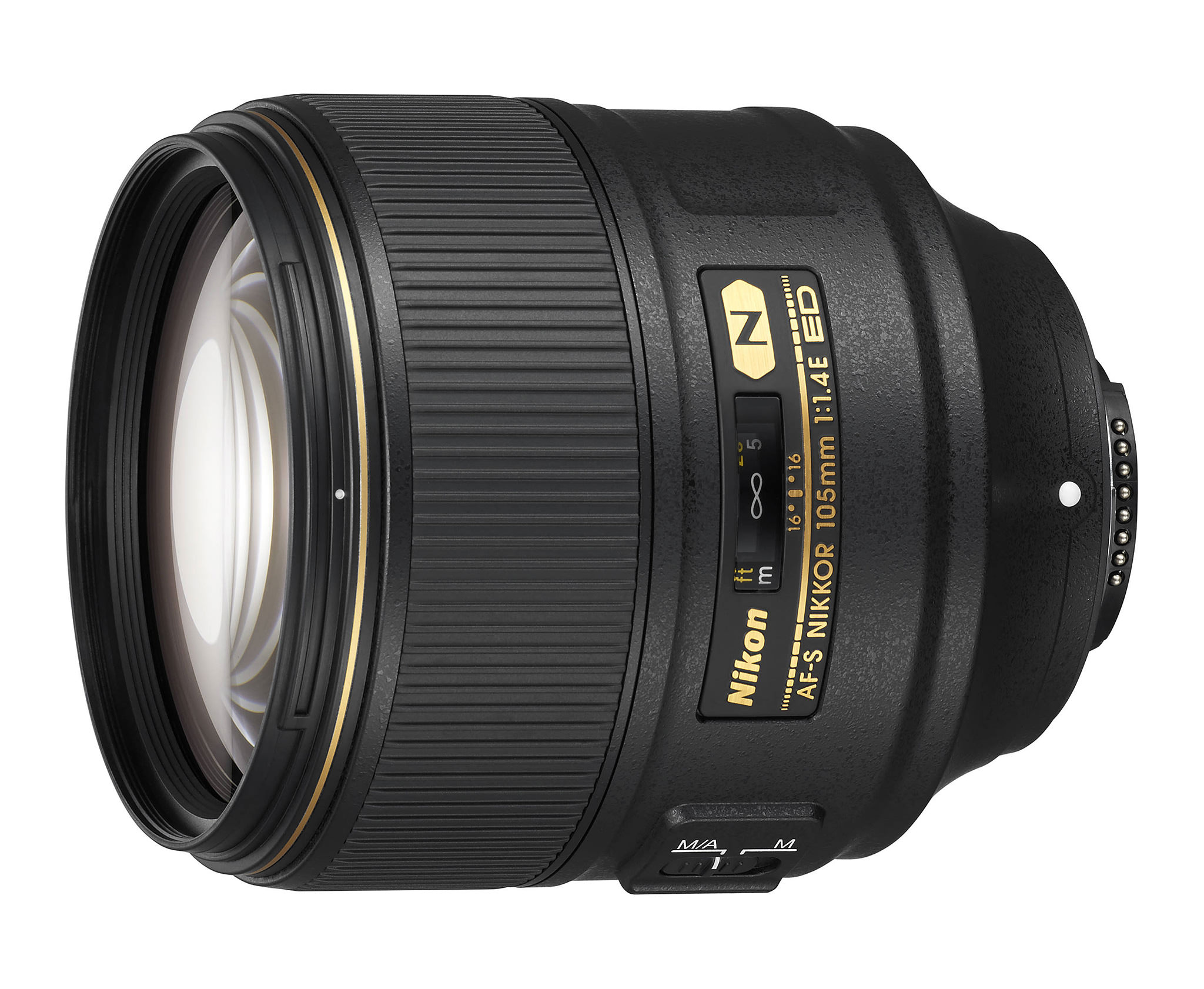
Nikon 105mm f/1.4E ED

Keep in mind that it is very challenging to optically design f/1.4 telephoto lenses without making lenses outrageously big and expensive. It took Nikon engineers quite a bit of effort to balance size, weight and cost to make the 105mm f/1.4E, so that it is not significantly bigger and heavier compared to its predecessor. The Nikon 200mm f/2G VR II is one heck of a lens, but it is a monster – at 3 kilos and a price tag of $ 5,699, it is a hard lens to justify for many portrait photographers. Nikon obviously beefed up the 105mm f/1.4E with all the new technologies, including an electronic diaphragm, Nano Crystal Coat, fluorine coating and a total of 3 extra-low dispersion (ED) lens elements to make it a very sharp lens. In order to achieve ultimate sharpness and contrast, Nikon had to more than double the number of optical elements used in the lens – the Nikon 105mm f/1.4E has a total of 14 elements in 9 groups, whereas the 105mm f/2 DC only had 6 elements in 6 groups. All that extra glass obviously resulted in a lot more weight, some of which Nikon was able to shave off by using a plastic barrel vs a metal barrel used on the 105mm f/2 DC. Still, even with a plastic barrel, the 105mm f/1.4E ended up being 345 grams heavier in comparison. The price has also seen a rather noticeable increase, with the new 105mm costing $ 1K more. A pretty noticeable change for sure.

Nikon 105mm f1.4E Image Sample (21)

NIKON D750 + 105mm f/1.4 @ 105mm, ISO 200, 1/3200, f/1.4

Let’s take a look at the lens in more detail.

1) Lens Specifications

Key Features:

  • World’s first full-frame 105mm with an f/1.4 maximum aperture
  • A marvel of optical precision, distortion correction and craftsmanship
  • Chromatic aberration, ghosting and flare is minimized by three Extra-Low Dispersion (ED) elements
  • Nano Crystal Coat (N) outperforms conventional antireflection coatings over a broad wavelength range for maximum contrast

Technical Specifications:

  • Focal Length: 105mm
  • Maximum Aperture: f/1.4
  • Minimum Aperture: f/16
  • Maximum Angle of View: 23°10′ (15°20′ with Nikon DX format)
  • Maximum Reproduction Ratio: 0.13x
  • Lens Construction: 14 elements in 9 groups
  • Number of Diaphragm Blades: 9 (rounded)
  • Nano Crystal Coat: Yes
  • ED Glass Elements: 3
  • Fluorine Coat: Yes
  • Autofocus: Yes
  • AF-S (Silent Wave Motor): Yes
  • Internal Focusing: Yes
  • Minimum Focus Distance: 1.0 m/3.3 ft.
  • Focus Mode: AF / Manual
  • Electromagnetic Diaphragm: Yes
  • Filter size: 82mm, screw-on
  • Approximate dimensions: 94.5mm x 106mm / 3.7in x 4.2in
  • Approximate weight: 985g / 34.8oz.
Nikon 105mm f1.4E Image Sample (3)

NIKON D810 + 105mm f/1.4 @ 105mm, ISO 100, 1/200, f/5.6

Detailed specifications for the lens, along with MTF charts and other useful data can be found on the Nikon AF-S NIKKOR 105mm f/1.4E ED page of our lens database.

2) Build Quality and Lens Handling

Despite its plastic shell, the Nikon 105mm f/1.4E is built very well, similarly to all other recent high-end Nikon prime lenses. Aside from a boatload of glass, there are plenty of metal components in the lens, as noted by our friend Roger Cicala in this article, where he took the time to disassemble the 105mm f/1.4E. Unlike the 105mm f/2 DC (which also has quite a bit of plastic on its barrel), the finish of the lens is quite smooth and covered with some texture for a solid grip. The focusing ring is very large, which is very useful, as it not only helps with the grip, but also allows for easy focus override using the thumb, index and middle fingers. Similar to other high-end primes, the lower section of the lens has the distance scale with a large “N” imprinted in gold to the right of it, indicating Nano Crystal coating. To the left of the distance scale there is a switch that allows switching from autofocus with manual focus override to manual focus. The back of the lens has “Nano Crystal Coat SWM ED IF”, which basically re-iterates the coating, then the Silent Wave Motor type (SWM), extra-low dispersion optical glass used in the lens (ED) and Internal Focus (IF).

Nikon 105mm f1.4E Image Sample (14)

NIKON D750 + 105mm f/1.4 @ 105mm, ISO 200, 1/2500, f/1.6

There is also a mark for an 82mm filter size. Speaking of which, the 105mm f/2 DC has a much smaller 72mm filter thread, so there is huge jump in filter size between the two lenses. In addition, there is also a pretty big difference in terms of the size and the location of the front element between the two lenses. The 105mm f/2 DC’s front element is buried deep inside the lens barrel and its size is fairly small when compared to the much larger front element on the 105mm f/1.4E, which sits pretty close to the edge of the barrel. When focusing, the front element of the 105mm f/2 DC does not move and you cannot see any movement from the front of the lens, since all the focusing takes place with the rear lens group, which is located past the diaphragm of the lens. In comparison, the Nikon 105mm f/1.4E seems to have its focusing group located closer to the front of the lens barrel. It is also worth noting that due to the electromagnetic diaphragm used on the new 105mm f/1.4E, there is no more aperture lever on the rear of the lens and by default the lens is going to be at its widest aperture. Both lenses are protected with a rear lens element, which is great, as it can play a pretty significant role in reducing potential dust and other debris from getting into the lens from the rear opening. Compared to the older 105mm f/2 DC, the 105mm f/1.4E also has a rubber gasket on its mount, which can help a great deal in reducing potential dust from collecting around the rear element of the lens or getting into the camera. Another difference is the lack of the aperture ring, which has been eliminated on all modern “G” type and “E” type Nikkor lenses.

Nikon 105mm f/2 DC vs Nikon 105mm f/1.4E vs Nikon 85mm f/1.4G

As can be seen from this image, the new Nikon 105mm f/1.4E (middle) is quite a bit thicker than both the 105mm f/2 DC (left) and the 85mm f/1.4G (right), although it is a little shorter in size compared to the 105mm f/2 DC

The home of manufacturing for the Nikon 105mm f/2 DC has always been Japan, but the new Nikkor 105mm f/1.4E clearly reads “Made in China” on the lens barrel. This can be disappointing news for those who are considering the 105mm f/1.4E and traditionally own Japanese-made lenses. To be honest, having tested various Nikon lenses made in Japan, Thailand and China, I have not seen much difference in quality between them. Nikon has pretty rigorous quality assurance standards in every manufacturing plant, no matter where it is located, so it should not be an issue. I have tested two 105mm f/1.4E lens samples and both of them seemed to have pretty similar performance overall, so the quality of manufacturing and assembly looks fairly consistent. In fact, I had to send the Japanese-made Nikon 70-200mm f/2.8E FL ED VR back while testing it and replace it with another copy, since the first sample was very inconsistent in terms of AF accuracy – even after dialing -15 in “AF Fine Tune” camera settings, I was not able to get good AF performance out of it. So in this particular case, a Chinese-made 105mm f/1.4E turned out to be better in terms of quality assurance compared to the 70-200mm f/2.8E VR, which is proudly made in Japan!

When it comes to lens hood, the Nikon 105mm f/1.4E comes with a plastic HB-79 bayonet lens hood, whereas the 105mm f/2 DC has a built-in metal hood that you can easily extend and mount by counter clock-wise rotation. Personally, I like the metal hood on the 105mm f/2 DC a bit better for its convenience and quality, since it is one less object to carry and mount in the field. It is also worth noting that since the 105mm f/2 DC’s front element is buried so deep inside the lens barrel, one rarely needs to worry about extending the lens hood, which is certainly an advantage when compared to the 105mm f/1.4E. Since it is expected to see ghosting and flare on long telephoto lenses, the 105mm f/1.4E should ideally have the lens hood attached when shooting in daylight conditions, as its front element will surely get a taste of sun rays due to its proximity to the front area of the lens barrel. While mounting the HB-79 lens hood on the 105mm f/1.4 is relatively easy, the plastic tends to bend when pushing the hood into its place, giving it a cheaper feel.

Nikon 105mm f1.4E Image Sample (4)

NIKON D810 + 105mm f/1.4 @ 105mm, ISO 100, 1/10, f/16.0

When handling both lenses, the 105mm f/2 DC is obviously more convenient to hand-hold, thanks to its thinner barrel and lighter construction. The 105mm f/1.4E is a noticeably heavier and bulkier lens in comparison, but not that much worse in terms of handling, since its large barrel nicely sits on the left hand and the zoom ring naturally aligns with the fingertips, allowing for quick AF override when needed.

Overall, the build quality and the handling of the 105mm f/1.4E are superb. Aside from the cheap feel of the bayonet lens hood, it feels like a high-quality lens that is built to last a lifetime.

3) Autofocus Performance

Before I talk about autofocus speed and accuracy, it is worth noting that the Silent Wave Motor used in the 105mm f/1.4E is of older, gear-based type instead of ring ultrasonic, as evidenced by Roger’s findings in the article linked above. While many found this news to be quite disappointing, I am personally not bothered with this, just like I am not bothered with recent lens releases that still have the old aperture lever on the back of the lens instead of the newer and more reliable electromagnetic diaphragm. One thing that certainly did bother me though, was the dishonesty about Nikon’s marketing about the SWM used in the 105mm f/1.4E, where they pointed out the advantage of the motor compared to “geared” motors. Thanks to Roger’s findings, Nikon quickly removed the wording and fixed the description on Nikon’s website, but still, it definitely did leave a bad taste in the mouth, didn’t it? Makes me wonder how many lenses that Nikon labels as “SWM” actually contain the ring ultrasonic mechanism…

Nikon 105mm f1.4E Image Sample (11)

NIKON D750 + 105mm f/1.4 @ 105mm, ISO 125, 1/250, f/1.4

Anyway, like I have already pointed out, I personally don’t care all that much for the type of AF motor used in the lens, as long as the motor is quick, silent and responsive. And it surely is on the 105mm f/1.4E – it feels no different compared to other primes I have used in the past. Unlike the “D” type lenses such as the 105mm f/2 DC, focusing is very quiet – all you hear is a little bit of “chirp” as the focus is adjusted. It does take a little bit of time to go from close distance to infinity and vice-versa, but that is expected, given that it is an f/1.4 lens with a much finer motor than found on older Nikkor lenses. Autofocus speed is quite fast and I found it to be good enough to photograph not only still portraits, but also moving subjects. Tracking fast, erratic movements can be a bit of a hit and miss depending on lighting conditions, but in very dim environments, I found the 105mm f/1.4E to focus better than both the Nikon 85mm f/1.4G and 85mm f/1.8G lenses. Similar to all other modern Nikkor lenses, the front element of the lens does not rotate when focus is adjusted.

Nikon 105mm f1.4E Image Sample (34)

NIKON D750 + 105mm f/1.4 @ 105mm, ISO 200, 1/2500, f/1.4

The finer motor definitely does a good job at delivering quite accurate focus. Keep in mind that there is a huge difference in depth of field between an f/2 and an f/1.4 lens. The full stop of advantage on behalf of the Nikon 105mm f/1.4E translates to paper-thin depth of field, which when put to use at very close distances can be very challenging in terms of nailing the focus. Both of the samples of the 105mm f/1.4E that I tested performed admirably in terms of AF accuracy and I did not have to dial any AF adjustments in the camera to nail focus, which is great. If your sample requires more than +- 10 adjustment, I would either send it back for a replacement, or send it to Nikon for re-calibration, since extreme AF values dialed through the camera never provide consistent, reliable autofocus. As you may already know, AF micro adjustments only work for a particular focusing distance, which can make it tough when switching from head and shoulders type portraits to a full body portrait. AF accuracy definitely goes down in poorly lit environments and you can expect the lens to behave very similarly to lenses like the Nikon 85mm f/1.4G.

Nikon 105mm f1.4E Image Sample (2)

NIKON D810 + 105mm f/1.4 @ 105mm, ISO 100, 4/10, f/5.6

4) Lens Sharpness and Contrast

With quite a complex lens construction comprised of a total of 14 elements, 3 of which are of “Extra-low Dispersion” (ED) type, one can tell that Nikon was aiming to produce a lens with a superb resolving power, capable of yielding extremely sharp results. Unlike the design of the Nikon 58mm f/1.4G, which was optimized more for its unique look and feel rather than sharpness, the 105mm f/1.4E is made to be extremely sharp at its widest aperture. That’s not to say that the lens does not produce beautiful depth like the 58mm f/1.4G does though! With this lens, the feel of depth is controlled more through the focal length of the lens and a very wide aperture, which already does a tremendous job at isolating subjects and making them “pop” from the scene. The Nikon 105mm f/1.4E was the first autofocus lens I held in my hands under $ 5K that combined extreme sharpness with soft, creamy and beautiful background rendering. The last time I saw such amazing sharpness combined with the special look was from the superb Nikon 200mm f/2 VR and if I were to explore manual focus lenses, a close contender would be the Zeiss 135mm f/2 Apo Sonnar, which is a class on its own.

I have owned the Nikon 85mm f/1.4G pretty much ever since it was released back in 2010 and while I love the way the lens is capable of rendering images wide open, it is nowhere close in sharpness to the 105mm f/1.4E – that’s how big the difference between the two is. Take a look at these images shot wide open, using the 105mm f/1.4E and 85mm f/1.4G lenses:

You can probably tell which one is which by looking at these two images. Since the field of view is vastly different, I had to step back with the 105mm f/1.4E a bit to have similar framing. As you can see, while the subject remains the same size in the frame, the rendering of the background is quite a bit different between the two, with the 105mm f/1.4E enlarging the background more, due to a much larger entrance pupil. And that’s one of the main reasons why one would want a longer focal length vs a shorter focal length lens, as the longer focal length allows the subject to be isolated more from the background and allows for a more intimate look, without any surrounding distracting elements. That’s why portrait photographers often prefer shooting on the long end of their 70-200mm lenses, since at 200mm they can separate their subject much more from the background than at 70mm.

But we were talking about sharpness, weren’t we? Let’s jump back to the above images, and this time, we will look at 100% crops from each image sample:

Nikon 105mm f/1.4E vs Nikon 85mm f1.4G Sharpness

Obviously, web-sized images cannot really show the extreme detail of images, unless they are presented in 100% as I have done above. With a fairly good amount of sharpening applied in Lightroom to both images (just a rough 50/1.0/50 setting), you can see just how different the two look in terms of sharpness – the 105mm f/1.4E is vastly superior compared to the 85mm f/1.4G. To make sure that I did not miss focus, I asked the model not to move, while I switched to live view, zoomed in to 100% and focused on the model’s eyes before taking each shot. So even if you can nail focus on the 85mm f/1.4G, that’s the best you can get wide open with that lens. Some people might argue that they prefer to have a softer image from the 85mm f/1.4G, because it hides the skin features one might not want to see, but I disagree. If one desires to hide skin features, it easy to do so in post, provided all the details are there. However, if one wants to make a soft image sharper, it is impossible to extract more detail out of those images, because that information simply does not exist…

To make the comparisons more scientific, I went ahead and put the lens in my lab and measured its MTF performance using Imatest. Here are the results:

Nikon 105mm f/1.4E MTF Performance

To appreciate just how amazing the above numbers look, take a look at some of the comparison charts below, where I put the data from the 105mm f/1.4E against the 105mm f/2 DC and 85mm f/1.4G. In short, this lens is one of the sharpest ones I have ever tested. Its wide open performance is stellar and once stopped down to f/2.8, you get insane amount of detail that you typically cannot get from most other Nikon primes. The Nikon 105mm f/1.4E’s center performance matches the performance of the superb Zeiss Otus 55mm f/1.4 and even surpasses it in the edges! The 55mm Otus is still a reigning champion when it comes to overall performance though, thanks to practically non-existent chromatic aberration, less vignetting and less distortion, but still, the 105mm f/1.4E is an absolutely amazing gem of a lens.

Nikon 105mm f1.4E Image Sample (5)

NIKON D810 + 105mm f/1.4 @ 105mm, ISO 200, 1/500, f/8.0

One thing to note, like many other primes, the lens does exhibit some field curvature. It is not bad by any means, but because of it, shooting a test target at large apertures would yield strong center performance at the expense of the corners. Obviously, the effect of field curvature is greatly diminished when stopping down, which is why the mid-frame and the corner performance figures above increase significantly as I stopped down. However, it also means that if you were to focus outside the center area of the frame, say towards the edges of the frame where your subject might be at, the sharpness might look drastically different than the presented chart above – it is likely to look much better! So don’t let the above chart lead you into thinking that this lens does not resolve enough details towards the edges at wide apertures, it certainly does.

The Nikon 105mm f/1.4E is so sharp wide open, that I would not hesitate to shoot it at its maximum aperture all the time when shooting portraits. Only stop it down when you need to increase depth of field, or if it is too bright out and you are maxing out on your camera’s shutter speed.

To give you an idea of what kind of sharpness you can expect from maximum aperture when shooting a landscape at infinity, take a look at the below image:

Nikon 105mm f1.4E Image Sample (1)

NIKON D810 + 105mm f/1.4 @ 105mm, ISO 100, 1/5000, f/1.4

5) Nikon 105mm f/1.4E vs Nikon 105mm f/2 DC

Let’s go ahead and compare the sharpness of the 105mm f/1.4E to the Nikon 105mm f/2 DC lens:

Nikon 105mm f/1.4E MTF Performance

Nikon 105mm f/2D MTF Performance

As you can see, the difference is pretty drastic – the new 105mm f/1.4E is a significantly sharper lens when compared to the 105mm f/2 DC, whether you are shooting wide open or you are stopping down. The 105mm f/2 DC was never made to be an ultra-sharp lens, that’s certainly not the point of it. For portrait photography, it has enough details to make stunning images, and with the ability to control the look of both foregrounds and backgrounds (with the Defocus Control ring), one can yield images with different looks – something the 105mm f/1.4E cannot produce. However, with the huge difference in maximum aperture and a completely different resulting “look” in images (which I personally favor the 105mm f/1.4E for), I really do not see much point in reintroducing the DC feature in lenses anymore. While the ability to defocus the foreground or the background sounds good on paper, DC lenses can be painful to use in practice. First, one has to constantly re-focus each time the DC ring is adjusted. Second, the additional rotating element certainly makes autofocus a lot less reliable, since AF shifts when DC adjustments are used. The bad part about it, is that AF can shift for each DC value! And if one already has challenges with autofocus in DC neutral position, AF reliability and accuracy can quickly go down the drain, making focusing very challenging. Third, having to adjust both the DC ring and the aperture at the same time can be a hassle in the field, particularly when working fast – if one forgets and uses a larger DC value than the aperture, the lens can add a really nasty “soft glow” effect. Soft glow might have been somewhat popular in film days, but it just never looked good in digital. And lastly, most photographers I personally know who shoot with either the 105mm DC or the 135mm DC lenses rarely ever touch the DC ring, so it does not seem to be that desirable of a feature in the first place.

Nikon 105mm f1.4E Image Sample (20)

NIKON D750 + 105mm f/1.4 @ 105mm, ISO 200, 1/4000, f/1.4

So if you are trying to decide between the 105mm f/1.4E and the 105mm f/2 DC and you have no budget constraints, I would get the 105mm f/1.4E without even giving it a second thought. If budget is an issue, I would encourage you to try out both the 85mm f/1.4G and the 105mm f/2 DC to see which one you like better. Personally, I favor the 85mm f/1.4G over the 105mm f/2 DC primarily because its AF is more reliable, but if you crave for the unique look and feel of the 105mm f/2 DC and the sample you are looking at does not have serious AF issues, then by all means go for it – it is certainly a beautiful lens.

Nikon 105mm f1.4E Image Sample (33)

NIKON D810 + 105mm f/1.4 @ 105mm, ISO 64, 1/1000, f/1.4

6) Nikon 105mm f/1.4E vs Nikon 85mm f/1.4G

The next lens to compare the sharpness to is the Nikon 85mm f/1.4G, which I personally own and have been using for many years, with wonderful results. Let’s take a look at the Imatest numbers:

Nikon 105mm f/1.4E MTF Performance

Nikon 85mm f/1.4G MTF Performance

Once again, we can see why the 105mm f/1.4E is an optical marvel – at wide open apertures, it out-resolves the 85mm f/1.4G by a pretty noticeable margin. I have already shown you the visual difference in images earlier and it is something you will certainly see when comparing the two side-by-side. This difference becomes even more noticeable with both lenses stopped down. At f/2.8, the 105mm f/1.4E is insanely sharp, reaching resolution numbers that most other lenses cannot even reach when stopped down to f/5.6. Still, having been using the 85mm f/1.4G for such a long time, I rarely complained about its sharpness, since images are so dreamy to look at. Unless you shoot with a high resolution camera like the Nikon D810, the softer look of images at f/1.4 probably won’t bother you that much and if it does, you can always stop it down a little to get a bit more crispness out of the lens.

Nikon 105mm f1.4E Image Sample (22)

NIKON D750 + 105mm f/1.4 @ 105mm, ISO 200, 1/640, f/2.5

Another alternative is to explore the Sigma 85mm f/1.4 Art, which I personally have not tested yet, but heard of being a very sharp lens (make sure to test its AF right away though, as many seem to have had issues with its AF accuracy). Or if you are open to exploring another third party offering, the Tamron SP 85mm f/1.8 VC is another great candidate, with built-in image stabilization – something no other 85mm lens for the Nikon mount offers. If you want to save even more money and you don’t care for an f/1.4 look or Nano Coating, you might want to give the Nikon 85mm f/1.8G a try. It is smaller, lighter and it is a sharper lens wide open. It obviously does not have all the bells and whistles of pro-level lenses (inferior build, no Nano Coating, etc), but for a third of the price of the 85mm f/1.4G, it is a real bargain!

7) Bokeh

By now, you have already seen plenty of examples of how beautiful the lens is capable of rendering bokeh. Compared to other lenses I have used in the past, including the 85mm f/1.4G, I would say that the 105mm f/1.4E is probably one of my top picks for its ability to yield pleasant-looking background highlights, certainly in a way that can be described as “creamy” and “dreamy”.

Nikon 105mm f1.4E Image Sample (6)

NIKON D810 + 105mm f/1.4 @ 105mm, ISO 100, 1/8000, f/1.8

Nikon 105mm f1.4E Image Sample (16)

NIKON D750 + 105mm f/1.4 @ 105mm, ISO 200, 1/3200, f/1.6

Nikon 105mm f1.4E Image Sample (28)

NIKON D750 + 105mm f/1.4 @ 105mm, ISO 100, 1/1250, f/1.4

The bokeh highlights look really good, with no thick borders around the circular shapes or onion-shaped rings inside those shapes, which typically happen when aspherical lens elements are used (and this lens has none). What happens when you put three world-class portrait lenses and compare their bokeh? Take a look at the below crops from the 105mm f/1.4E to the 105mm f/2 DC and 85mm f/1.4G at f/2:

Nikon 105mm f/1.4E Bokeh Comparison

Well, there are no real surprises here – all lenses look stellar, producing very pleasing bokeh. I looked hard between the different areas of the frame and apertures and to be honest, I could not pinpoint one lens that did better than others. All three look about the same! However, it is worth noting that the wider f/1.4 aperture certainly does make a difference in the size of bokeh highlights and how the background is rendered, since it has a full stop advantage over f/2. Also, note that there are always going to be differences between lenses shot wide open vs stopped down. The bokeh highlights from the 105mm f/1.4E and 85mm f/1.4G do not appear fully circular, since the aperture blades start impacting them.

Now keep in mind that the lens will yield “cat’s eye” bokeh towards the edges of the frame and that’s very normal (every prime lens will do that), since the shape of the background highlights will change in shape due to optical vignetting (caused by variations in angles of light):

Nikon 105mm f1.4E Image Sample (30)

NIKON D750 + 105mm f/1.4 @ 105mm, ISO 100, 1/1250, f/1.4

In fact, if you place the subject in the center and you have background highlights surrounding your subject, you will find these elliptical shapes swirling around your subject, which can give that special, pleasing look to your images. It might not be as extreme as the swirling bokeh produced by Petzval lenses, but it is definitely there.

8) Vignetting

As expected with any fixed f/1.4 lens, there is a considerable amount of vignetting present when shooting wide open @ f/1.4. Imatest measured 2.67 EV of vignetting for close focus and 2.90 EV of vignetting when shooting at infinity, as can be seen from the below chart:

Nikon 105mm f/1.4E Vignetting

And here is the worst-case scenario represented visually via Imatest, with the image shot at f/1.4, infinity focus:

Nikon 105mm f/1.4E Vignetting at f/1.4 Infinity Focus

Now keep in mind that the vignetting characteristics of a lens are often part of the lens design. Vignetting can be beautiful and it can help draw the viewer’s eye towards the center of the subject. However, if you happen to place your subject towards the edges of the frame and you want to address the vignetting issues, it is very easy to do so using post-processing software like Lightroom, which is capable of taking care of those issues with a single click.

Personally, when shooting with portrait lenses like the 105mm f/1.4E, I rarely ever correct vignetting in post, since I find their vignetting characteristics to be beautiful.

Nikon 105mm f1.4E Image Sample (26)

NIKON D750 + 105mm f/1.4 @ 105mm, ISO 100, 1/1000, f/1.4

9) Ghosting, Flare and Chromatic Aberration

Thanks to the Nano Crystal Coat that is applied to the lens elements, the Nikon 105mm f/1.4E is able to handle ghosting and flare really well in most situations. However, due to the long focal length of the lens, one should take precaution when shooting without the lens hood – with very bright sources of light at particular angles of the frame, light rays can really impact images negatively, adding some ghosting and flare to images. It is not bad by any means though and Nano Coating certainly does perform really well when shooting with the sun in the frame, even if you happen to leave the lens hood behind. Take a look at the below two images, captured with the lens at f/1.4 and f/5.6 apertures, without the hood:

As you can see, if you shoot with the sun right behind your subject, ghosting and flare might show up in your images. The effect gets a bit more amplified as you stop down and that’s very normal. And as expected, there is a definite drop in contrast as well, which might actually look far worse if you have a lot of dust on the front element of the lens, since light particles get bounced all over the place.

I would recommend to keep the lens hood on at all times to prevent accidental flares from showing up in your images. Also, if you use a low quality filter, you might get some nasty flare even with the hood on when pointing at a bright light source, so make sure to use only high-quality multi-coated “MRC” filters from B+W, Hoya or Tiffen for digital cameras.

Nikon 105mm f1.4E Image Sample (10)

NIKON D750 + 105mm f/1.4 @ 105mm, ISO 110, 1/250, f/1.4

When it comes to lateral chromatic aberration, the Nikon 104mm f/1.4E demonstrated fair results, on par with both the Nikon 105mm f/2 DC and the Nikon 85mm f/1.4G at large apertures. Imatest measured chromatic aberration right under a pixel, which unfortunately did not get any better as I stopped down the lens. Longitudinal chromatic aberration (LoCA) can also be pretty pronounced in images, especially in high contrast situations. If you take a closer look at the above image of a Star Wars stormtrooper shot at f/1.4, you can see quite a bit of that purple and green fringing on the helmet and the hands, which is a typical case of pronounced LoCA.

Here is how Imatest measured lateral chromatic aberration at different apertures:

Nikon 105mm f/1.4E Chromatic Aberration

10) Distortion

Distortion-wise, the Nikon 105mm f/1.4E exhibits very little of it. Imatest measured 0.79% barrel distortion, which is a bit worse than both the Nikon 105mm f/2 DC (0.23% pincushion distortion) and the Nikon 85mm f/1.4G (0.38% pincushion distortion). Anything under 1% is nothing to worry about and you won’t even notice it in images. If you are shooting straight lines and the lines appear a little curved, you can easily fix it in post-processing software like Lightroom, which already has a built-in profile for the lens.

Nikon 105mm f1.4E Image Sample (24)

NIKON D750 + 105mm f/1.4 @ 105mm, ISO 100, 1/1250, f/1.4

11) Summary

For many years now, Nikon shooters have been patiently waiting to see an updated version of the Nikon 105mm f/2 DC classic and it has finally arrived. The refresh was delivered in the shape of the Nikon 105mm f/1.4E, which turned out to be a completely different beast in comparison, thanks to its much larger aperture and a total optical rehash with over twice the number of elements, (three of which are of extra-low dispersion type), Nano Crystal and fluorine coatings, and a much faster, more accurate and silent autofocus motor. All this obviously made the lens not only noticeably heavier and thicker than its predecessor, but also significantly more expensive.

Nikon 105mm f1.4E Image Sample (8)

NIKON D810 + 105mm f/1.4 @ 105mm, ISO 64, 1/8, f/8.0

Since last year, I have been fortunate to test a couple of different samples of the Nikon 105mm f/1.4E and after putting the lens through quite a bit of use, I am happy to report that it is one of the best Nikon primes I have reviewed so far in overall performance. As you have seen from this review, the lens is stunning not only in terms of sharpness and other optical characteristics, but also in terms of its rendering capabilities. Thanks to the magic that Nikon put into this marvel, the lens is able to produce aesthetically pleasing images that rival the look of some of the best portrait lenses in the world. Its ability to beautifully isolate subjects from the background with creamy bokeh, while capturing incredible amount of detail at maximum aperture will surely keep its reputation high for many years to come, and make it the ideal tool for portrait photography. Although the Nikon 105mm f/2 DC and the 135mm f/2 DC have been favored by many portrait photographers in the past, those who wanted more subject isolation or sharpness found themselves reaching out to such lenses as the Zeiss 135mm f/2 Apo Sonnar and the Nikon 200mm f/2. In my opinion, the new Nikon 105mm f/1.4E fills the gap very nicely and if Nikon continues actively developing fast telephoto prime lenses, we might see another “world’s first” 135mm+ lens soon.

Nikon 105mm f1.4E Image Sample (32)

NIKON D750 + 105mm f/1.4 @ 105mm, ISO 100, 1/640, f/1.4

The Nikon 105mm f/1.4E is not without its faults though. Both lens samples I have tested produced some distortion, a bit higher than expected level of chromatic aberration and quite a bit of vignetting at maximum aperture, especially when shooting at infinity. However, these issues are relatively minor overall and can be easily dealt with in post-processing software, so I do not look at any of them as critical. Longitudinal chromatic aberration can be concerning when shooting at very wide apertures against bright backgrounds, resulting in visible purple and green fringing, but that’s quite normal for most prime lenses out there. Lastly, the steep price of $ 2,200 is not an easy pill to swallow, putting the 105mm f/1.4E out of reach from many photographers.

Overall, the 105mm f/1.4E is an absolutely amazing piece of glass that I can highly recommend. It is big. It is heavy. It is expensive. But it is worth every penny. If you are looking for the best telephoto portrait lens today, don’t look any further – the Nikon 105mm f/1.4E is the one.

12) Where to Buy

You can order your copy of the Nikon 105mm f/1.4E lens through our trusted partner B&H Photo Video.

13) More Image Samples

Nikon 105mm f1.4E Image Sample (7)

NIKON D810 + 105mm f/1.4 @ 105mm, ISO 800, 1/500, f/8.0

Nikon 105mm f1.4E Image Sample (9)

NIKON D750 + 105mm f/1.4 @ 105mm, ISO 125, 1/250, f/1.4

Nikon 105mm f1.4E Image Sample (12)

NIKON D750 + 105mm f/1.4 @ 105mm, ISO 100, 1/250, f/1.4

Nikon 105mm f1.4E Image Sample (13)

NIKON D750 + 105mm f/1.4 @ 105mm, ISO 100, 1/640, f/2.0

Nikon 105mm f1.4E Image Sample (15)

NIKON D750 + 105mm f/1.4 @ 105mm, ISO 200, 1/2500, f/1.6

Nikon 105mm f1.4E Image Sample (17)

NIKON D750 + 105mm f/1.4 @ 105mm, ISO 200, 1/3200, f/1.6

Nikon 105mm f1.4E Image Sample (18)

NIKON D750 + 105mm f/1.4 @ 105mm, ISO 200, 1/3200, f/1.6

Nikon 105mm f1.4E Image Sample (19)

NIKON D750 + 105mm f/1.4 @ 105mm, ISO 200, 1/4000, f/1.4

Nikon 105mm f1.4E Image Sample (23)

NIKON D750 + 105mm f/1.4 @ 105mm, ISO 200, 1/2500, f/1.4

Nikon 105mm f1.4E Image Sample (25)

NIKON D750 + 105mm f/1.4 @ 105mm, ISO 100, 1/800, f/1.4

Nikon 105mm f1.4E Image Sample (27)

NIKON D750 + 105mm f/1.4 @ 105mm, ISO 100, 1/640, f/1.4

Nikon 105mm f1.4E Image Sample (29)

NIKON D750 + 105mm f/1.4 @ 105mm, ISO 200, 1/2500, f/1.4

Nikon 105mm f1.4E Image Sample (31)

NIKON D750 + 105mm f/1.4 @ 105mm, ISO 100, 1/500, f/1.4

All Images Copyright © Nasim Mansurov, All Rights Reserved. Copying or reproduction is not permitted without written permission from the author.

The post Nikon 105mm f/1.4E Review appeared first on Photography Life.

Photography Life

Posted in Photograpy How To | Tagged , , , | Leave a comment

Carol Lynne Canvas Floater Frame 3/4″ Matte Black 22×27 Photo On Canvas

Carol Lynne Canvas Floater Frame 3/4″ Matte Black 22×27 Photo On Canvas


Carol Lynne” is an art print by Gjon Mili from The Life Picture Collection. Get photo prints of “Carol Lynne” in a variety of frames, styles, and materials. Photographer Bio Emigrating to the United States from Albania in 1923, Gjon Mili is regarded as the first photographer to use electronic flash and stroboscopic light to create photographs outside of a scientific context. A true pioneer of the artform, Mili’s photographs of dancers, athletes, and pictures or performances have shaped our understanding of how movement too rapid or too complex for the eye to discern is captured in the still image. Mili’s career as a photographer for Life Magazine spanned four decades and saw the publication of thousands of his photographs, taking him around the world; from collaborations with Pablo Picasso, to the incarceration of Adolph Eichmann, to original photos from Broadway plays. The Life Picture Collection From one of the most iconic magazines ever to hit the shelves comes The Life Collection – an archive of some of the most recognizable imagery of the 20th Century. Documenting events in politics, culture, celebrity, the arts and the American experience, these compelling and provocative photographs include the works of some of the greatest photographers capturing some of the greatest moments in history.

Price: $
Sold by Photos.com by Getty Images

Posted in How To Photograph | Tagged , , , , , , , , | Leave a comment

Actress Marilyn Monroe At Home. Canvas Traditional 1 5/8″ Matte Black 29×24 Photo On Canvas

Actress Marilyn Monroe At Home. Canvas Traditional 1 5/8″ Matte Black 29×24 Photo On Canvas


Actress Marilyn Monroe at home.” is an art print by Alfred Eisenstaedt from The Life Picture Collection. Get photo prints of “Actress Marilyn Monroe at home.” in a variety of frames, styles, and materials. Photographer Bio Alfred Eisenstaedt (1898-1995), or Eisie to those who knew him, received his first camera as a gift from his uncle at 14, a few years after moving to Berlin from Poland with his family. At 17, he was drafted to the German army. His interest in photography blossomed while recovering from a shrapnel wound. He became a regular at museums, studying light and composition. By 31, he was a full-time photographer. In 1933 he was sent to Italy where he shot the first meeting between Hitler and Mussolini. Two years later, when Hitler came to power, Eisie immigrated to America. Soon after arriving in New York, he was hired along with three other photographers-Margaret Bourke-White, Thomas McAvoy and Peter Stackpole-by Time Inc. founder Henry Luce for a secret start-up venture known as “Project X.” Six months later, Life magazine premiered on November 23, 1936. The first issue sold for 10 cents and featured five pages of Eisie’s pictures. His most famous photo was the kiss in Times Square on V-J day, about which he said, “I was running along the street grabbing any and every girl in sight. Whether she was a grandmother, stout, thin, old, didn’t make any difference. None of the pictures that were possible pleased me. Then, suddenly in a flash I saw something white being grabbed. I turned and clicked the moment the sailor kissed the nurse.” Over his career, Eisie shot a total of nearly 100 covers for Life magazine and some 10,000 prints. The Life Picture Collection From one of the most iconic magazines ever to hit the shelves comes The Life Collection – an archive of some of the most recognizable imagery of the 20th Century. Documenting events in politics, culture, celebrity, the arts and the American experience, these compelling and provocative photographs include the works of some of the greatest photographers capturing some of the greatest moments in history.

Price: $
Sold by Photos.com by Getty Images

Posted in Family Photography | Tagged , , , , , , , , , | Leave a comment

Tamron’s SP 70-200mm f/2.8 VC G2 and 10-24mm Lenses to Challenge Nikon

It is always exciting to see great lens announcements, because lenses play such a huge role in making images and making them appear special. This week we have seen two such announcements from Tamron. Without a doubt, the most exciting announcement is the Tamron SP 70-200mm f/2.8 Di VC USD G2 designed for full-frame cameras from both Nikon and Canon. I am personally intrigued by the Tamron SP 70-200mm f/2.8, since that lens is going to retail for a mere $ 1,299 – that’s less than half the price of what Nikon sells its high-end Nikkor 70-200mm f/2.8E FL VR for! I don’t know how Tamron managed to price its 70-200mm so low, but at this price, I almost wonder what corners Tamron had to cut to make it happen. After reviewing its MTF charts and other lens specifications, I could not really find any…

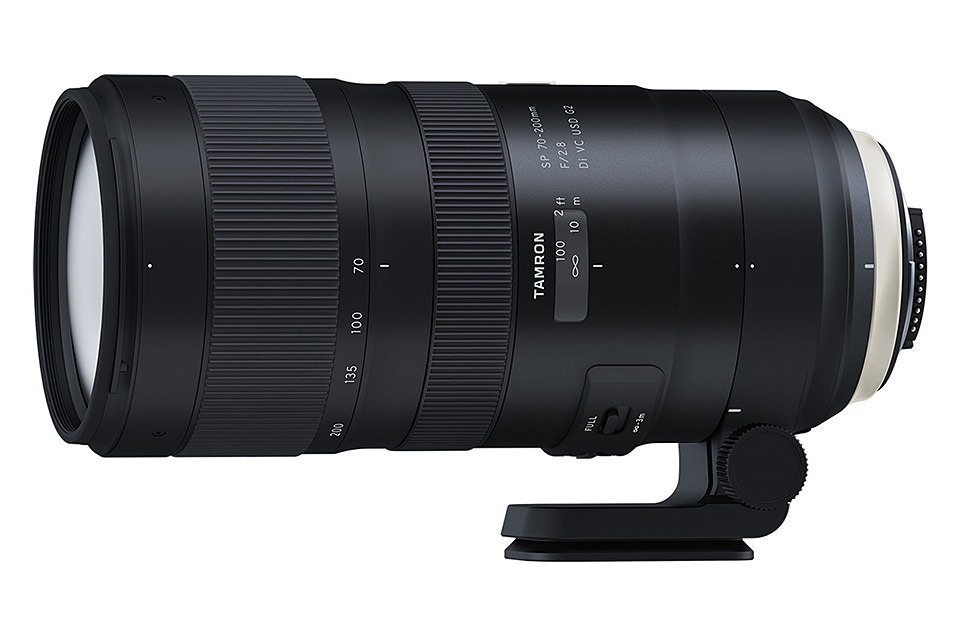
Tamron 70-200mm f/2.8 Di VC USD G2

Let’s just straight into it and compare the Tamron SP 70-200mm f/2.8 VC to the Nikon 70-200mm f/2.8E VR.

Tamron SP 70-200mm f/2.8 Di VC USD G2

While the Tamron SP 70-200mm f/2.8 VC might not have the exotic fluorite glass to make it lighter, it only weighs 55 grams heavier than the Nikon 70-200mm f/2.8E VR, so we could say that there is practically no weight difference between the two. It also measures 191.3mm in length, whereas the Nikkor is 202.5mm, so the Nikkor is a tad longer in comparison. Both lenses feature 9-blade rounded diaphragm and the same minimum and maximum aperture. While the two lenses are image-stabilized, the Tamron claims a 5 stop compensation, whereas Nikon claims to have around 4 stops of compensation. Hard to say whether Tamron can really go beyond Nikon’s excellent VR system, but if it manages to compensate up to 4 stops, it is already as good as the Nikon. The optical construction of the Tamron is comprised of 23 elements in 17 groups, whereas the Nikon 70-200mm f/2.8E VR has a pretty similarly complex construction with 22 elements in 18 groups. Both are weather-sealed to perform in all kinds of challenging environments. Let’s take a look at the projected MTF performance of both lenses to see if we can spot major differences:

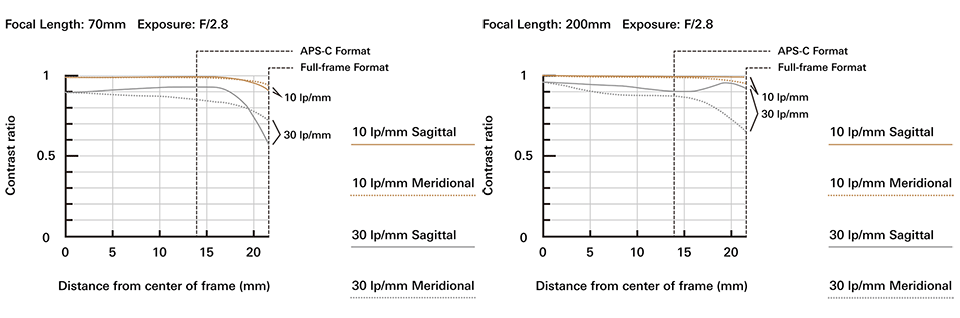
Tamron SP 70-200mm f/2.8 Di VC USD G2 MTF Chart

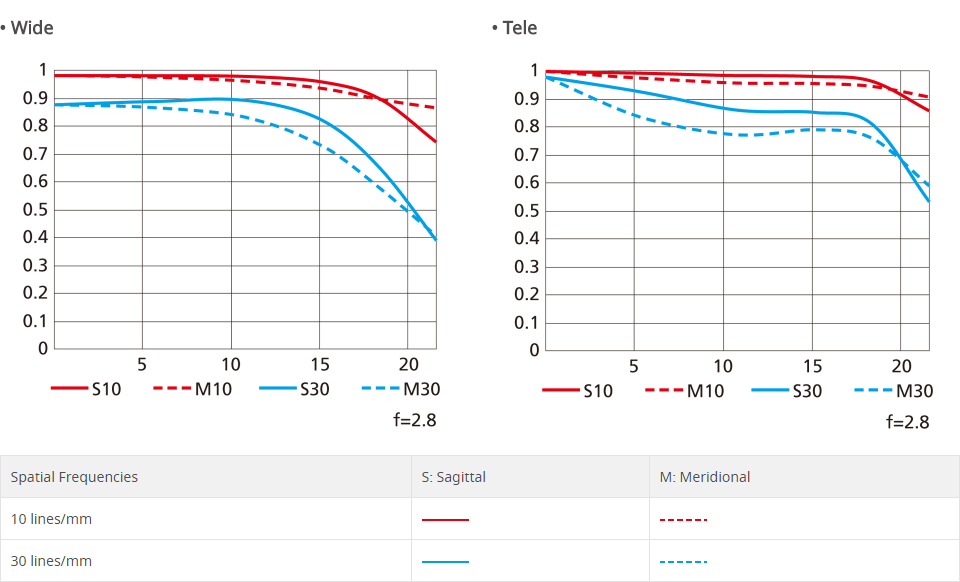
Nikon AF-S NIKKOR 70-200mm f2.8E FL ED VR MTF Chart

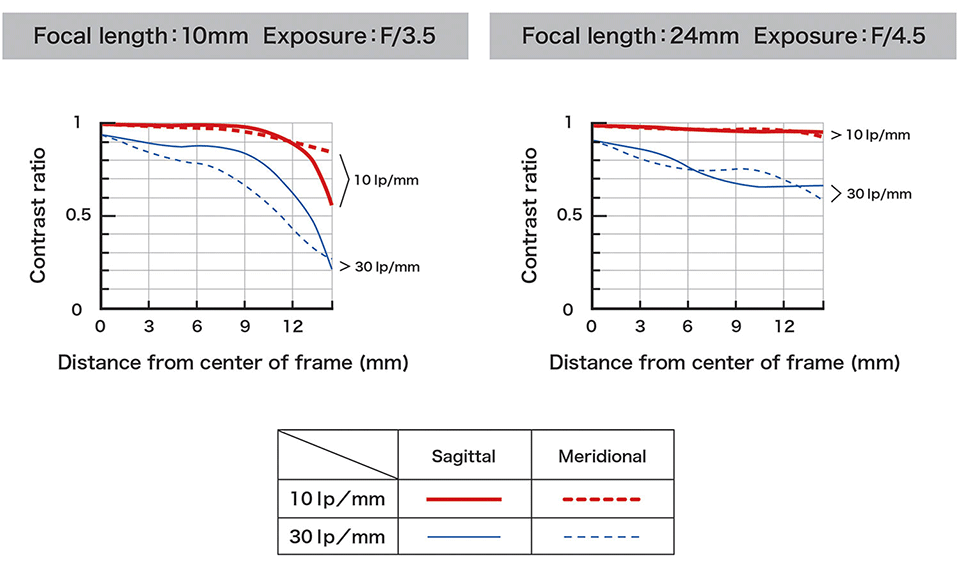
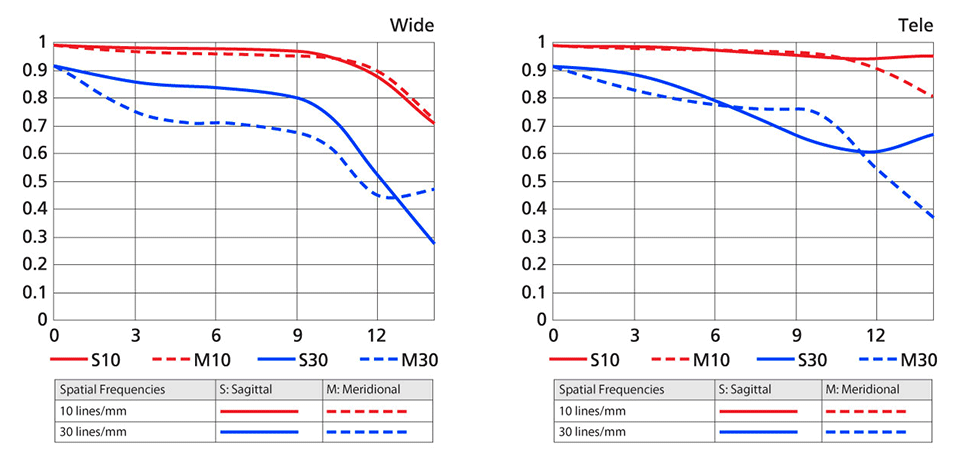
Although MTF charts speak little of the overall performance of the lens, since they are shown at maximum aperture for only two focal lengths on a zoom lens, we can get an idea of what to expect from a given lens. In this particular case, the Tamron SP 70-200mm f/2.8 VC G2 is claiming to be a better lens in terms of sharpness at 70mm – you can see that the edges get towards the 0.6 mark, whereas the Nikon drops below 0.4. The same goes for contrast, where Tamron is claiming to have higher contrast. And for the telephoto range, we see a similar picture again – the Tamron SP 70-200mm f/2.8 VC G2 is showing better contrast and much better overall sharpness at maximum aperture, which would be shocking to see, if it turns out to be true. Such sharpness does seem to come at an expense though – see how the sagittal and meridional lines separate? It means that the Tamron should have slightly worse bokeh performance in comparison. How much worse is something we are going to have to see when I test the two lenses side by side later this year when the lens becomes available. I seriously doubt the bokeh difference is going to be drastically different between the two though. The Tamron does not have any aspherical lens elements, so I expect its bokeh to be smooth, without any onion-ring artifacts.

It is worth noting that there might be an advantage to the Nikon 70-200mm in terms of focus breathing – based on the previous generation 70-200mm and its magnification ratio, the Tamron is likely to exhibit focus breathing, while Nikon addressed that issue for the most part in the new 70-200mm design.

If Tamron truly does manage to bring us a 70-200mm with better performance characteristics than the Nikon, it will be the end game for the Nikon, mainly because of its ridiculously high price tag of $ 2,700. I can see the Tamron 70-200mm selling like hotcakes compared to the Nikon. Way to go Tamron!

You can find out more about the lens by visiting the Tamron SP 70-200mm f/2.8 Di VC USD G2 in our lens database.

Tamron SP 70-200mm f/2.8 Di VC USD G2 Official Press-Release

Below is the official press-release from the manufacturer:

February 6, 2017, Commack, NY – Tamron, a leading manufacturer of optics for diverse applications, announces the launch of SP 70-200mm F/2.8 Di VC USD G2 (Model A025), a new telephoto zoom lens product for full-frame and APS-C DSLR cameras. Model A025 was developed by substantially enhancing the features of its predecessor.

These include a thorough review of the optical, mechanical and electronic designs to increase autofocus speed and precision, reinforce VC (Vibration Compensation) functions and to shorten the MOD. New features include eBAND Coating, Moisture-Proof and Dust-Resistant Construction, Fluorine Coating and compatibility with teleconverters. The lens design features a metal-based barrel for improved handling and ease-of-use. The result of this dramatic evolution is Model A025, a high-speed telephoto lens that widens the scope of expression for photography in a broad range of genres, such as portraits, landscapes, sports and photojournalism. The lens is expected to be available in the U.S. in March at $ 1299.

PRODUCT HIGHLIGHTS

  1. Outstanding resolution and contrast reproduction performance, beautiful bokeh and full compatibility with Tamron teleconverters
    Based on the current model (A009), the optical design has been revised and improved. Both the resolution and contrast reproduction performance far exceed the present levels. Bokeh has been enhanced and expanded to deliver outstanding background effects across the entire zoom range. Use of a circular diaphragm with nine blades further improves bokeh. The optical design of the new A025 consists of 23 elements in 17 groups. Optimum deployment of XLD (eXtra Low Dispersion) and LD (Low Dispersion) glass elements thoroughly eliminate chromatic aberrations, which tend to become particularly prominent in high-speed telephoto lenses, across the entire zoom range, while ensuring uniform, high-level image quality even on the periphery of the image plane.

    The new lens is also fully compatible with the TELECONVERTER 1.4x (Model TC-X14) and TELECONVERTER 2.0x (Model TC-X20)1, which increase the focal length of the lens to 1.4 times and 2 times the original, respectively. Both teleconverters are carefully designed and constructed to provide outstanding high quality.

  2. Improved VC system provides highest Vibration Compensation ability in its class (5 stops using CIPA standard compliant) and offers three situation-specific VC modes
    Utilizing Tamron’s original VC (Vibration Compensation) system, which uses a moving coil mechanism, further reinforcement of the drive system power and control performance has now achieved the highest VC level in its class, with an image stabilization performance of 5 stops according to the CIPA standard (using VC Mode 3).

    Also, the VC system of Model A025 offers three VC modes, including one mode exclusively for panning. Photographers can freely choose between the different VC modes according to their shooting conditions. Even when telephoto shooting in low light, which tends to be severely affected by camera shake, photographers can now enjoy jitter-free handheld shooting with much greater flexibility.

    • VC MODE 1 is the standard mode that strikes a great balance between the stability of the viewfinder image and the stabilization effects.
    • VC MODE 2 is exclusively used for panning.
    • VC MODE 3 prioritizes the stabilization of the captured images and forgoes the stabilization of the viewfinder image.

    With the optional accessory TAMRON TAP-in Console, you can customize the configuration of VC MODE 1. Choose the viewfinder view of either standard or image priority.

  3. Demonstratively improved autofocus speed and responsiveness
    Model A025 is equipped with a USD (Ultrasonic Silent Drive) ring-type ultrasonic motor, whose outstanding responsiveness and control ensures accurate high-speed focusing. Incorporating two advanced, high-performance microcomputers and optimizing the algorithm has improved both the focusing speed and accuracy compared with SP 70-200mm (Model A009). Additionally, thanks to the Full-time Manual Focus override mechanism, photographers shooting with AF can instantaneously make fine focusing adjustments using MF without wasting time by switching the AF-MF mode back and forth.
  4. Focuses closer (shorter Minimum Object Distance, or MOD) for greater versatility
    Improvements made to the focus cam and zoom cam inside the lens barrel have reduced the MOD from 50.7 inches in the older Model A009 to 37.4 inches for Model A025, which has a maximum magnification ratio of 1:6.1. The shorter MOD, coupled with the excellent optical performance of the SP 70-200mm (Model A025), allows photographers to further broaden their range of expression.
  5. Optimized and exclusively designed eBAND Coating
    The new A025 features Tamron’s original eBAND (Extended Bandwidth & Angular-Dependency) Coating, a technology that combines a nano-structured layer with an extremely low refractive index with the conventional multiple-layer coatings. Optimized and exclusively designed for this new zoom, the eBAND Coating provides superior anti-reflection performance, effectively reducing any flare and ghosting. Even when taking backlit portraits, the new lens delivers flawless, crystal clear images.
  6. Moisture-Proof and Dust-Resistant Construction
    Ideal for use in outdoor photography, the new 70-200mm telephoto zoom has moisture-resistant construction because special sealants that are dust-resistant and moisture-resistant are used at every joint and seam. The sealant material helps to prevent the intrusion of any dirt, dust or water droplets, compared to conventional Moisture-Resistant Construction.
  7. Fluorine Coating for greater protection
    The front surface of the lens element is coated with a protective fluorine compound that is water- and oil-repellant. The lens surface is easier to wipe clean and less vulnerable to the damaging effects of dirt, dust, moisture and fingerprints.
  8. Electromagnetic diaphragm system now used also for Nikon-mount lenses
    An electromagnetic diaphragm system, which has been a standard feature for Canon-mount lenses, is now available for Nikon-mount lenses. More precise diaphragm and aperture control is possible because the diaphragm blades are driven and controlled by the motor through electronic pulse signals.
  9. Lightweight and easy-to-hold tripod mount is compatible with Arca-Swiss style quick release plates
    A new textured grip and Arca-Swiss style tripod interface enhances both speed and utility. Because the tripod mount is made of lightweight magnesium, it is much easier to carry.
  10. Compatible with TAMRON TAP-in ConsoleTM, an optional accessory product
    The optional TAP-in Console provides a USB connection to a personal computer, enabling users to easily update the lens firmware as well as customize features, including fine adjustments to the AF and VC.
  11. Based on the rigorous quality standards worthy of the SP series, this new lens is manufactured with a thorough attention to details
    For the SP series products in particular, Tamron has established rigorous design and quality standards. These standards apply to the optical design, mechanical design and the cosmetic appearance, as well as to such wide-ranging areas as the product’s robustness and improvements in the various individual functions. Tamron thoroughly reviews all of the design and manufacturing processes in order to offer products to customers with even-higher levels of precision and quality.

    For the SP 70-200mm G2 (Model A025), the optical design was refreshed, mechanical parts were improved and a new exterior design was adopted. To maximize the optical performance intrinsic to this product, Tamron improved the accuracy of the component parts and increased the precision of the overall zooming mechanism.

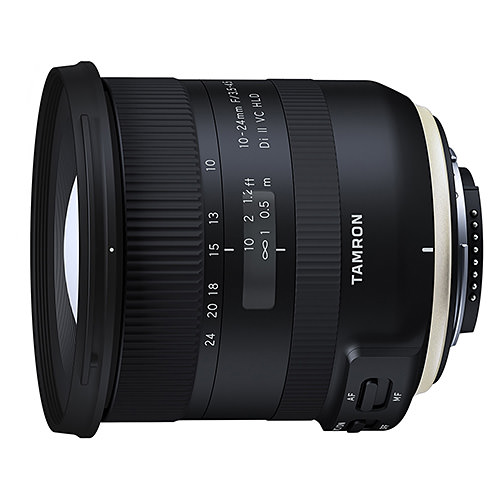
Tamron 10-24mm f/3.5-4.5 Di II VC HLD

Another update is the Tamron 10-24mm f/3.5-4.5 Di II VC HLD lens designed for APS-C cameras, which replaces the previous generation Tamron 10-24mm f/3.5-4.5 Di II. This particular release by Tamron is another attempt to steal some market share from Nikon, since it directly competes with Nikon’s AF-S DX NIKKOR 10-24mm f/3.5-4.5G ED.

Tamron 10-24mm f/3.5-4.5 Di II VC HLD

With a price tag of $ 499, this lens is bound to outsell the Nikon, which retails for $ 899 – another huge price difference. The Nikon is clearly an inferior lens, as it does not have image stabilization and the technology we see in the Tamron 10-24mm is also better: fluorine coating, moisture-resistant construction, molded glass and hybrid aspherical elements, plus the ability to tweak autofocus via a Tap-in console. That’s a lot to ask for a low price of $ 499!

Let’s take a look at the MTF performance of the two lenses:

Tamron 10-24mm f/3.5-4.5 Di II VC HLD MTF Chart

Nikon AF-S DX NIKKOR 10-24mm MTF Chart

At 10mm, both lenses seem to be as good in terms of center performance, but once you look at the extreme edges, the Nikon 10-24mm looks a tad better. Contrast on the Tamron 10-24mm also looks slightly worse towards the edges. Zoomed into 24mm, both lenses have about the same contrast and overall sharpness, so there are practically no differences there.

Again, these performance differences are projected and only show wide open performance. If the Tamron performs as good or better than the Nikon when stopped down to the f/5.6-f/8 range, it will be another nail in the coffin of the Nikon 10-24mm f/3.5-4.5G, since the price difference between the two is huge.

Both lenses are supposed to ship in spring of 2017 – you can find the pre-order information in the links below.

Tamron 10-24mm f/3.5-4.5 Di II VC HLD Official Press-Release

Below is the official press-release from the manufacturer:

February 6, 2017, Commack, NY – Tamron, a leading manufacturer of optics for diverse applications, announces the launch of 10-24mm F/3.5-4.5 Di II VC HLD (Model B023), a new ultra-wideangle zoom lens for APS-C DSLR cameras. The lens is expected to be available in the U.S. this Spring at $ 499.

Model B023 is a wideangle zoom lens that covers an exceptionally large range—the largest focal length range in its class1 (35mm equivalent is 16mm to 37mm). The lens is ideal for street photography, landscapes, group photos and casual everyday scenes. In 2008, Tamron launched the SP AF 10-24mm F/3.5-4.5 Di II LD Aspherical [IF] (Model B001) that provided an unprecedented focal length range in its class. Building on that lens’s popularity, the successor Model B023 has improved optical performance and new features. It embodies Tamron’s most advanced technologies, including the VC (Vibration Compensation) system, Moisture-Resistant Construction and Fluorine Coating, and the first implementation of Tamron’s new HLD (High/Low torque modulated Drive). Additionally, the Model B023 has a refreshing new design derived from the design of the new product lineup in the SP series.

PRODUCT HIGHLIGHTS

  1. Inheriting the broadest focal length range in its class of ultra-wideangle zoom lenses
    The new Model B023 achieves a broad focal length range of 10-24mm, the largest range among ultra-wideangle zoom lenses for APS-C DSLR cameras. This is the 35mm equivalent of covering a very wideangle of view, from 16mm ultra-wideangle to 37mm semi-wideangle. A photographer can enjoy diverse wideangle expressions with just this one lens, from dynamic landscapes far beyond the normal human field of vision to simple, casual snapshots.
  2. Improved optical performance across the entire zoom range
    The optical design of the new Model B023 consists of 16 lens elements in 11 groups. Special lens elements are utilized in an optimum configuration of one LD (Low Dispersion) lens element, one XLD glass element, one molded glass aspherical element, and one hybrid aspherical lens. While curbing an increase in the size of the optical system, the new lens very effectively compensates for a wide variety of aberrations in the entire zoom range, including transverse chromatic aberration, comatic aberration and distortions that tend to become more prominent with a wideangle lens.

    Tamron’s highly regarded BBAR (Broad-Band Anti-Reflection) Coating and the optical design paying close attention to internal reflections in the lens barrel also curb the effects of harmful light rays that tend to occur with a wideangle lens, achieving excellent resistance against ghosting and flare seen in backlighting situations.

  3. 4-Stop Vibration Compensation that is especially useful in low light conditions
    In response to the requests of many customers who have asked the company to equip a wideangle lens with image stabilization, we have now installed Tamron’s acclaimed VC (Vibration Compensation) on the new Model B023. Optimizing the actuator and the control algorithm has made it possible to incorporate the VC, while maintaining the compact design of the previous Model B001. The VC especially enhances the photographer’s freedom in handheld shooting at dusk or in a dimly lit room, and under other relatively low light conditions, as the mechanism proves particularly effective in the shooting conditions with slower shutter speeds.
  4. Equipped for the first time with the new HLD with outstanding driving power and stability
    Tamron’s new HLD (High/Low torque modulated Drive) has been developed for use as the AF drive system for Model B023. With its outstanding driving power and stability, the HLD is capable of smoothly controlling the AF mechanism of the new Model B023 that is actually equipped with large focusing lens elements. When shooting in AF mode, the Full-time Manual Focus override allows you to instantly make fine focusing adjustments manually, without having to switch between modes.
  5. Compressed into a compact body with structural ingenuity
    While enhancing image quality, adding new functions and substantially improving the basic performance, Model B023’s space-saving design has ensured an optimum configuration for components such as the VC and AF unit, thus successfully reducing overall length compared to the previous Model B001. The lightweight and compact body with outstanding ease of use will prove to be very well-balanced when attached to an APS-C DSLR camera.
  6. An even more user-friendly lens with Fluorine Coating and Moisture-Resistant Construction
    The front surface of the foremost lens element is coated with a protective fluorine compound that is water- and oil-repellant. The lens surface is easier to wipe clean and is less vulnerable to the damaging effects of dirt, dust, moisture and fingerprints, allowing for much easier maintenance. For greater protection when shooting outdoors, leak-proof seals throughout the lens barrel help protect your equipment.
  7. Electromagnetic diaphragm system now used also for Nikon-mount lenses
    An electromagnetic diaphragm system, which has been a standard feature for Canon-mount lenses, is now employed in Nikon-mount lenses2. More precise diaphragm and aperture control is possible because the diaphragm blades are driven and controlled by a motor through electronic pulse signals.
  8. Compatible with TAMRON TAP-in Console, an optional accessory product
    The optional TAP-in Console provides a USB connection to your personal computer, enabling you to easily update your lens’s firmware as well as customize features including fine adjustments to the AF and VC.
  9. External design placing importance on functionality and ease of use
    While inheriting the design that makes use of a lot of organic curves and the delicately polished form down to fine details that characterize the SP lens series, the new Model B023 comes with a highly sophisticated design that also places much importance on the lens’s functionality and ease of use, featuring an overall form that faithfully encompasses the internal structures within, a slim Luminous Gold brand ring, the switch shape and the distance-scale window design.

Pre-Order Information

You can pre-order both lenses using the links below:

  1. Pre-order Tamron SP 70-200mm 2.8 Di VC USD G2 from B&H Photo Video for $ 1,299 / Canon EF mount
  2. Pre-order Tamron 10-24mm f/3.5-4.5 Di II VC HLD from B&H Photo Video for $ 499 / Canon EF mount

Kudos to Tamron for bringing out such amazing lenses. These will put a lot pressure on Nikon’s pricing, so I am expecting to see some big discounts heading our way this holiday season.

The post Tamron’s SP 70-200mm f/2.8 VC G2 and 10-24mm Lenses to Challenge Nikon appeared first on Photography Life.

Photography Life

Posted in Photograpy How To | Tagged , , , , , , | Leave a comment

Improving Your Photos Without Buying More Gear

If you want to take your photos to another level, camera equipment is a natural place to look. It’s a very tangible part of photography; we work with our gear constantly. In fact, new equipment often does help you capture certain photos more easily, or it improves the technical quality of the images you take. However, it’s easy to get swept away in this marketing message and forget that there are other, better ways to improve your photos — techniques that don’t require new equipment to put into practice, and tips that are applicable to every photographer.

1) Learn Composition

Composition is all about getting your photos to say what you want them to say. It’s how you draw attention to your primary subject, making it as noteworthy as possible and excluding any unimportant details from your frame.

If you give Nikon’s cheapest DSLR to a professional photographer and force them to use automatic mode, they’ll still be able to capture fantastic photos. If you give a non-photographer the Nikon D5, even assuming that its settings are perfect, they probably won’t get anything that is nearly as good.

The reason should be obvious: The professional photographer knows how to get their point across. They can stand at a beautiful overlook and capture the essence of the scene; they can photograph someone’s wedding and paint a detailed story in a single frame.

If you want to do the same, most of it comes down to practice, along with ruthlessly critiquing your own work. Any time that there’s a problem with one of your photos — light, camera settings, composition, or something that’s harder to quantify — pay attention. What could you have done to avoid that mistake? Would the image be better if you had captured it at a different time of day, or from a different perspective? Be very tough on all your photos; even your best ones aren’t perfect.

It can be hard to critique your work harshly, even if you want to do so. But, if your goal is to learn the intricacies of light and composition, you need to be honest with yourself — what doesn’t work about a photo, even your good ones? When you’ve identified the negatives of a photo, that information will stick with you. Next time you’re in the field, you’ll correct those mistakes.

Photography is about constant self-improvement. After you look through your photos and find areas to work on, that should be your priority — be it light, color, composition, technical settings, or anything else. Gear should be the last thing on your mind.

Spencer-Cox-Alleyway

NIKON D7000 + 24mm f/1.4 @ 24mm, ISO 360, 1/50, f/1.4
I took this photo with the Nikon D7000, which was released in 2010 — in terms of digital cameras, practically a lifetime ago. Yet, viewers would never know; my composition is the only important part of the image. It’s what makes or breaks this shot.

2) Get to Know Your Gear

I tend to believe that you’ll often get better photos by using a single piece of camera equipment for a long time rather than constantly upgrading to the best new model. Why? Simple: As you get to know your equipment, it becomes easier and easier to coax out the photos that you want. If you’re a portrait photographer who understands all the intricacies of a decades-old manual flash and an old light-modifying kit, you’ll get better results than if someone handed you Nikon’s new $ 600 SB-5000 and top-of-the-line lighting accessories. Sure, you can learn how to use the new kit over time, but — short term — your photos from the “inferior” equipment will be better.

As I’ve switched around my camera kit over the years, this has been very true in my experience. When I upgraded from the Nikon D7000 to the D800e, it definitely took me some time to adjust. After using the D7000 for years, I intuitively understood everything about it — the button locations, the autofocus behavior, the metering system, and so on. No, the D800e wasn’t some alien camera, but it still me took several months before I really understood it to the same degree as I understood the D7000. If I had jumped to a different DSLR brand, or from the D7000 to a mirrorless camera, I’m sure it would have been an even longer process.

Rather than upgrading to the newest equipment, then, you’ll be surprised how much better your photos will be if you truly get to know the gear you already have. Even if you already have a pretty good understanding, there’s always room to improve. Can you set the camera with your eyes closed — or, more realistically, with your eye to the viewfinder? How quickly can you switch from manual mode to aperture-priority, then change your camera’s minimum shutter speed settings? The more you practice, the faster you’ll be.

From what I’ve seen, the most important part of your camera equipment is not the equipment at all. Instead, what matters is how familiar you are with your kit. If there’s something spectacular happening in front of you, and you’re about to take the perfect photo, your reaction time is what makes the difference — not whether you upgraded to the highest-resolution camera on the market.

Simply by practicing with your current kit, you’ll be able to solidify your skills in a way that wouldn’t be possible if you constantly upgraded. That’s not to say you should never get a new camera, but that it isn’t the only way to take higher-quality photos. By learning your current gear at the deepest possible level, you’ll make more progress than if you had “upgraded” to a marginally-better camera that you don’t yet know how to use.

Spencer-Cox-Mountain

NIKON D810 + 70-200mm f/2.8 @ 70mm, ISO 140, 1/500, f/9.0
I was on a helicopter with an open door when I took this photo, wearing thick gloves and trying to make sure that I didn’t turn into an icicle. Luckily, I knew how to use this camera without a second thought, or it would have been impossible to capture any good photos. If someone had handed me the newest Hasselblad camera before the flight, there’s no way I would have gotten as many good photos along the way. (A quick note: I used a D810 here rather than my typical D800e, since I had multiple cameras around my neck at the time. Luckily, the D810 works very similarly to the D800e, so there was no real learning curve.)

3) It’s Possible with Any Equipment

Whenever I feel the urge to buy a new piece of gear, there’s a simple question I like to ask myself: Does anyone use the equipment that I already have (or, perhaps, worse equipment) to take the types of photos that I want? Almost always, the answer is yes — and if the answer is yes, I don’t need to buy anything new.

If you’re disappointed that you still use a crop-sensor camera from six years ago, just search online; you’ll find people who use that camera to take spectacular images, no matter the genre. Are you a landscape photographer using the Nikon D7000? Google “Nikon D7000 landscape photos,” and you’ll surely be impressed by the results.

You’ll find that other photographers already have a lot of secrets figured out — which is great, because you can learn from them. Although new cameras may indeed provide tangible benefits, typically in terms of image quality or ease of use, you can capture great photos with any equipment. It is very rare that a photo you want to take will be impossible to capture, no matter the gear you have. (Exceptions include things like underwater photography that require very specific equipment in the first place, of course, but you’ll know if that applies to you.)

Spencer-Cox-Crater-Lake

NIKON D5100 @ 18mm, ISO 100, 1/80, f/13.0
I took this photo with an entry-level DSLR that first went for sale in early 2011. New equipment is nice, but the best way to improve your photos has nothing to do with it.

4) Understand Visualization

The real secret to great photos isn’t really a “secret” at all — and it’s something you can do regardless of your gear.

Visualize everything; picture the final result in your head. Imagine the best possible photo of the scene in front of you, then do everything you can to make that photo a reality.

Visualization is the trick to taking successful photos, from landscapes to portraits. It is important regardless of the type of photography that you do.

Some photographers think of visualization as a very abstract tool that isn’t easy to implement in the real world, so I always like to provide an example of what I mean. Here’s a photo of the Eiffel Tower that I captured a few years ago:

Spencer-Cox-Beacon

NIKON D7000 + 24mm f/1.4 @ 24mm, ISO 800, 1/30, f/1.4

Notice something interesting about this photo? It looks as though a spotlight on top of the Eiffel Tower is pointing straight up in the air, illuminating a cloud like a beacon over the city of Paris.

In fact, that’s not what’s happening (and this isn’t a Photoshop trick, either). Instead, this photo is a result of some very clever visualization that I did in the field, where I had a distinct goal in mind: I wanted to take a photo that looked almost exactly like this! So, how was it done?

If you’ve been to Paris, you may remember that there’s a large spotlight on top of the Eiffel Tower that turns on at night. It spins 360 degrees across the city, pointing mostly straight out, but tilted slightly upwards. Can you guess how I took this photo, now? I took advantage of the slight upward tilt of the spotlight. I waited for it to shine perfectly in my direction, and then I quickly took a photo when it did. An optical illusion makes it look like it’s pointing straight up!

It’s also worth mentioning that it took several tries to capture a believable illusion in this case, since the spotlight moves rather quickly. However, because I had visualized this exact result, I knew that I’d be able to capture a good photo in the end!

Your visualization efforts won’t always be this extreme; this is the clearest example I can think of from my own photography. However, visualization matters even for casual photos. Every time you look at a scene, think about the ideal photo, then work towards making it a reality. In almost every situation, you’ll be able to do something to make the image match your goal.

5) Conclusion

Even if your photos aren’t good enough, your gear probably is. There are countless ways to improve your images without purchasing new equipment, and this article only scratches the surface.

The essence is simple: Focus on improving your technique, and great photos will fall in line naturally. A new piece of equipment won’t improve your composition or lighting skills. Short term, before you really understand how to use it, you may even end up with worse results!

Right now, people are out there capturing the photos you want using exactly the equipment you already have, if not something significantly worse. If you want to be like them, buying more gear won’t help.

I’m not trying to disparage new equipment — I love it, too. New cameras and lenses make certain photos easier to capture, and they can improve the resolution and detail of the images that you take.

However, if your photos are lacking, gear isn’t the solution. In order to improve the true quality of a photograph, you need to focus on things like light, subject, and composition. These aren’t factors your equipment can fix; you’re the only one who has that power.

Spencer-Cox-Lupine-Flowers

NIKON D800E + 14-24mm f/2.8 @ 14mm, ISO 200, 1/50, f/16.0

The post Improving Your Photos Without Buying More Gear appeared first on Photography Life.

Photography Life

Posted in Photograpy How To | Tagged , , , , , | Leave a comment