How to keep a month-by-month light journal for your home

Fun fact: My absolute favorite place to shoot during March mornings is at the top of the main stairs using the tiny window in my laundry room.

In April mornings, the kitchen. May mornings, the living room. June mornings, the back porch.

And don’t even get me started on evenings.

Most photographers know that winter light is scarce and that spring will bring with it a whole new slew of light-soaked shooting opportunities. But for those of us who love to document life at home, the arrival of spring light is so much more nuanced than: no light/ light. I'd love to show you how to keep a room-by-room light journal.

Most photographers know that winter light is scarce and that spring will bring with it a whole new slew of light-soaked shooting opportunities. But for those of us who love to document life at home, the arrival of spring light is so much more nuanced than: no light/ light.

I’d love to show you how to keep a room-by-room light journal, not just of a single day, but over months – preferably over an entire year. Once you start to notice the sun’s slow journey across the sky, you will see brand new shooting opportunities open up all over your house.

You can organize your journal in any way that makes the most sense for you, but the important thing to remember is that it’s more complex than just the sun rises in the east and sets in the west. As the year wears on, the rising sun will shine into your eastern windows at all different angles, intensities, and directions. It’s quite an exciting thing to watch unfold.

Be sure that your journal is long term (over months, not just a day or a week) and gives you the opportunity to observe the light in all different rooms of your home. And in my home at least, March is the perfect time to begin a journal! Because of my geographical location, it’s the start of spring and the return of the light.

Here is my light journal for March:

Most photographers know that winter light is scarce and that spring will bring with it a whole new slew of light-soaked shooting opportunities. But for those of us who love to document life at home, the arrival of spring light is so much more nuanced than: no light/ light. I'd love to show you how to keep a room-by-room light journal.

Most photographers know that winter light is scarce and that spring will bring with it a whole new slew of light-soaked shooting opportunities. But for those of us who love to document life at home, the arrival of spring light is so much more nuanced than: no light/ light. I'd love to show you how to keep a room-by-room light journal.

You’ll notice that while I do make note of where the light is soft, I mostly am concerned with where the light shines in most strongly. I love soft, diffused light. But if I know where my dramatic, strong light is entering, I also always know where I can go to find soft light. (At the opposite end of the house, of course!)

Therefore, questions I think about are:

  • Where do patches of hard light fall on the wall and floors?
  • What is the angle of the light?
  • What direction is the light entering the window?
  • Is there potential for reflected light?

Reflected light happens when light bounces off of a light or neutral surface and back into the subject’s face so that he or she is able to enjoy the benefits of being both backlit and evenly front lit with catch lights in the eyes. Take, for example, the first picture below where the light is bouncing off of the cereal box and back to my son’s face and the second picture, where the strong morning light is bouncing off of the white counter top and lighting up my younger son.

Most photographers know that winter light is scarce and that spring will bring with it a whole new slew of light-soaked shooting opportunities. But for those of us who love to document life at home, the arrival of spring light is so much more nuanced than: no light/ light. I'd love to show you how to keep a room-by-room light journal.

Most photographers know that winter light is scarce and that spring will bring with it a whole new slew of light-soaked shooting opportunities. But for those of us who love to document life at home, the arrival of spring light is so much more nuanced than: no light/ light. I'd love to show you how to keep a room-by-room light journal.

take-better-pictures-with-the-help-of-the-Clickin-Moms-photography-forum

In March, the light entering my home is fierce and almost perpendicular in angle. It allows for all kinds of amazing opportunities for rim light and lens flares. But just for comparison’s sake, here is my May Light Journal:

Most photographers know that winter light is scarce and that spring will bring with it a whole new slew of light-soaked shooting opportunities. But for those of us who love to document life at home, the arrival of spring light is so much more nuanced than: no light/ light. I'd love to show you how to keep a room-by-room light journal.

As you can see by reading my notes, there is some truly magical light to be found in May. But it is a little more angled and therefore, more subtle.

When I was just beginning my photography journey, I missed a lot of opportunities for interesting light because I had a very fixed mindset. I thought, this is what the sun is like in my home in the summer, and this is what it’s like in the winter. I had no idea how much change four weeks could bring and so I didn’t continue searching.

Don’t let that happen to you!

Grab a journal, a pen, and your camera and keep your eyes and mind wide open to all the possibilities. You never know what you’ll uncover if you stay curious!

“To pay attention, this is our endless and proper work.” – Mary Oliver

Most photographers know that winter light is scarce and that spring will bring with it a whole new slew of light-soaked shooting opportunities. But for those of us who love to document life at home, the arrival of spring light is so much more nuanced than: no light/ light. I'd love to show you how to keep a room-by-room light journal.

The post How to keep a month-by-month light journal for your home appeared first on Clickin Moms.


Clickin Moms

Posted in Photograpy How To | Tagged , , , , | Leave a comment

6 easy ways to photograph your teenager

Teenagers can be a tough crowd to photograph, but it’s a rapidly changing time in their life, and can still be a lot of fun to document.

I don’t get too much push back from my twin girls, because they’re on Instagram and love the material. Still, they don’t always offer photo-worthy moments around the house the way that a three-year-old does.

Storytelling sessions are my favorite way of documenting their life these days. A great way to pull this off with older kids is to shoot an outing, or preferred activity. My girls love going out to restaurants with me, which is what I shot here. Here are some tips on how to shoot a beautiful story with older kids:

Choose the right activity.

Choose an activity that will allow you to observe, while also participating: a meal out, shopping, hiking, swimming. The bonus to doing this with older kids is that you don’t have to worry about keeping them alive as much. They know not to walk into a busy street while you’re shooting something in the other direction, and they’re relatively self-sufficient.

Think about the atmosphere when you’re choosing the venue. I handle these somewhere in between documentary and “lifestyle” shooting, meaning I strategically choose a place that’s visually appealing, and I loosely choreograph their actions, but no posing. I personally wouldn’t choose a movie theater for example, because I love natural light.

Storytelling sessions during an outing or preferred activity are my favorite way of documenting my teenagers these days. Here are some tips on how to shoot a beautiful story with older kids:

Shoot how it feels.

The old saying, “don’t shoot what it looks like, shoot what it feels like” is perfect for this. Capture the details, the environment, the weather, the season you’re in. Doing this transports the “reader”. This is what makes your photo set a “story” instead of just a series of portraits.

Shoot things that help tell the story, but that also stay within the color scheme you’re going for. I loved the rain droplets on the railing here, and the patches of dry dune grass that bordered the beach. These are tell-tale signs of winter at the shore for me.

Storytelling sessions during an outing or preferred activity are my favorite way of documenting my teenagers these days. Here are some tips on how to shoot a beautiful story with older kids:

I parked intentionally in front of a neutral colored home to put the focus on our big red vehicle, after realizing that red, green and white were my color theme.

Storytelling sessions during an outing or preferred activity are my favorite way of documenting my teenagers these days. Here are some tips on how to shoot a beautiful story with older kids:

Edit in a way that enhances the mood.

If it’s grey and foggy, like this day, choose one or two colors to showcase, and let the rest stay muted. On a sunny day at the beach, I play up the blues and the bright sand toys. When we’re at home, I love to make the pink pop in my images, because I have four daughters.

Play with film presets, especially if you’re going for a moody or more unique look. They still require a lot of hand editing, but can give you beautiful tones that would’ve taken awhile to find by hand.

Storytelling sessions during an outing or preferred activity are my favorite way of documenting my teenagers these days. Here are some tips on how to shoot a beautiful story with older kids:

Storytelling sessions during an outing or preferred activity are my favorite way of documenting my teenagers these days. Here are some tips on how to shoot a beautiful story with older kids:

take-better-pictures-with-the-help-of-the-Clickin-Moms-photography-forum

Focus on things that mark this phase of their life.

My oldest loves coffee, and now on special occasions we let her order a cappuccino. Remember when you first started drinking coffee, and how grown up you felt? Do they have favorite jewelry? A trendy hair style? These are the equivalent of tiny toes and eyelashes on babies. Are they always on their phone, taking pictures? Do they take their skateboard everywhere? Details matter at this age, too.

Storytelling sessions during an outing or preferred activity are my favorite way of documenting my teenagers these days. Here are some tips on how to shoot a beautiful story with older kids:

Storytelling sessions during an outing or preferred activity are my favorite way of documenting my teenagers these days. Here are some tips on how to shoot a beautiful story with older kids:

Extend the outing and let them play.

After lunch we walked across the street and they ran around an empty beach. Older kids will still run and play if you let them. Capture the silly, the energy, the interaction. Only shooting in the restaurant could’ve been a bit boring. This added variety, and shared the unique environment that we live in. It’s also quality time, which can be scarce between busy parents and teens.

Storytelling sessions during an outing or preferred activity are my favorite way of documenting my teenagers these days. Here are some tips on how to shoot a beautiful story with older kids:

Storytelling sessions during an outing or preferred activity are my favorite way of documenting my teenagers these days. Here are some tips on how to shoot a beautiful story with older kids:

Practice creative shooting techniques.

Like I said, you don’t have to worry about them running off or getting hurt, and it’s not a client, so if it doesn’t work out so what? Take the opportunity to experiment. Pull out a prism, try a new lens, shoot from a strange perspective, slow your shutter speed and let things blur, play with dramatic light. Most of all, have fun with it!

Storytelling sessions during an outing or preferred activity are my favorite way of documenting my teenagers these days. Here are some tips on how to shoot a beautiful story with older kids:

Storytelling sessions during an outing or preferred activity are my favorite way of documenting my teenagers these days. Here are some tips on how to shoot a beautiful story with older kids:

The post 6 easy ways to photograph your teenager appeared first on Clickin Moms.


Clickin Moms

Posted in Photograpy How To | Tagged , , , | Leave a comment

An In-Depth Look at Canon 5D Mark IV vs. Sony a7R II: Which Would You Choose?

Video and still photographer Tyler Stalman recently reviewed both the Canon 5D Mark IV and Sony a7R II based on six factors: noise/high ISO, color, dynamic range, sharpness, focus and 4K. With that in mind, he compared the two, evaluated the strengths and weaknesses of both cameras and decided which is better for both photographers and videographers. Primarily a street-style photographer and travel/commercial videographer, Stalman said in the video his priorities may be different than others, but did his best to be helpful and informative for any style shooter.

Nonetheless, it’s quite an in-depth and unbiased review. Here are some of the key takeaways from the video, which you can watch above.

Photography

1. Sharpness

Stalman said the a7R II is noticeably sharper when it comes to shooting photos—just take a look at these side by side comparisons below:

2. Dynamic Range

Stalman said in DP Review‘s test of the cameras with dynamic range, there is a clear advantage to using the Sony a7R II, but in his opinion, the cameras can be used in the same way. There may be a slight difference, but for this category it’s a draw.

3. Noise and High ISO

Stalman said he typically shoots between one and 6400 ISO on both cameras, and they are equally capable at shooting in that range. However, when moving above that to higher ISOs, the Sony takes the cake.

4. Focus

The a7R II has its focus plane on the censor, which lets the camera know when an image is focused, meaning the photographer must trust that it will shoot with accuracy. It also has a feature that most other cameras don’t, which is eye tracking. However, Stalman, in the end, crowned the Canon 5D IV as the winner of this round because of its dual-pixel AF feature and touchscreen, in addition to its extremely fast 64-point autofocus.

5. Color

He knows Canon is notorious for amazing color, but Stalman said the a7R II camera is just at good making colors pop. Also, he said the white balance on the Sony is a little strange compared to what he is used to shooting on the Canon, yet both deliver equally impressive results.

6. Speed

It comes with little surprise that the Canon is hands down much faster than the Sony, which is one aspect Sony has yet to master. Additionally, Stalman said reviewing photos, zooming in, and other actions are just not quick and efficient enough compared to Canon, which prevents him from doing his job correctly.

Videography

1. Dynamic Range

The Sony a7R II captures more highlights than the Canon. If it included C-log, it may have been able to express more dynamic range in its shots.

2. Color

Interestingly, Canon takes the prize for color when it comes to video. However, Stalman does request that C-log is added to its cameras.

3. Sharpness

After a few tests, the a7R II came out on top when it comes to sharpness for video. In 1080 vs. 4K, crop mode and color profile, the Sony camera showed the best quality compared to the Canon test.

4. Focus

Sony’s focus peaking in the EVF is a huge advantage for manual focusing, which is why Stalman ranks it higher when it comes to focus for video. Canon still wins in auto focus though.

5. 4K

The 5D Mark IV can only shoot in cropped mode in 4k, which really hinders it as a product. Because of this, the a7R II takes the win.

Resource

Posted in Photograpy How To | Tagged , , , , , , | Leave a comment

My Complicated Relationship with Seascapes

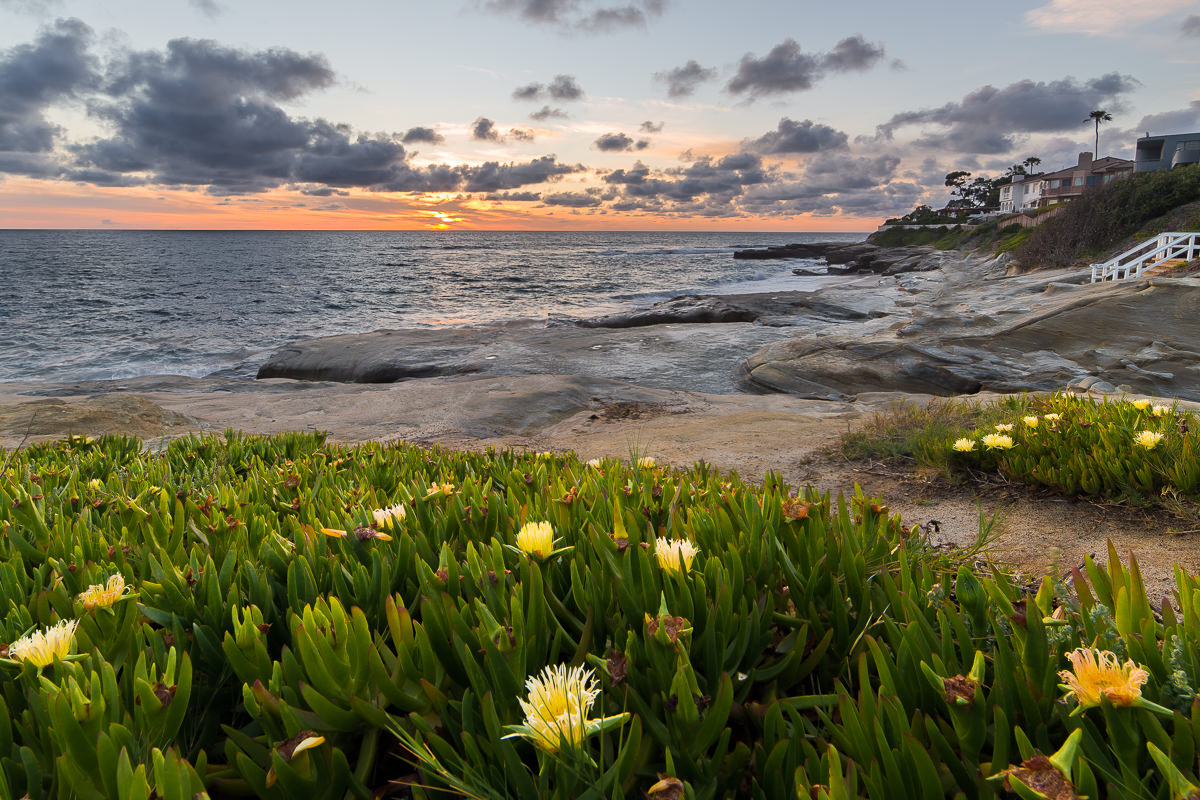
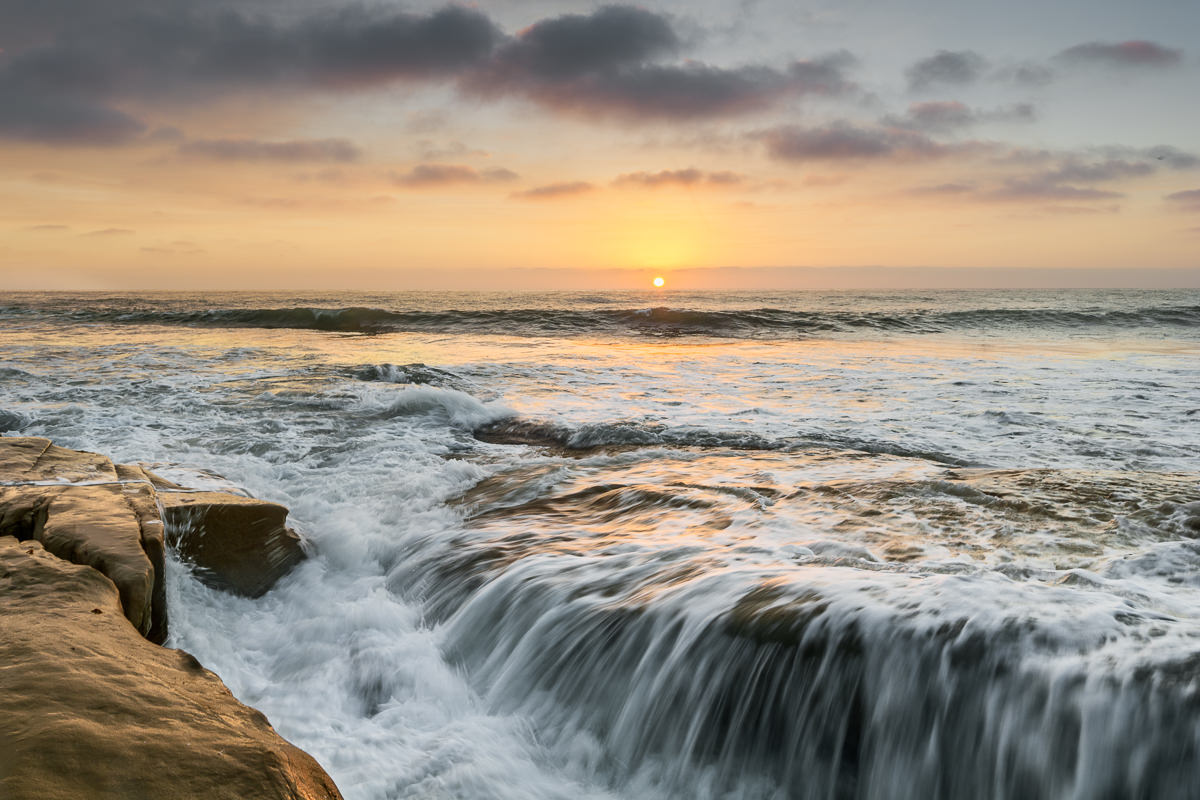
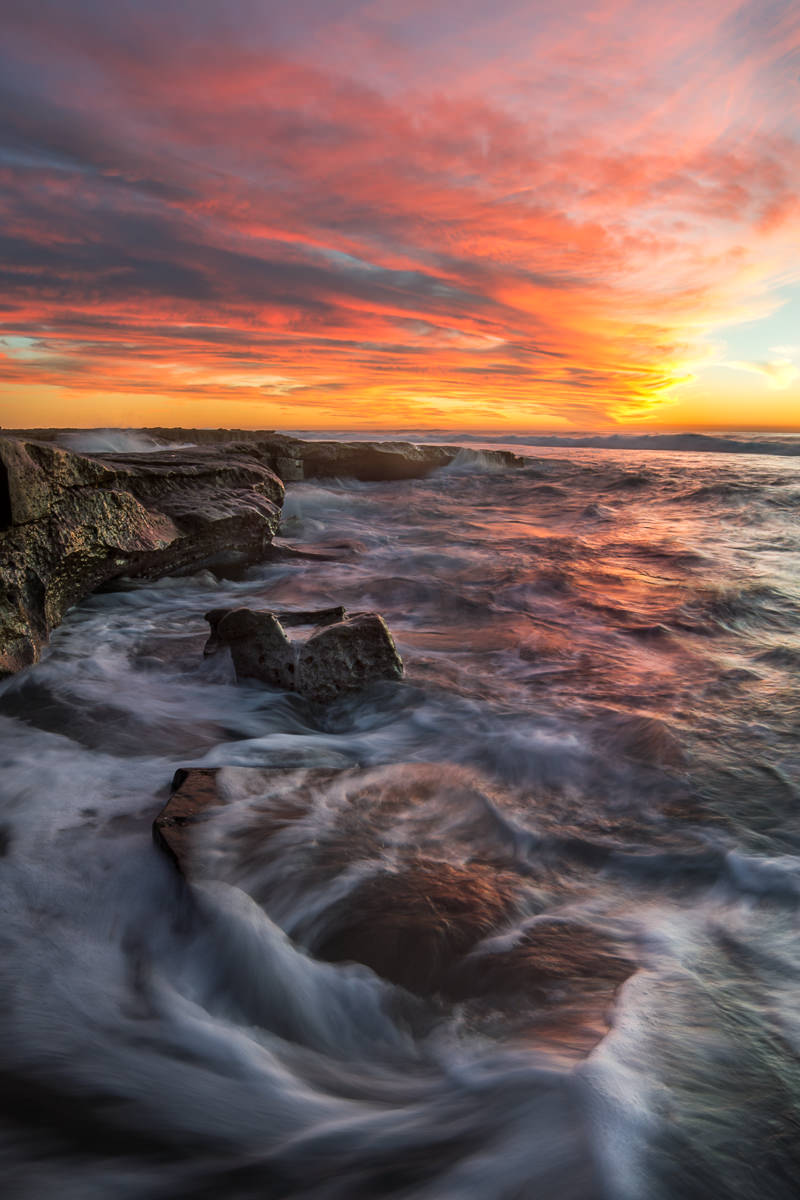
I have a confession: I have a love/hate relationship with seascapes. Sometimes I feel like they are easy, monotonous and a little bit of a sham — an easy way to impress others without having to put in the requisite amount of work. On such days I vow never to shoot a seascape again. And then there are moments when I cannot resist the pull of the ocean. When the sky looks like it will go up in flames at sunset casting it’s glow on everything the light touches — the sand, the rocks, the water. When the tide is high and the waves crashing violently into the surf promise dramatic foregrounds. ‘This will be my greatest seascape,’ I tell myself as I pick up my gear and head for the beach, bracing for the challenge ahead.

By now the reader has probably picked up on the contradiction. How can something be easy and boring and challenging and exciting at the same time? I would argue that it can be.

Truth is that the seascapes do simplify the most critical aspect of photography — the composition. A typical ocean-front vista is so inherently interesting and appealing and the shapes of the constituent elements (shoreline, rocks, sand, waves) so undefined that the photographer has tremendous freedom and opportunity with how to frame the shot.

easy

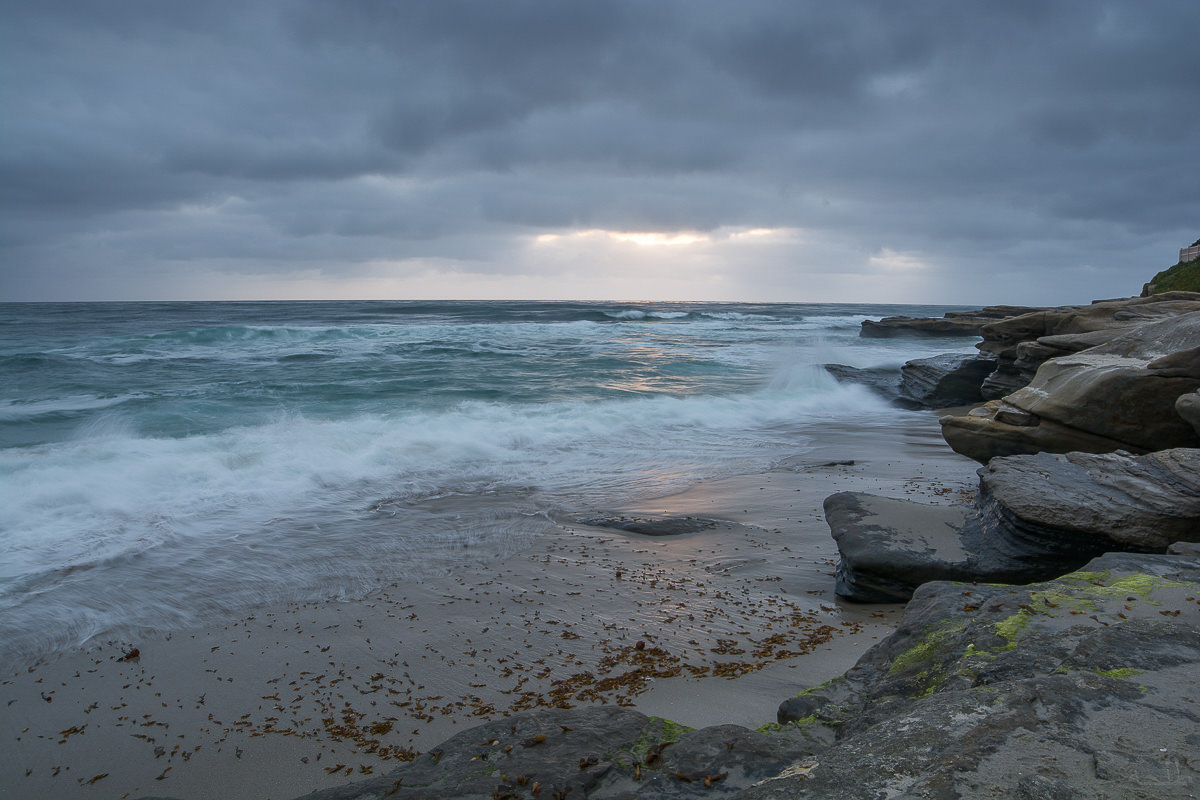
The photo above taken on a day when the sunset had complete fizzled out. The thick clouds had flattened the dynamic range and so all I had to do was point-and-shoot to capture this image. I returned home disappointed but out of curiosity, posted this image on social media to see how it would be received. To my surprise it garnered far more accolades than images that I believed were far more creative and challenging to execute.

At the same time, the most interesting seascapes often involve getting up close and personal with those nemeses of cameras and lenses: water & sand.

disaster
NIKON D7100 + 14mm f/2.8 @ 14mm, ISO 100, 1/4, f/11.0

Soon after I took this picture, a rogue wave came, swept right past me and my gear, slamming into the rocks behind me leaving me drenched on the rebound.

While depth-of-field is a challenge for all types of landscape photography, it is especially difficult in seascapes. So much of what’s in the frame is in motion, making techniques like focus stacking impossible and forcing the photographer to get it right on the spot.

it's that time
NIKON D610 + 14mm f/2.8 @ 14mm, ISO 100, 1/15, f/9.0
depth3
NIKON D7100 + 14mm f/2.8 @ 14mm, ISO 125, 3/1, f/5.6
depth1
NIKON D610 + 14mm f/2.8 @ 14mm, ISO 100, 1/80, f/5.6

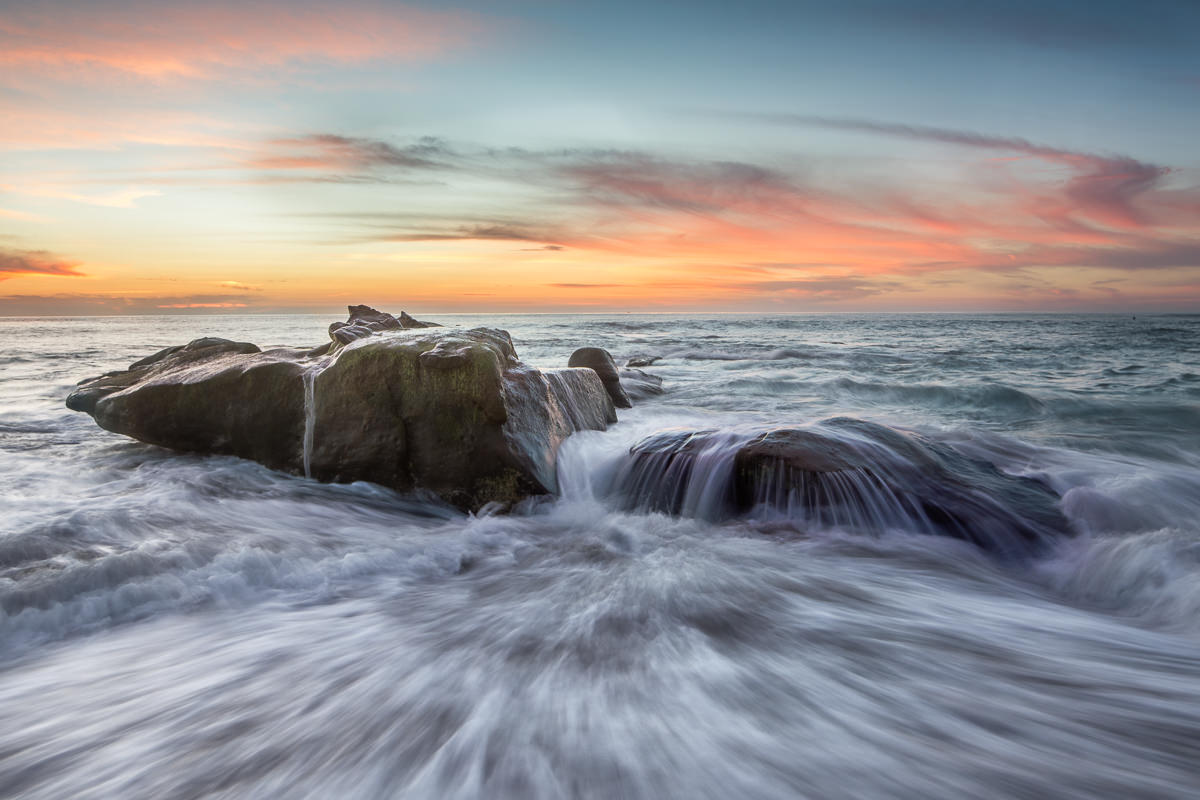
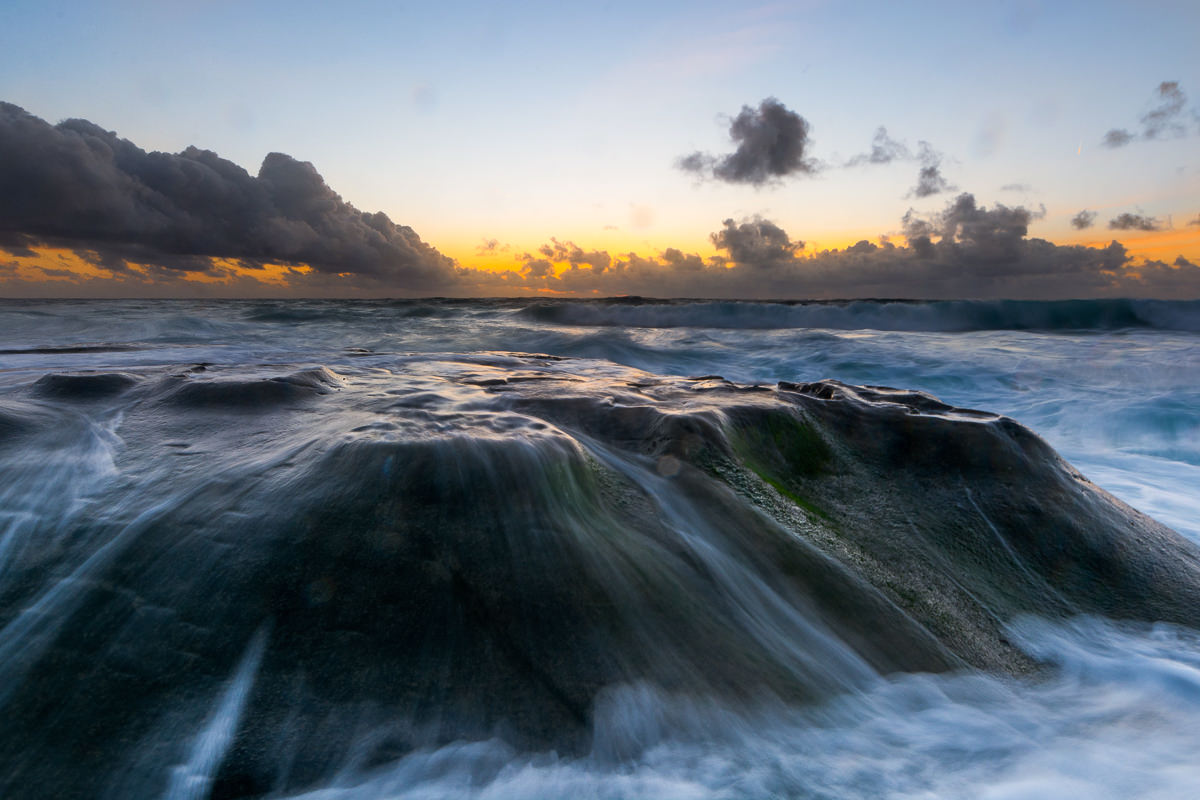
More often than not, a very promising sunset will fizzle out, forcing the photographer to get creative in other ways, using wave motion and light to create interest.

fizzle
NIKON D610 + 14mm f/2.8 @ 14mm, ISO 100, 1/6, f/11.0

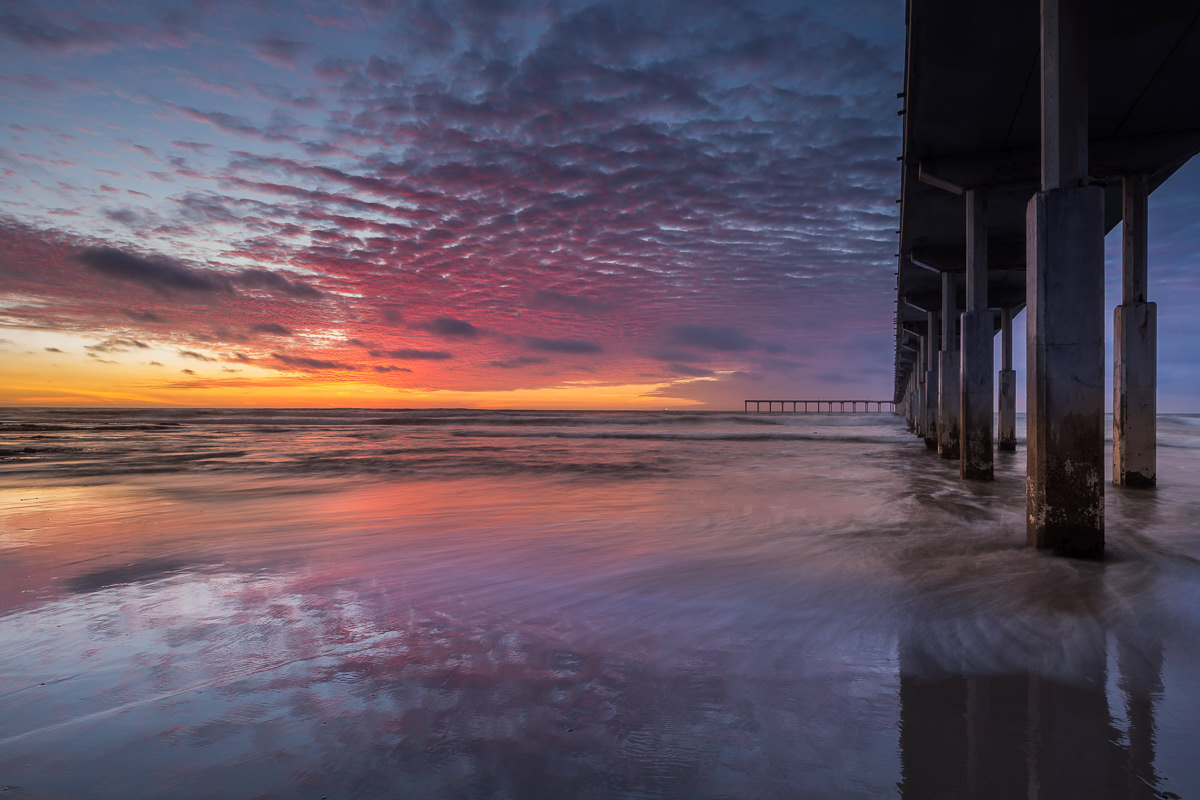
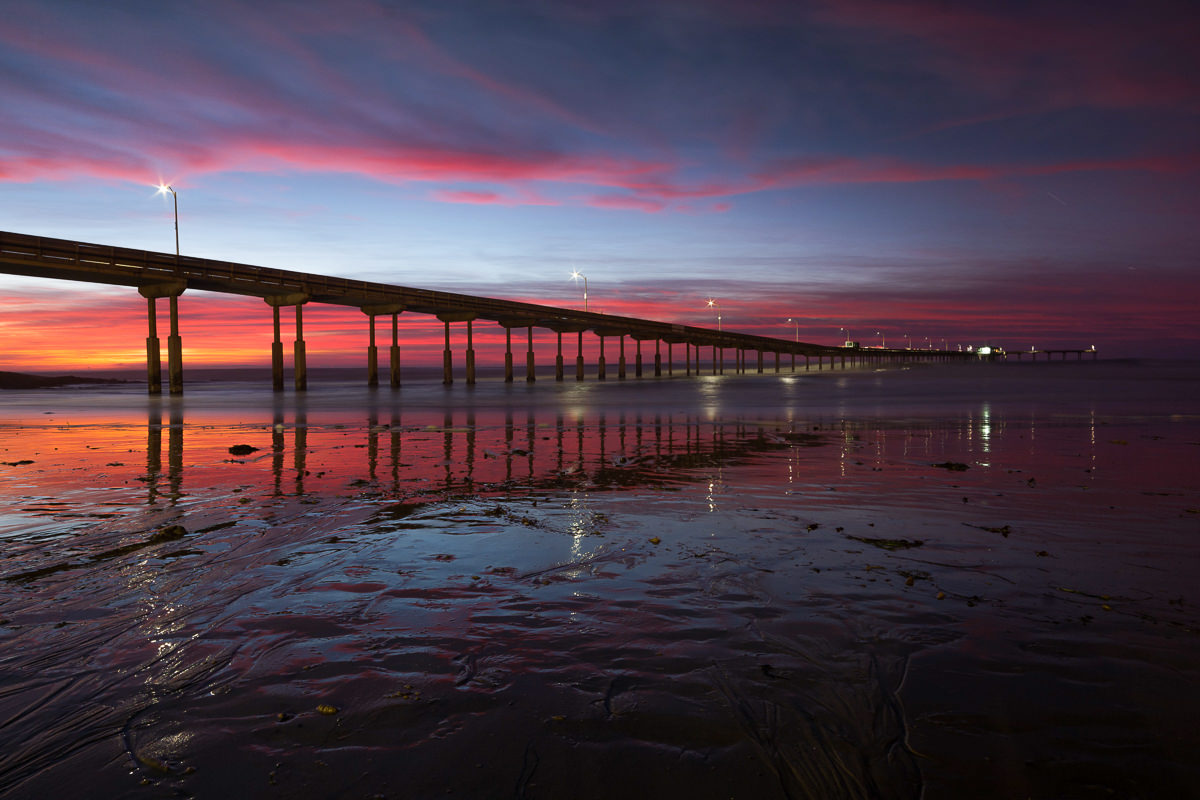
Pier shots are quite often a safe choice, with the pier providing a convenient, frame-filling foreground for the dramatic sky. It is not wholly without challenges however, as most compositions have a significant portion of the pier covering the background making it difficult to use graduated filters to address reduce contrast. Also, in my experience, piers offer limited composition opportunities.

pier1
NIKON D7100 + 14mm f/2.8 @ 14mm, ISO 100, 13/10, f/11.0
pier2
NIKON D7100 + 14mm f/2.8 @ 14mm, ISO 100, 13/1, f/11.0

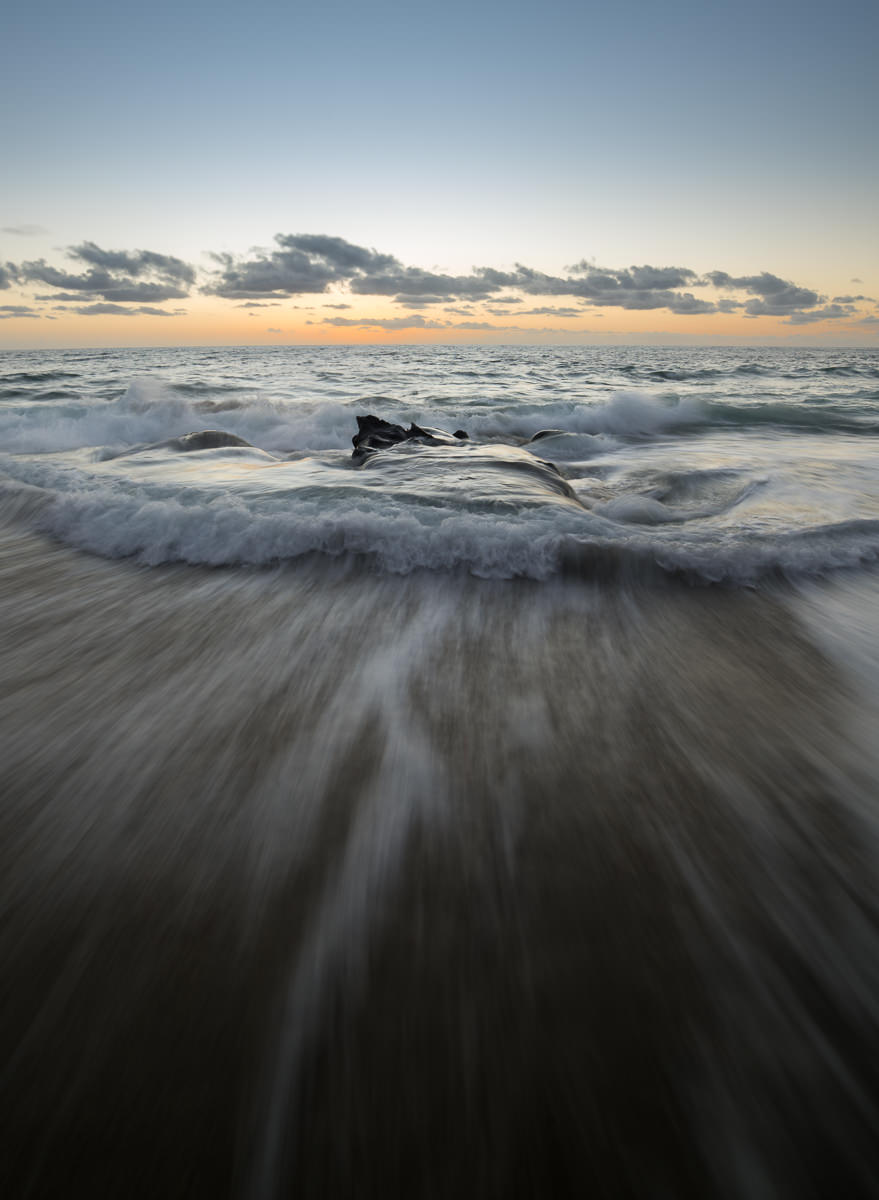
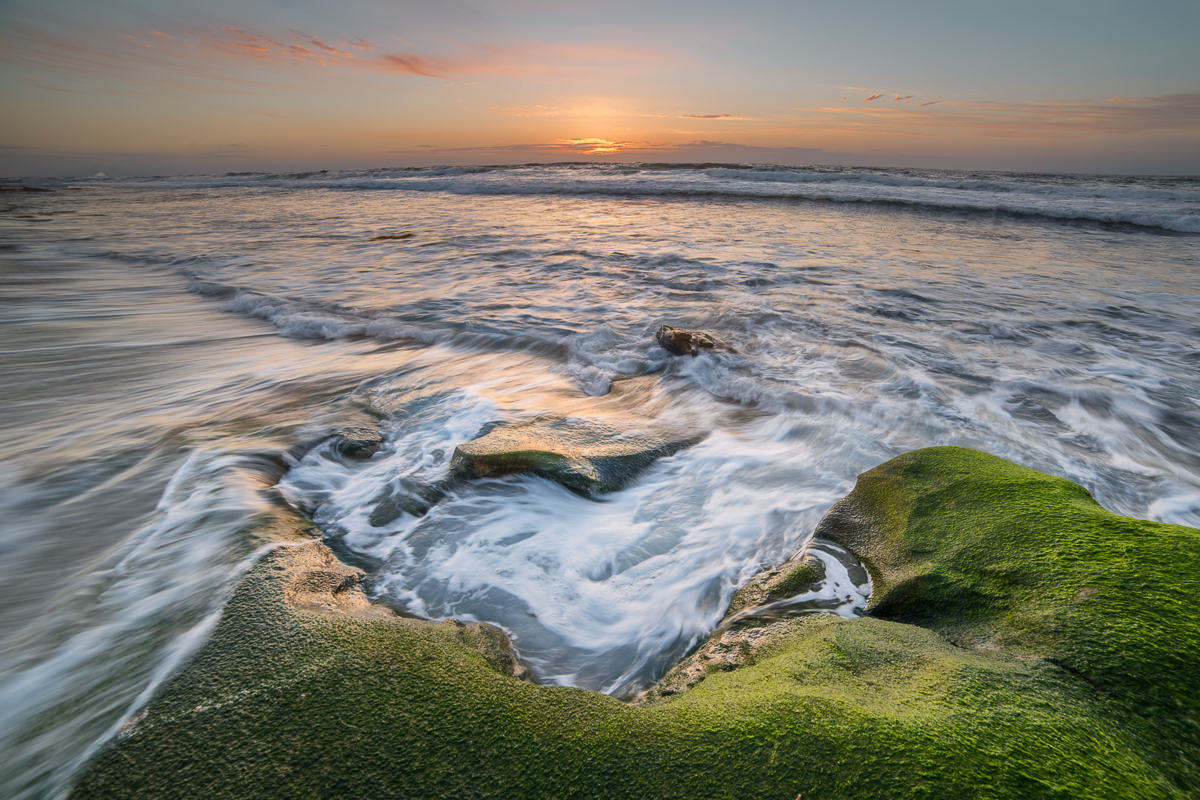
Quite often seascapes involve slowing down the shutter speed to create that silky water motion, thereby requiring the use of tripods. It is not quite that easy though, because conditions are often windy and the tripod will need to be placed in moving water for the most interesting compositions. Therefore, the tripod needs to be stable as well as durable (salt water and sand are not kind to tripods).

rewind
NIKON D7100 + 14mm f/2.8 @ 14mm, ISO 100, 1/20, f/9.0
motion3
NIKON D610 + 14mm f/2.8 @ 14mm, ISO 100, 1/50, f/11.0
motion2
NIKON D7100 + 14mm f/2.8 @ 14mm, ISO 100, 4/10, f/20.0

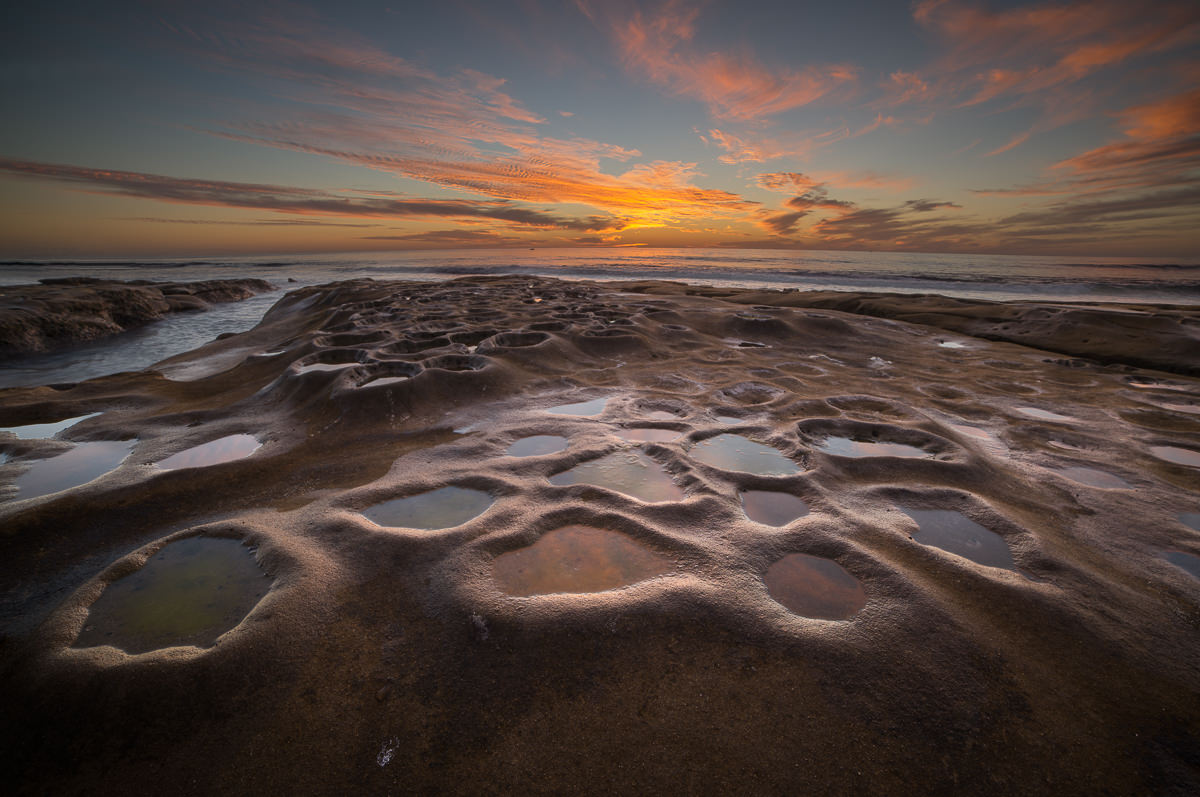
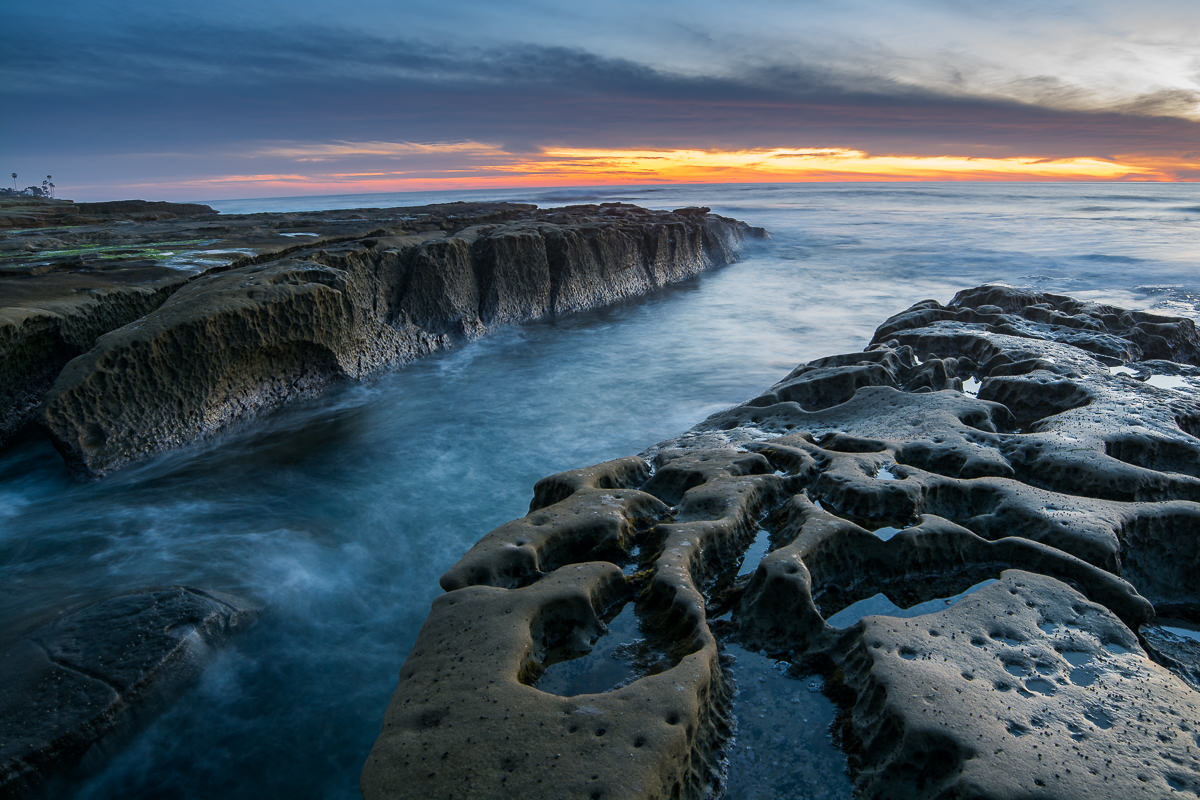
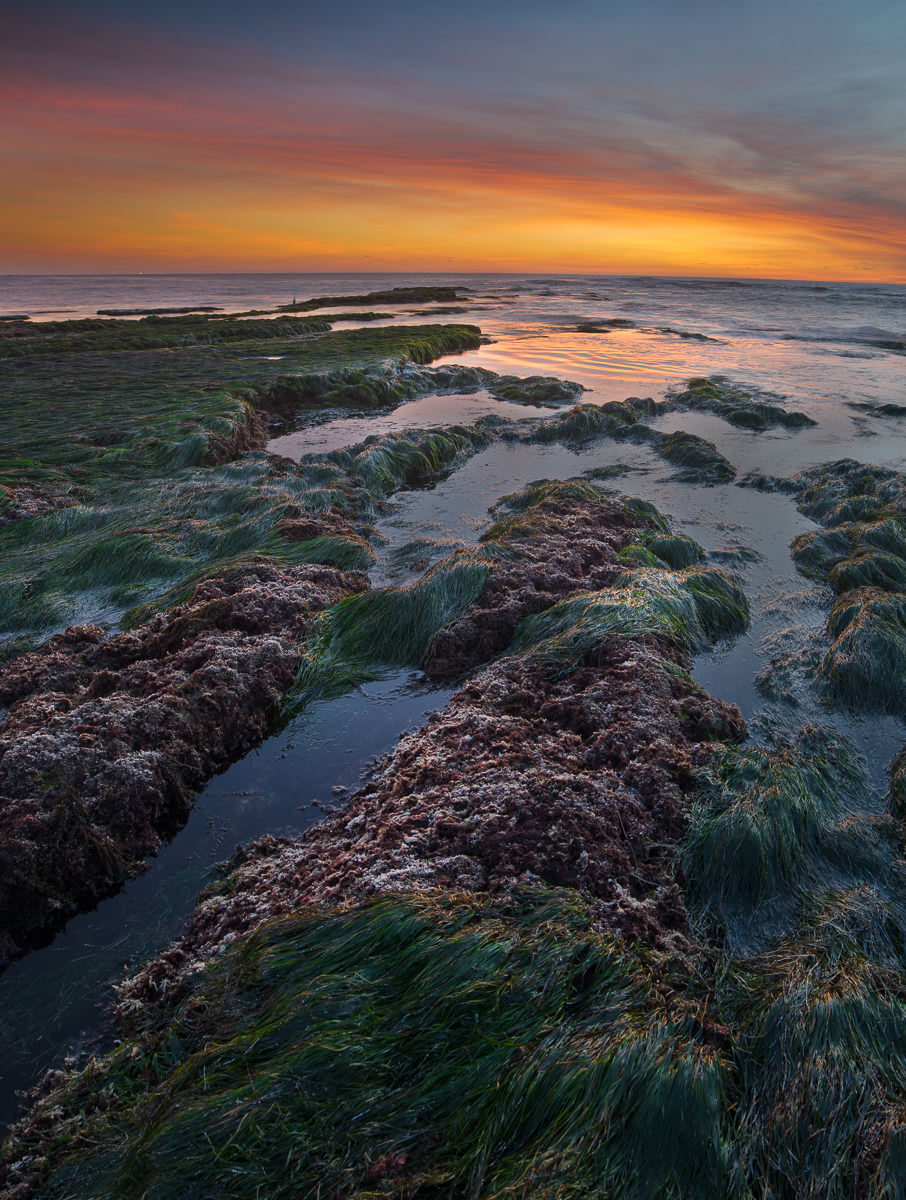
A low tide is not all bad. When the water recedes, it reveals a diverse, alien landscape below that can make for some interesting photography.

slippery
NIKON D610 + 14mm f/2.8 @ 14mm, ISO 100, 1/10, f/5.6

Sometimes, all the stars align perfectly and I manage to make the kind of capture that is going to motivate me to keep going back for more.

silky
NIKON D7100 + 14mm f/2.8 @ 14mm, ISO 100, 1/3, f/11.0

At the end of the day — photography or not photography — sunsets at the beach are one of nature’s most remarkable spectacles and I realize what a privilege it is to be able to partake on a regular basis — something for which I will be eternally grateful.

The post My Complicated Relationship with Seascapes appeared first on Photography Life.

Photography Life

Posted in Photograpy How To | Tagged , , | Leave a comment

The Art of Visuals Travel Photos of the Week

It is no secret that we love sharing the passion of our Instagram community who continuously share their travel adventures with us by using the hashtag #ResourceTravel. In the almost 2 years since we started Resource Travel, we have come to really appreciate how inspirational being part of a community can be. That’s why we have joined forces with the team from Art of Visuals, who have garnered a loyal and excited community of over 800,000 followers on Instagram.

For weeks, we have been working with the Art of Visuals team here in Boise, Idaho to custom tailor a package of Lightroom Travel Photography presets that will help adventure hounds edit photos that they will be proud to share. There is no magic wand for photo editing, but with presets made for specific scenes, such as ‘Desert’, ‘Mountain Landscapes’ or ‘Portrait Warm’, we hope the presets give you a great starting point for making your travel photos look awesome, and quickly. We all know how busy being on the road can be, so the less time you have to spend editing your photos, the more time you will have to explore the world around you.

For a limited time, the presets are 25% off. Also, like an app on your phone, we will be continuously updating and adding new presets every month for users who own the pack. So get started with the 25 included now, but be ready to get even more sent to your email in the coming months.

To help share Art of Visuals community’s love of travel, we are kicking off a new weekly collection of our favorite travel photos submitted to the Art of Visuals iPhone App. To have your photo considered, download the app and submit your favorite travel photos, and make sure to include the photo location to be considered! Simple as that.  For those of you with an Android phone, upload the photo to Instagram with the hashtag #ResourceTravelAOV.

Now, the best part. Each week, we will select our favorite photo and the winner will receive the complete Resource Travel preset bundle ($ 100 value) as well as a one-year subscription to Resource Magazine ($ 30 value). Even better? The photo will be shared on both the Art of Visuals and Resource Travel Instagram and Facebook accounts, allowing your awesomeness to be seen by almost one million people (Value: Priceless)

So what are you waiting for? Download the AOV app and get entered today! Here are today’s Art of Visuals’ travel photos of the week.

This week’s winner is…@nathanaelbillings! Congratulations Nathanael, we will be in touch soon!

Lynn Canyon – North Vancouver, British Columbia, Canada by @nathanaelbillings

Berne, Switzerland by @supertrampeur

Troms, Norway by @eventyr

Knights Ferry, California by @a_guy_named_eric

Levi – Kittilä, Finland by @pie_aerts

Yosemite Falls, California by @ryanlsmith1

Huntington Beach, California by @dallas_dunn

Hokitika Gorge, New Zealand by @mydetoxtravel

La Push, Washington by @kristiankeenen

Bellwald, Switzerland by @valerianobs

San Francisco, California by @sean00patrick

Þórsmörk – Iceland by @tavinpratt

Los Angeles, California by @le_g00zfraba

Tongariro Alpine Crossing – Tongariro National Park, New Zealand by @ryan_domenico

Singapore by @junjie.jpeg

Huntington Beach, California by @thomaskovacik

O‘ahu, Hawaii by @vincelimphoto

Chicago, Illinois by @resh510

Tromsø, Troms, Norge by @eventyr

Multnomah Falls, Oregon by @zach.hagy

Crystal Mill – Carbondale, Colorado by @markdingee

Verona, Veneto, Italia by @lin.alessio

Bangkok, Thailand by @k.khemkhon

California by @artbyart_LA

Emerald Lake, British Columbia, Canada by @3to2

Big Sur, California by @paymon_b

Chivasso, Piemonte, Italia by @samfiore72

Landwasser Viaduct – Filisur, Graubünden, Switzerland by @nattesferd

Golden Gate Bridge, San Francisco, California by @andrewoptics

Hallstat, Austria by @christophschlein

Yosemite National Park, California by @bgwynn

Glacier National Park, Montana by @syntax_error

Bregaglia, Switzerland by @julien_ledermann

Resource

Posted in Photograpy How To | Tagged , , , | Leave a comment